Even Split Pace Calculator
Build a steady race plan from distance, target time, split length, terrain, race type, aid station delay, unit system, and positive or negative split tolerance.
📌Named Race Presets
Even split pacing divides the usable moving time across the course, then shows the gross plan after terrain allowance and any planned aid station delays.
⚙Race Inputs
Race split snapshot
Enter race details to calculate target pace, split windows, aid-adjusted moving pace, and terrain allowance.
📊Pace Metrics Grid
📑Split Planning Tables
| Split | Target Time | Allowed Range | Cumulative Target |
|---|---|---|---|
| --- | --- | --- | --- |
| Profile | Allowance | Best Split Size | Planning Note |
|---|---|---|---|
| Track | 0% | 400 m | Use tight tolerance |
| Signal | Meaning | Next Split Action | Risk |
|---|---|---|---|
| Green | Inside range | Hold rhythm | Low |
| Race | Common Split | Watch Cue | Use When |
|---|---|---|---|
| Mile or 1500 m | 200-400 m | Lap rhythm | Track racing and pacing groups |
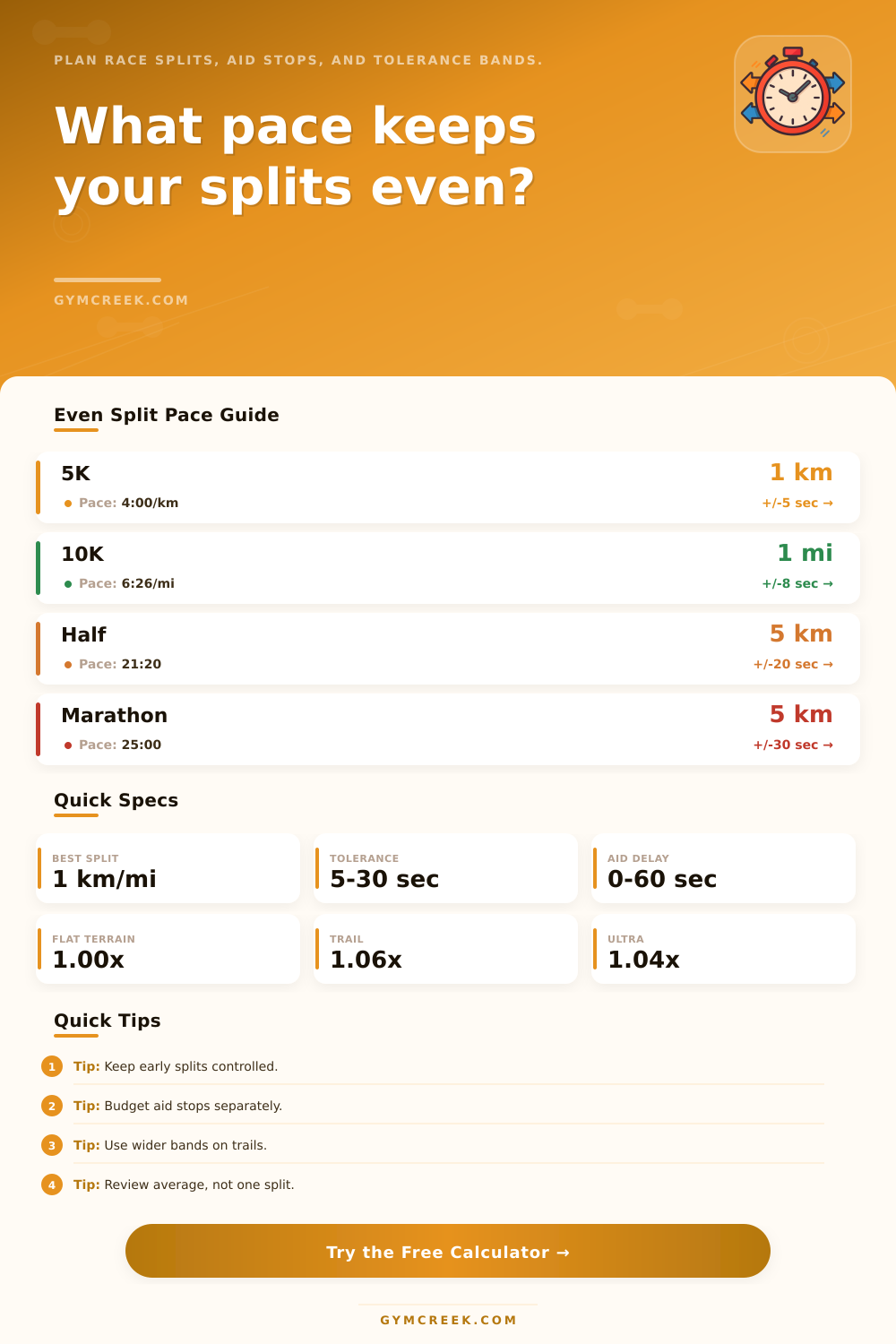
| 5K to 10K | 1 km or 1 mi | Short feedback loop | Road race effort control |
| Half marathon | 5 km or 5 mi | Fuel and pace check | Long steady efforts |
| Marathon and ultra | 5 km to 10 km | Aid and terrain blocks | Managing stops and drift |
💡Even Split Tips
The goal is to go at an even pace. The result is being off by mile eight or kilometer twelve, too slow or too fast on the watch. Now it’s about damage control for remainder of race.
Chances are it wasn’t because of lack of effort; most likely it’s because your plan fail to consider variations in terrain and a few seconds here and there. That desire becomes actionable through an even split pace calculator. Plug in how far you’ll go, when you want to be done, and what your watch display as a split. It’ll allocate moving time into those chunks with some buffer for aid stops.
How to Use Your Race Plan
What it doesn’t do is spit out just one number. It gives you a target split and a range within which you can still recover from drifting outside of it. So what about the inputs? They reflect your decisions made on race day. You need a terrain allowance if there are a lot of roll-y bits or trails to slow you down. Race type matter because ultrarunners stop a lot and triathletes’ legs is shot after all that swimming and biking. Aid station delay (you’re not going to fly past each table). These vary the pace at which you should of move from stop to stop.
But what good does it do to output that stuff unless you know what those numbers mean? Gross pace is everything because it shows whether your goal will be realistic. Moving pace removes aid time and tells you your run pace should be like this. Tolerance bands tell you when you can go off track and still have a shot at finishing.
On a flat road, a narrow tolerance band is fine. On trails with elevation change, a wide tolerance band makes more sense. Runners tend to initially set their tolerance band too narrow at one extreme and then too wide at the other. Early in the race it’s tempting to maintain a five- or eight-second range that seems doable; anything else are a crisis. Late in the game, when tiredness hits, they throw it out the window altogether.
It is better to establish the tolerance band once for the race and what it require (terrain, etc.). Treat it as a steering mechanism. Ease up if you’re at high end of band; relax if you’re at the low end, but don’t push.
So what do these reference tables tell us? They do not give specific prescriptions, but rather provide context. For example, they show how split length and distance relates, since not all distances is equal. They also shows how tolerance relates to distance. While a 5K runner will be able to maintain their running rhythm while checking their pace every kilometer, a marathoner may either obsess over the watch or not bother with it at all. Use the tables to select a split length that provide the right amount of feedback for you.
Perfectly paced doesn’t mean evenly split, either. Instead it’s about establishing a rhythm in your day that can endures some surface change and minor interruption. After determining the type of day you want to plan for, the rest is math, the calculator do the arithmetic.