Essential Amino Acid Calculator
Estimate daily essential amino acid needs, leucine target, protein equivalent, meal distribution, and remaining EAA gap from your body size, training load, protein intake, and protein source.
📌EAA Presets
Presets load realistic training and diet contexts. Adjust any field to compare minimum adult EAA needs with a training-focused target.
⚙Calculator
Essential amino acid estimate
Enter your body size, training, and protein details to estimate EAA targets.
📊Fitness Metrics
📑Reference Tables
| Essential amino acid | Adult reference pattern | 70 kg daily floor | Calculator use |
|---|---|---|---|
| Histidine | 10 mg/kg/day | 0.7 g | Included in total EAA floor. |
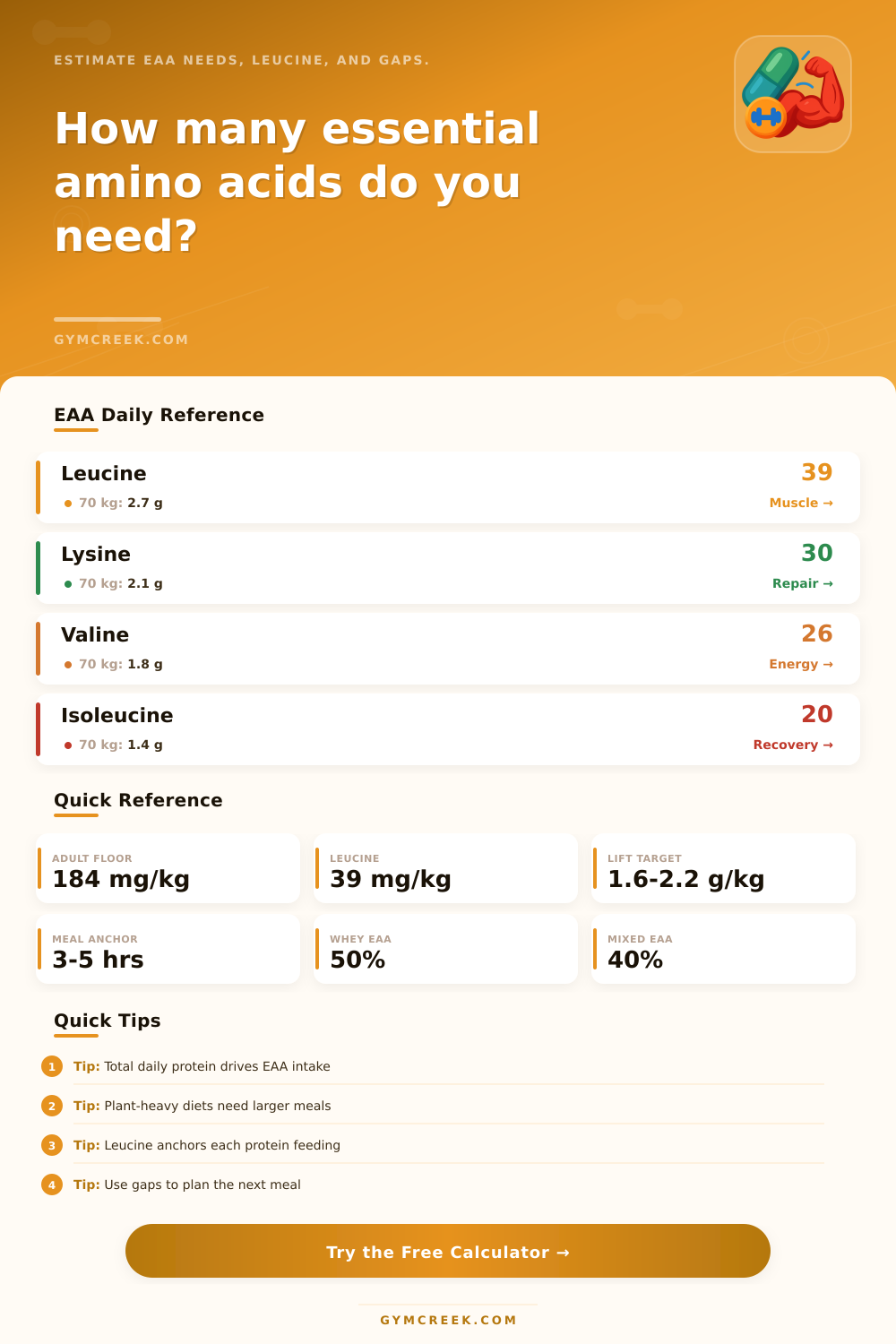
| Isoleucine | 20 mg/kg/day | 1.4 g | Part of branched-chain amino acids. |
| Leucine | 39 mg/kg/day | 2.7 g | Used for meal trigger estimate. |
| Lysine | 30 mg/kg/day | 2.1 g | Often watched in grain-heavy diets. |
| Methionine plus cysteine | 15 mg/kg/day | 1.1 g | Sulfur amino acid grouping. |
| Phenylalanine plus tyrosine | 25 mg/kg/day | 1.8 g | Aromatic amino acid grouping. |
| Threonine | 15 mg/kg/day | 1.1 g | Included in daily minimum pattern. |
| Tryptophan | 4 mg/kg/day | 0.3 g | Smallest reference amount. |
| Valine | 26 mg/kg/day | 1.8 g | Part of branched-chain amino acids. |
| Protein source | Estimated EAA share | Leucine share | Planning note |
|---|---|---|---|
| Whey or dairy dominant | About 50% of protein | About 11% | High EAA density per gram of protein. |
| Egg dominant | About 46% of protein | About 8.8% | Strong complete protein estimate. |
| Meat or fish dominant | About 45% of protein | About 8.5% | High complete protein density. |
| Soy dominant | About 39% of protein | About 7.8% | Complete plant source with moderate density. |
| Mixed omnivore | About 40% of protein | About 8.0% | Useful default for varied diets. |
| Mixed plant proteins | About 34% of protein | About 6.8% | Often needs larger protein servings. |
| Training context | Protein target range | EAA implication | Calculator cue |
|---|---|---|---|
| General maintenance | 1.2-1.6 g/kg | Usually clears the adult EAA floor. | Moderate daily target. |
| Muscle gain | 1.6-2.2 g/kg | Higher daily EAA and leucine exposure. | Raises training target. |
| Fat loss | 1.8-2.4 g/kg | Protein gap matters more during deficits. | Higher per-day target. |
| Endurance block | 1.4-1.8 g/kg | Supports repair after repeated sessions. | Moderate to high target. |
| Hard hypertrophy | 1.8-2.2 g/kg | Meal distribution becomes important. | Higher timing priority. |
| Formula item | Formula | Typical input | Output affected |
|---|---|---|---|
| Adult EAA floor | Body kg times 184 mg/kg | Weight | RDA floor card |
| Training protein target | Body kg times goal g/kg | Goal and load | Protein metric |
| Training EAA target | Protein target times source EAA share | Protein source | Daily EAA card |
| Current EAA estimate | Current protein times EAA share | Protein eaten | Remaining gap |
| Meal leucine target | Per-meal protein times leucine share | Meals per day | Leucine card |
💡Tips
When people track their food intake, most of them only go as far as total grams of protein. “I ate one-hundred and fifty grams today; it’s all good,” with a combo of chicken and rice. “Muscle repair? Yeah, I got it.” But they miss the mark here, which realy costs them in terms of recovery potential.
There is certain amino acids, there are nine of ’em; that you can’t produce yourself, meaning you need to get them straight-up from what you eat. Those are the building blocks that dictate if tissue repairs itself under stress…or just breaks down some more. When you begin to think about each meal in terms of total protein versus density of these key ingredients, everything shift.
Why Protein Quality Matters More Than Quantity
Once you plug in your training context and body weight, it spares you from having to remember any of biochemical coefficients, a complicated equation the calculator above crunches for you. What remains are the numbers: actionable targets for what you should aim to eat each day. Surprisingly, the inputs is far more important than most give them credit for.
Muscle sensitivity to protein signals decreases with age (starting at about thirty-five), which also affects your efficiency at using protein. And then there’s activity level, which dramatically shifts your baseline requirement. If you’re sitting around all day, you’ll have fewer structural repairs to make than someone who trains intensely in either endurance sports or high-rep resistance exercises.
When you choose your primary goal, do you want to lose fat? Gain muscle? Maintain?; it changes your anticipated system demand, so the tool can calculate not only your total protein needs but how much of it needs to be in the form of essential amino acids to stimulate synthesis. What truly gets the needle moving are output cards: How many grams of pure essential ingredients does my body need daily to support my activity? That’s called the EAA target.
It tends to be more than the standard recommended dietary allowance for non-active people who don’t work out very hard. And then there’s the most important metric for an active person: the leucine target per meal. You see, leucine is the chemical signal that starts muscle-protein-synthesis machine going. If you don’t get enough of this one amino acid in a meal, your body might not be able to start recovery, even if you eat plenty of total protein during the rest of the day.
Why? Distribution. So while it’s not a great stimulus to eat everything all at once (as a big dinner), it’s better to spread out those feeds over multiple smaller meals. Each gram of protein is not equal: some foods pack more bang for the buck compared to others. For example, animal-based proteins such as eggs and whey contain much higher amounts of essential amino acids compared to non-animal protein sources. While plant-based proteins are great for health, they tend to be less dense (e.g., you need bigger portions to reach the minimum leucine dose).
To account for this, calculator automatically adjusts the estimate based off the main protein source you select. In other words, if most of your food comes from plants, it will recommend a slightly higher dose to compensate so that you don’t fall short. This happens frequently on vegan diets where people assume that grams of anything equals nutrients.
It’s important to note that nutrition use depends on timing as well. You don’t want long periods of time without protein-rich foods because it puts your body into what’s called a catabolic state: Your muscles break down faster then they can be repaired. To help with meal planning, the tool takes into account your longest fasting period. So if you have a long gap coming up, it will prioritize getting that leucine target hammered right when you open up the caloric floodgates.
This is especially important for people who lift first thing in the morning. Since their bodies are depleted while they sleep, a heavy serving of essential amino acids after a workout help start the recovery process and reverses the overnight damage. To illustrate this point, check out the reference tables posted on the page. They list the baselines of each amino acid (e.g., valine, lysine, etc.) and how they contribute to the total.
If you’re consuming a variety of food, you won’t need to keep tabs on all these individually. In other words, the total method used by calculator is much easier to apply in real life. It’s simpler, but not simplistic.
And lastly, the moral of the story is that quality matters more than pure quantity. For example, having a high protein count doesn’t mean anything if it’s low-quality or poorly spaced throughout the day. Make sure every meal provides enough leucine to start muscle repair; the remaining amino acids will fall into place from there.
Making this slight mindset change often leads to noticeable changes in body composition and recovery with time. Once you grasp the underlying principles driving the equation, the math becomes easy.