Espresso Caffeine Calculator
Estimate caffeine per espresso shot from coffee dose, bean caffeine density, extraction yield, shot volume, bodyweight, daily intake, and timing.
📌Presets
Each preset loads a realistic espresso scenario with dose, yield, caffeine density, extraction, bodyweight, daily caffeine, and timing assumptions.
⚙Calculator
Espresso caffeine snapshot
Enter your shot details to estimate total caffeine and timing.
📊Espresso Metrics Grid
📑Reference Tables
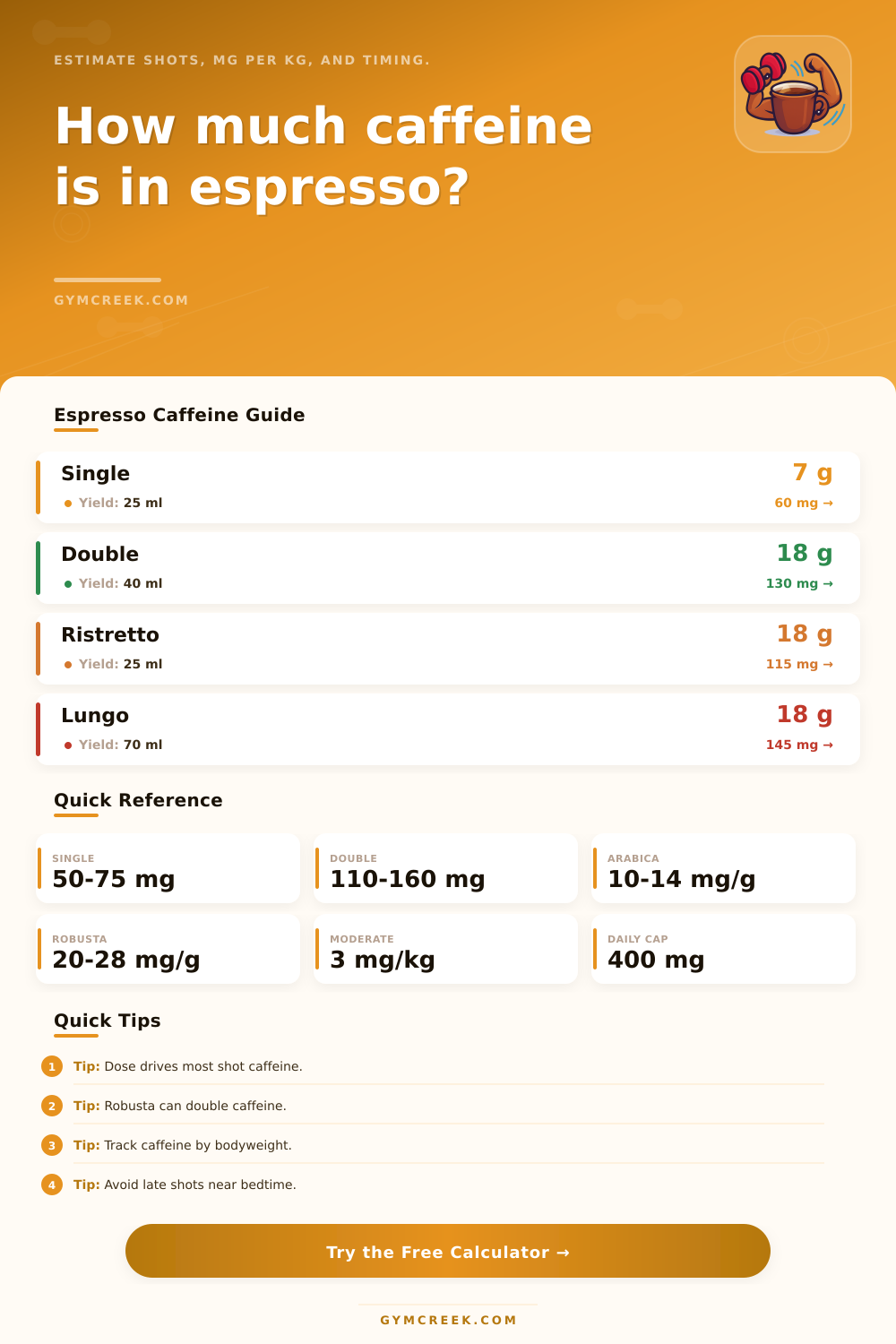
| Espresso Style | Typical Dose | Typical Yield | Common Caffeine |
|---|---|---|---|
| Single espresso | 7-9 g coffee | 25-30 ml | 50-75 mg |
| Double espresso | 16-20 g coffee | 35-45 ml | 110-160 mg |
| Ristretto | 16-20 g coffee | 20-30 ml | 95-140 mg |
| Lungo | 16-20 g coffee | 55-80 ml | 120-170 mg |
| Bodyweight Dose | Use Case | Example | Timing Note |
|---|---|---|---|
| 0.5-1.5 mg/kg | Light focus | 35-105 mg at 70 kg | Morning or midday |
| 1.5-3 mg/kg | Moderate alertness | 105-210 mg at 70 kg | Allow a longer window |
| 3-6 mg/kg | High caffeine load | 210-420 mg at 70 kg | Use with caution |
| Over 6 mg/kg | Very high intake | 420+ mg at 70 kg | Often excessive |
| Timing Goal | Common Peak | Planning Window | Best Input |
|---|---|---|---|
| Focus | 30-60 minutes | Before deep work | Drink time |
| Training | 45-75 minutes | Before warmup | Workout start |
| Morning | 30-60 minutes | After breakfast | Daily cap |
| Late day | 30-75 minutes | Check bedtime left | Sleep time |
| Bean Type | Caffeine Density | Extraction Range | Calculator Use |
|---|---|---|---|
| Arabica | 10-14 mg/g | 75-90% | Most cafe espresso |
| Robusta blend | 16-24 mg/g | 78-92% | Higher caffeine shots |
| Robusta heavy | 22-28 mg/g | 80-94% | Strong traditional blends |
| Decaf | 0.5-2 mg/g | 65-85% | Evening estimates |
💡Tips
You’re standing at the counter in coffee shop with a tiny cup. It is the one meant for 30 milliliters of highly potent stuff. It’s going to influence how you sleep, your heart rate and your productivity.
Caffeine isn’t binary, it’s a biochemical bargaining session involving your body, the type of beans used, and the length of time they were extracted. Everyone guesses their consumption based off experience. People gets jittery in the afternoon or groggy in the morning. Plug it all in here and it will calculate it for you:
How Caffeine Works in Your Body
A dose represent where the caffeine is located. That’s why it begins there. Two shots off the same sized basket might look different, but if they’re both from a one-size basket, then each has about the same amount of caffein. Coffee bean type matters too. Robusta beans is higher in caffeine than Arabica. Many times, half as much. What’s your bean source? Know your brew.
If you’re swilling on a dark roast Robusta blend, your cup contains more energizing drug per gram than your friend downing the light-roast Colombian drip coffee. The calculator factors in that density disparity. So don’t underestimate your strong, Italian-style espressoes.
Most folks get tripped up about the timing. A typical adult’s time for caffeine to be cut in half is around 5 hours. What that means is that 50% of what they ingest at noon will remain in their system until five o’clock in the afternoon. Might that be enough caffeine to stay awake all night? Not necessarily. But it’s often enough to lower the quality of one’s sleep, reducing time spent in deeper levels of rest.
Using the calculator, users can visualize that decay curve based on their own level of sensitivity and desired bedtime. This illustrates the amount of caffeine left over when lights-out arrives. From there, they can dial back their final cup. This applies especially for students staying up late studying, as well as for athletes using pre-workout doses. Finding that right balance between alertness and recovery.
Perception is also very much linked to weight. For someone with a bodyweight of 50kg, one hundred milligrams will feel like a lot. For someone at 90 kg, it’s hardly noticeable. By normalising the dose by bodyweight, you’re better able to assess its physiological effect. That’s something that doesn’t become clear when you just count shots.
That’s what table on the page does. It breaks down a load into light, moderate, and heavy, all in relation to your bodyweight. Why does your friend get away with three espressos before bedtime but you can only handle one? How come they wake up fine after drinking four cups of coffee whereas you feel like crap?
You have different liver enzymes that processes the compound. And these enzymes are affected by genetics. They’re also influenced by medication. Birth control usage affects your body’s processing of caffeine as well.
Some obsess about tamp pressure and grind size. Few consider what it means for caffeine. These do influence body and flavor clarity, but they don’t have much effect on how much caffeine you extract relative to the dry dose. Caffeine is extracted quite well in normal brew time periods. A long shot becomes a lungo by adding some volume. This doesn’t realy increase caffeine levels much at all. That’s where the calculator helps divide things out.
You’ll notice that while yield affects your perception of strength, it isn’t as important than the total level of stimulants. By using different doses and beans, you can pull a low-caffeine, but tasty espresso or a highly caffeinated, but weak espresso shot. Caffeine management is less of an “avoid” problem and more of a “control” problem. Don’t worry, drinking coffee doesn’t mean quitting coffee. It just means respecting its power.
By measuring your real consumption vs a self-imposed limit, you can stretch yourself without going overboard. And you won’t crash in the process. The point isn’t to be numb or groggy; it’s to use that kick as a fine-tuned instrument for energy and focus. It’s to stop treating the stimulant like a wild card, and instead treat it like a choice.
When you see the math beneath the mug, you stop guessing. You begin to choose. That switch from response to decision-making changes your experience throughout the entire day. Your mornings will improve. Sharper afternoon. And eventually, the night will be yours once more.