Epley 1RM Calculator
Estimate a one-rep max with the Epley formula, adjust for reps in reserve, and turn one set into usable training max and rep-max loads.
📌Presets
Each preset loads a specific lifted set, RIR call, training max percent, and rounding increment before calculating.
⚙Calculator
Epley strength snapshot
Enter a lifted set to estimate 1RM, training max, and usable rep-max loads.
| Reps | Rep-Max Load | % of e1RM | Use |
|---|---|---|---|
| --- | --- | --- | --- |
📊Strength Snapshot
📑Reference Tables
| Completed Reps | Epley Factor | Estimated %1RM | Best Use |
|---|---|---|---|
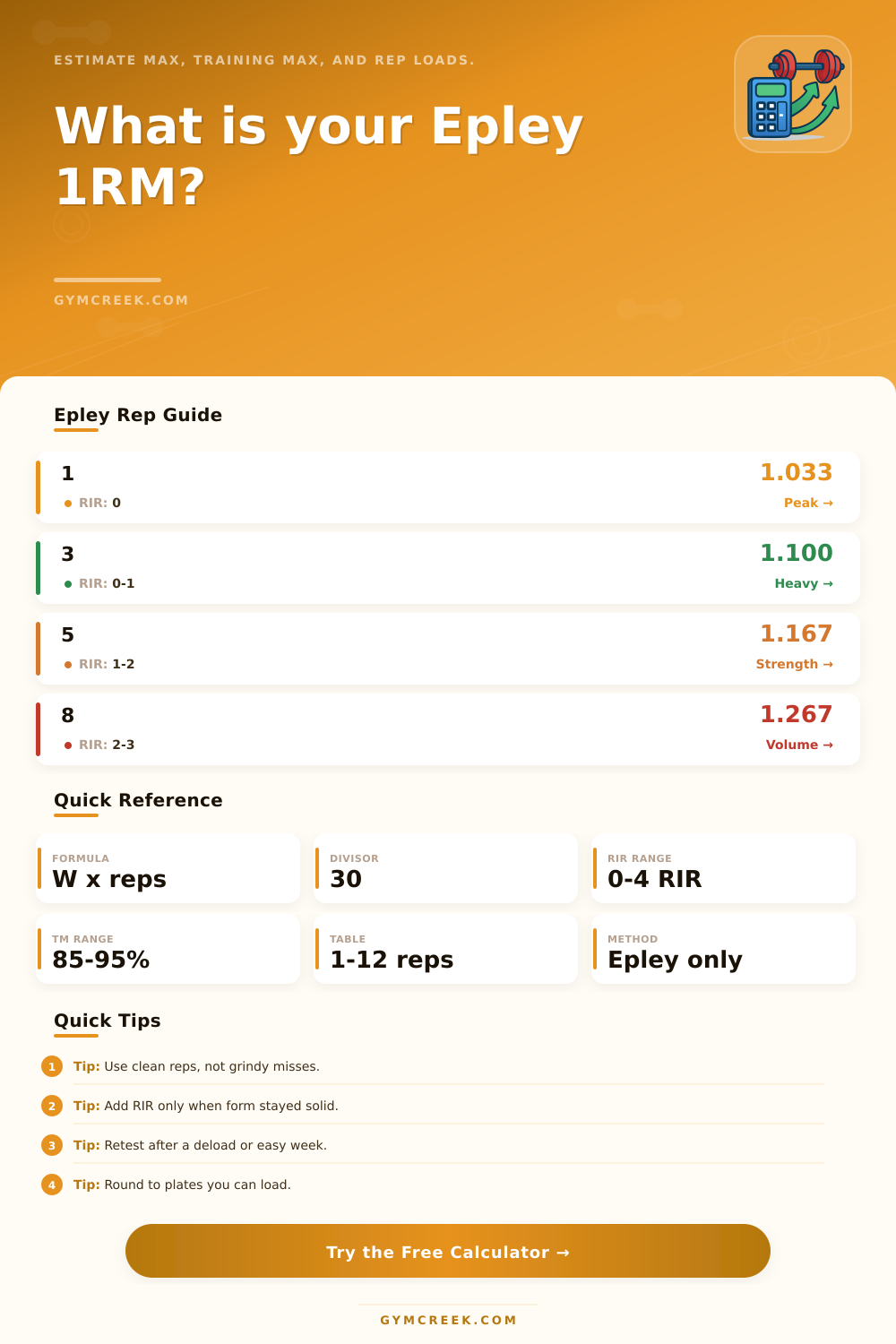
| 1 | 1.033 | 96.8% | Heavy single check |
| 3 | 1.100 | 90.9% | Strength test |
| 5 | 1.167 | 85.7% | Reliable estimate |
| 8 | 1.267 | 78.9% | Volume PR |
| 10 | 1.333 | 75.0% | High-rep check |
| RIR Call | Effective Reps | What It Means | Use Carefully When |
|---|---|---|---|
| 0 RIR | Actual reps | True max set | Technique changed |
| 1 RIR | Reps + 1 | One rep left | Bar speed slowed hard |
| 2 RIR | Reps + 2 | Strong clean set | Set had pauses |
| 3+ RIR | Reps + RIR | Submax estimate | RIR is guessed |
| Training Max | Typical Use | Load Feel | Good For |
|---|---|---|---|
| 80-85% | Restart blocks | Very manageable | Technique rebuilds |
| 85-90% | General strength | Repeatable | Most lifters |
| 90-95% | Peak prep | Demanding | Experienced lifters |
| 95-100% | Direct max work | Very heavy | Short testing phases |
| Lift Type | Best Rep Range | RIR Suggestion | Rounding |
|---|---|---|---|
| Squat | 2-8 reps | 0-2 RIR | 5-10 lb |
| Bench press | 3-10 reps | 0-2 RIR | 2.5-5 lb |
| Deadlift | 1-6 reps | 0-1 RIR | 5-10 lb |
| Press | 3-8 reps | 1-2 RIR | 1-5 lb |
💡Tips
The Epley estimate is a mathematical formula that allow a person to calculate there estimated one-rep max based off a single set of lifting. The Epley estimate take the weight that a person lifted during a set, the number of repetitions that they lifted, and add a fraction of those repetitions to the lifted weight to create a predicted maximum weight for that individuals. The Epley estimate is useful in that it allows for the determination of the one-rep max for an individual without having to attempt to performing a one-rep set of weight each week.
That individual can use the resulting number to plan there upcoming training sessions. In order to calculate the Epley estimate, an individual need to know three numbers: the weight lifted, the number of repetitions perform, and the number of repetitions that they had in reserve (the number of repetitions they could of performed before completing the set). The number of repetitions in reserve is important in that it can have an impact on the accuracy of the Epley estimate.
Epley Estimate: How to Find and Use Your One-Rep Max
An individual who has zero repetition in reserve performed a set to exhaustion. An individual who has two or three repetitions in reserve performed a set that was below there maximum strength. By including the repetitions in reserve in the calculation of the Epley estimate, the estimate more accurate reflects the strength of the individuals performance of that set.
In addition to the Epley estimate, another number that an individual can use in there training period is the concept of a training max. A training max is a number that is used for training programming, and it is usualy lower then the one-rep max that is determined from the Epley estimate. An individual may use a training max so that they can avoid performing sets that are too heavy for there current state. Many weightlifters chooses to use a training max of between 80% and 90% of the Epley estimate.
Using a training max that is set lower than the Epley estimate will protect the joints of the individual, and it will ensure that the speeds of the barbell during training sessions is consistent. The accuracy of the Epley estimate can change based upon a number of factor. One factor is the readiness of the individual each day.
The amount of sleep that they had the previous night, or the level of pain that they experience in their joint, can affect an individuals readiness. Another factor that can impact the accuracy of the Epley estimate is the number of repetitions that they perform in a set. If an individual performs sets that contain ten or more repetitions, the accuracy of the Epley estimate may be affected.
To ensure that the Epley estimate is accurate, the individual may wish to perform a set with fewer repetition later in the week. A person must understand that the Epley estimate is not a permanent number for that individual. The Epley estimate will change as the individual become stronger.
Therefore, a person can perform the Epley estimate at the beginning of a training period, and again after several week of training have passed. If the repetition of the set is performed with the same range of motion as when the initial estimate was created, and if the same type of lift are performed, the Epley estimate will be a trustworthy number. Finally, the goal of this entire process is to develop a plan that can be repeated over time, which will eventualy allow that individual to increase there strength.