Energy Balance Calculator
Compare daily intake with estimated total energy expenditure, exercise, steps, food thermic effect, and goal rate to see your projected calorie balance and weight trend.
◎Presets
Presets load realistic energy-balance scenarios and recalculate instantly.
⚙Calculator
Energy balance snapshot
Enter your intake and expenditure assumptions to calculate the projected balance.
▦Fitness Metrics
▣Reference Tables
| Balance range | Likely signal | Best use | Review note |
|---|---|---|---|
| -750 kcal or lower | Aggressive deficit | Short phases | Watch recovery and hunger |
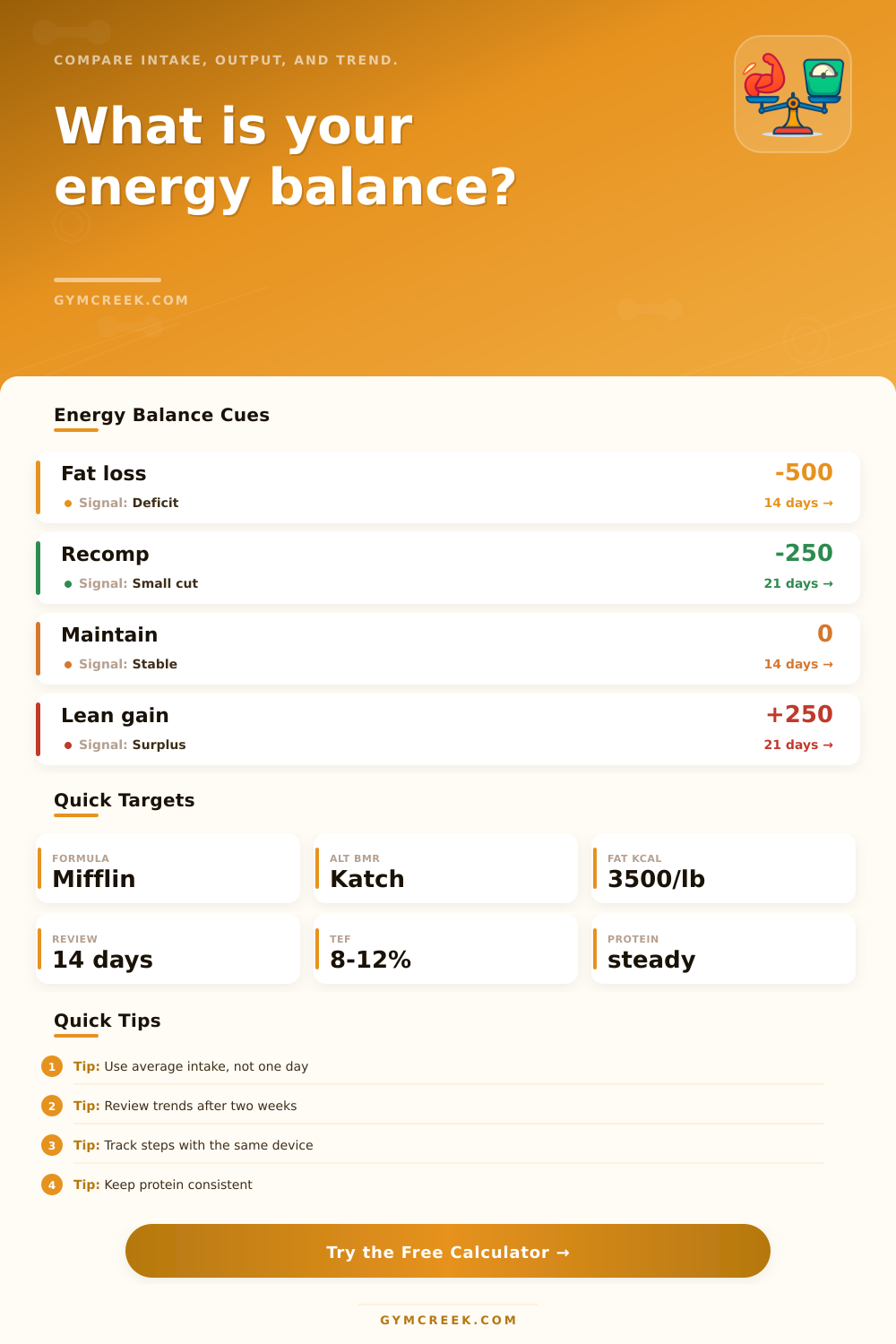
| -250 to -500 kcal | Moderate deficit | Fat loss | Review 2-week trend |
| -100 to +100 kcal | Near maintenance | Maintain or recomp | Scale noise may hide changes |
| +150 to +350 kcal | Small surplus | Lean gain | Check waist and training |
| Goal mode | Energy bias | Common weekly rate | Primary check |
|---|---|---|---|
| Fat loss | Deficit | 0.25% to 1.0% BW | Average scale trend |
| Recomposition | Small deficit | 0% to 0.4% BW | Strength and measurements |
| Maintenance | Neutral | Within 0.25% BW | Stable weekly averages |
| Lean gain | Small surplus | 0.1% to 0.5% BW | Training performance |
| Component | Inputs used | What it estimates | When to trust it |
|---|---|---|---|
| Mifflin-St Jeor BMR | Age, sex, size | Resting needs | Body fat unknown |
| Katch-McArdle BMR | Lean mass | Resting needs | Body fat estimate is credible |
| Step energy | Steps and stride | Walking output | Same tracker each week |
| Thermic effect | Food intake | Digestive cost | Macro pattern is consistent |
| Scenario | Balance clue | Interpretation | Next review |
|---|---|---|---|
| High steps, flat weight | Near zero gap | Intake rose with activity | Hold or tighten logging |
| Low steps, fast gain | Large surplus | NEAT dropped or intake rose | Review steps and weekends |
| Hard training, poor recovery | Large deficit | Fuel may be too low | Reduce deficit size |
| Small surplus, slow gain | Positive but modest | Often appropriate for lean gain | Review after 3 weeks |
◇Tips
Every morning when you wake up, you wonder whether to be suspicious or hopeful as you gaze at the scale. You see the scale change. It have an agenda, apparently. So on Mondays you cut back; on weekends you eat a little extra. And so instead of being a straight trend line, your weight fluctuates unpredictably.
Your failure isn’t really a matter of trying harder. Usually it’s that you’re comparing short-term blips (single days) to longer-term trends (months, even years). You don’t distinguish between signal and noise. Energy balance isn’t like a static snapshot. It’s like a running average. It is calories in versus calories out.
Understanding How Your Weight Changes Over Time
Calories out, including resting metabolism and the calories expended from walking to mailbox. Those variables are plugged into calculator, which does math and spits out an estimate of your daily balance. This is where most folks draw line. They say, “I’ll calculate my TDEE,” and then they deduct five-hundred calories to lose weight.
But this method fails to account for the cost of digesting all those calories (known as thermic effect of food), about ten percent of what you consume. Nor does it consider burning any energy while walking seven-thousand steps per day. Plug in your typical intake, plus an estimate of your baseline caloric burn based off your average day’s steps and activity level, and it will tell you how far from a healthy range you are: Is your current plan causing you to gain? Lose? Or maintain?
It will also alert you if you’re setting your rate for success too high, given your bodyweight. A half-a-percent drop each week may seem overly ambitious on paper. However, it works out to be a reasonable number of calories to cut without losing muscle mass like more aggressive diets tend to cause.
I don’t chase precise accuracy, I understand why the numbers move. As your body sheds pounds, your metabolism slows slightly. There’s less tissue to support. That’s a normal change in how your body burns energy. It can feel like stubbornness.
The page has a reference table that puts all of this down: when your step count is up, yet your weight doesn’t budge, the tool will tell you that you probably increased your food intake at the same rate as your activity. Your body responds by either increasing your hunger or decreasing the energy you burn from daily movement. You stand less. You fidget less. It’s not a moral failing. It’s a defensive move of your biology.
Protein is also a quiet but important part of this. Keeping protein steady helps preserve lean mass during a deficit, which keeps your resting metabolic rate higher for longer. You can adjust the protein target to be whatever amount of grams per pound of body weight you prefer. This guarantees that you’re getting enough high-quality calories to match their quantity.
If you don’t get enough protein, a “calorie deficit” is more likely to appear as losing muscle weight on scale instead of fat weight in the mirror. This is why most folks only focus on overall number and miss this point.
The other key lever is review windows. The scale doesn’t make sense day-to-day: water weight, sodium consumption, glycogen storage can hide your actual fat loss for several weeks. A two-week (or longer) review window filters out this noise. You don’t react to Sunday’s carb binge or yesterday’s salad. You just see the overall trend.
Think of calculator as a planning tool, not a crystal ball. Plug your numbers in, look at expected balance, and watch how it plays out in real world over a couple weeks. If things aren’t going the way you expected on the scale, tweak one variable at a time. Adding more steps is a safer bet different than wildly slashing calories; drastically slashing calories risks burning out both your metabolism and your motivation.
It’s easy math, though it’s difficult discipline. Yes, exercise can help. But you can’t outrun your mouth! And yes, we do expend energy just livig. Use this tool as a starting point. Use two weeks of steady input to determine if what you think you’re doing is really balancing out, or if you’re winging it.
Trust that the trend is real. Don’t believe the noise. The scale will deceieve you every day. It doesn’t lie over time.