Energy Availability Calculator
Estimate energy availability from daily intake, planned exercise energy, and fat-free mass so athletes can spot low-fueling risk before performance and recovery drift.
◎Presets
Presets load realistic athlete profiles, body composition, intake, training load, and calculation confidence so you can compare low, target, and surplus energy availability scenarios.
⚙Calculator
Fueling status
Enter intake, training energy, and fat-free mass estimates to calculate kcal/kg FFM.
▣Fitness Metrics Grid
▤Reference Tables
| Band | kcal/kg FFM | Common interpretation | Review action |
|---|---|---|---|
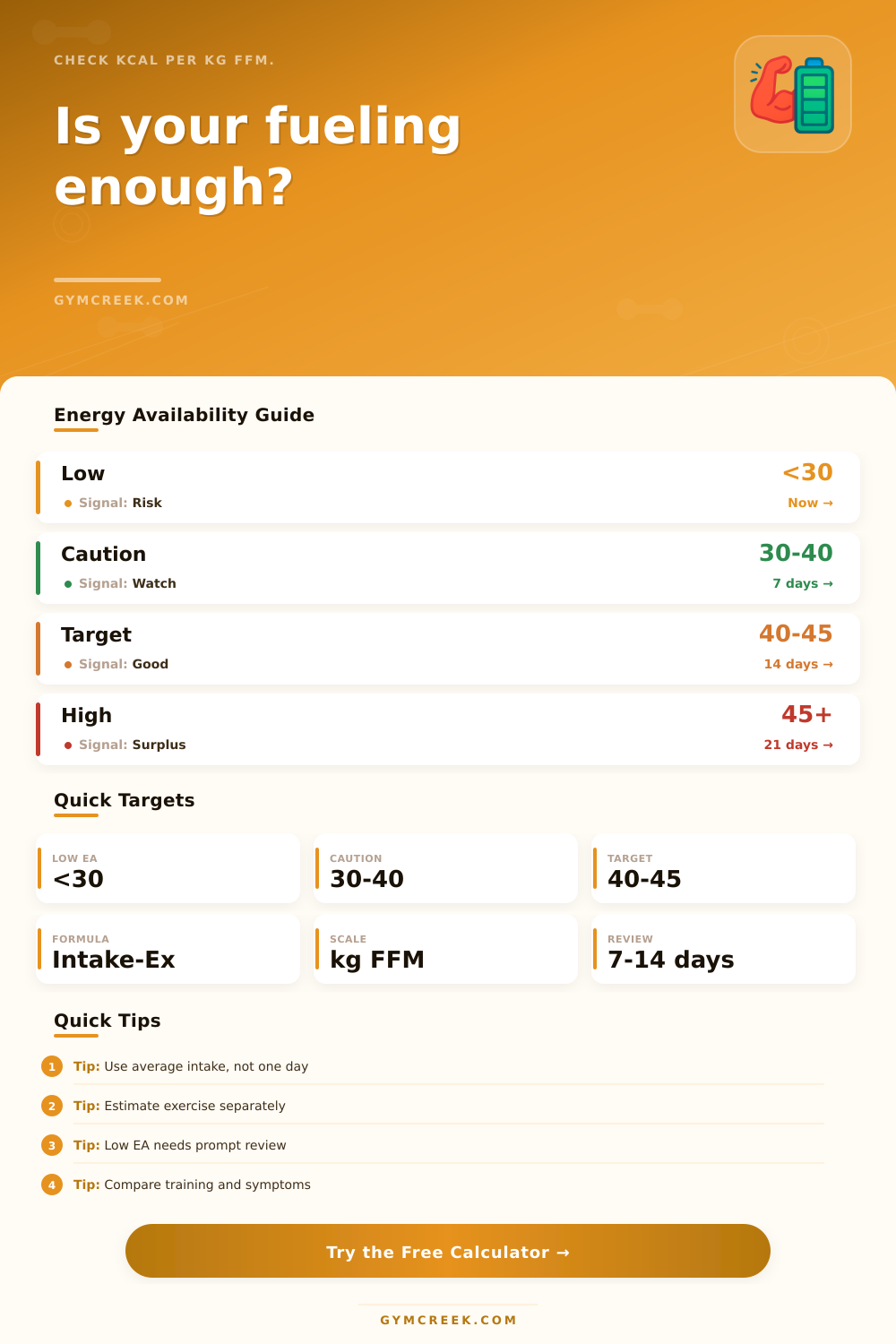
| Low availability | Below 30 | Higher risk for poor recovery, hormonal disruption, and performance drift | Review fueling promptly with qualified support |
| Caution range | 30 to 40 | May work briefly, but can be too low during heavy blocks | Track symptoms, training quality, and weekly averages |
| Performance target | 40 to 45 | Common practical range for many active adults | Maintain unless body composition or training goals change |
| High availability | 45 plus | Often supports recovery or gain phases, depending on total energy balance | Useful in hard blocks or intentional surplus phases |
| Goal | Suggested floor | Useful target | Notes |
|---|---|---|---|
| Maintain performance | 40 | 40 to 45 | Prioritize stable training output and recovery |
| Fat loss phase | 35 | 35 to 42 | Short phases may run lower, but watch recovery closely |
| Muscle gain phase | 42 | 45 plus | Supports training volume and tissue gain |
| Race prep or high volume | 42 | 45 plus | Heavy endurance blocks often need more carbohydrate and total energy |
| Scenario | Intake pattern | Exercise estimate | EA concern |
|---|---|---|---|
| Hard training plus diet | Lower daily calories | High session burn | Net energy can fall quickly |
| Rest day underfueling | Big rest day drop | Low session burn | May reduce weekly average recovery |
| Endurance peak week | Normal intake | Very high volume | Exercise subtraction dominates the formula |
| Strength gain block | Higher intake | Moderate session burn | Availability often supports recovery |
| Output | Formula | Inputs | Purpose |
|---|---|---|---|
| Fat-free mass | Body weight x (1 - BF%) | Weight, body fat | Denominator for energy availability |
| Exercise energy | Session average plus MET add-ons | Training kcal, sessions, minutes | Intentional exercise subtraction |
| Energy availability | (Intake - exercise) / FFM | Daily kcal, exercise kcal, FFM kg | Primary fueling estimate |
| BMR context | Mifflin-St Jeor | Age, sex, height, weight | Resting energy comparison only |
◇Tips
Train smart and eat right, and still you might fail. Why? Because the body doesn’t care about good intentions. It’s a mathematical creature. It follows energy availability, which is a measure of food that gets to your tissues minus exercise calories. Most people guess at this number. They try to feel full and hope they’re getting enough.
The calculator above does the math for you, it tells you whether you’re fueling properly or surviving on adrenaline. It sounds so easy. It works, unless you examine inputs. To use this, you must have a measurement of your fat free mass. That’s what remains after subtracting body fat from your weight. Fat is fairly inert. It stores energy and doesn’t burn much in and of itself. But muscle tissue do. Muscle burns fuel just by being there.
How to Fuel Your Body for Better Performance
When you divide calories by total body weight, the image blurs. The tool needs a different number: the bottom part of the fraction should be only the part of your body that really drives your metabolism, which is your fat-free mass. Your lean tissue are the engine. Your brain operates on that stuff. Your heart pumps for that lean tissue. When it has less available, those systems throttle back to conserve.
Most estimates ignore the subtraction: the energy cost of exercising itself. We tend to over-estimate the amount we burn during a workout and under-estimate the amount we consume afterwards. A runner feels as if he burned off two thousand calories; really, he gained back eight hundred. There is confusion around sweat loss and heart rate variability. Small variations in tracking accuracy shift net energy. The chart below show this in a reference table. Off by ten percent on one side or another? Your risk band can change entirely.
Low energy availability is a silent crisis. It doesn’t have to resemble outright starvation. It resembles the marathoner who increases his mileage but can’t get any stronger. It’s the lifter who adds weight to the bar but hits a stall in strength while maintaining her scale weight. The body slows down your metabolism and suppresses reproduction. When resources are scarce, hormones drops. It’s biology, not a moral failure. You’re trying to sprint with an empty tank and engine’s cutting the juice to maintain the lights.
Safety depends on context. On a rest day, you need less fuel different than in a hard training block. To compensate, the calculator allows you to enter the frequency and intensity of your sessions. If you train high volume, then availability needs to be high as well to help tissue repair. Without it, injuries will accumulate since bones and ligaments can’t recieve the nutrition required to remodel themself.
Perhaps a small deficit here or there is okay for a week. However, being chronic is where it becomes dangerous. It also tracks your confidence. Roughly guessing what you eat makes the result a rough guide. Using a GPS watch and weighing everything sharpens data. This input change how certain the tool is that it’s right.
So: How do you track? Are you being honest? Don’t pretend to be accurate if you’re estimating. This creates a false sense of security. Low score + high confidence = a warning sign. Low score + low confidence = a nudge to check your habits more closely. But it’s not about perfect. It’s about sustainable. You need enough energy for performance, recovery and feeling good.
Monitor your output. If you find yourself in the caution zone, monitor how you feel. How’s your resting heart rate? Sleep? How is your mood? Often these will be signs that something isn’t right, and if you don’t address the problem earlier, your performance won’t of been far behind. It’s also not about weight; it’s about fueling so you can keep your body going so you can do what you love without breaking down. The numbers are a start, but hear what they say.