Endurance Nutrition Calculator
Estimate carbs, fluid, sodium, pack count, and gut-training risk for running, cycling, triathlon, and ultra-distance events.
📌Presets
Each preset loads a realistic event profile and calculates a fuel target you can test in training.
⚙Calculator
Endurance fuel snapshot
Enter event details to estimate hourly intake and total supplies.
📊Fuel Metrics
📑Reference Tables
| Duration | Carb Target | Fluid Target | Use Case |
|---|---|---|---|
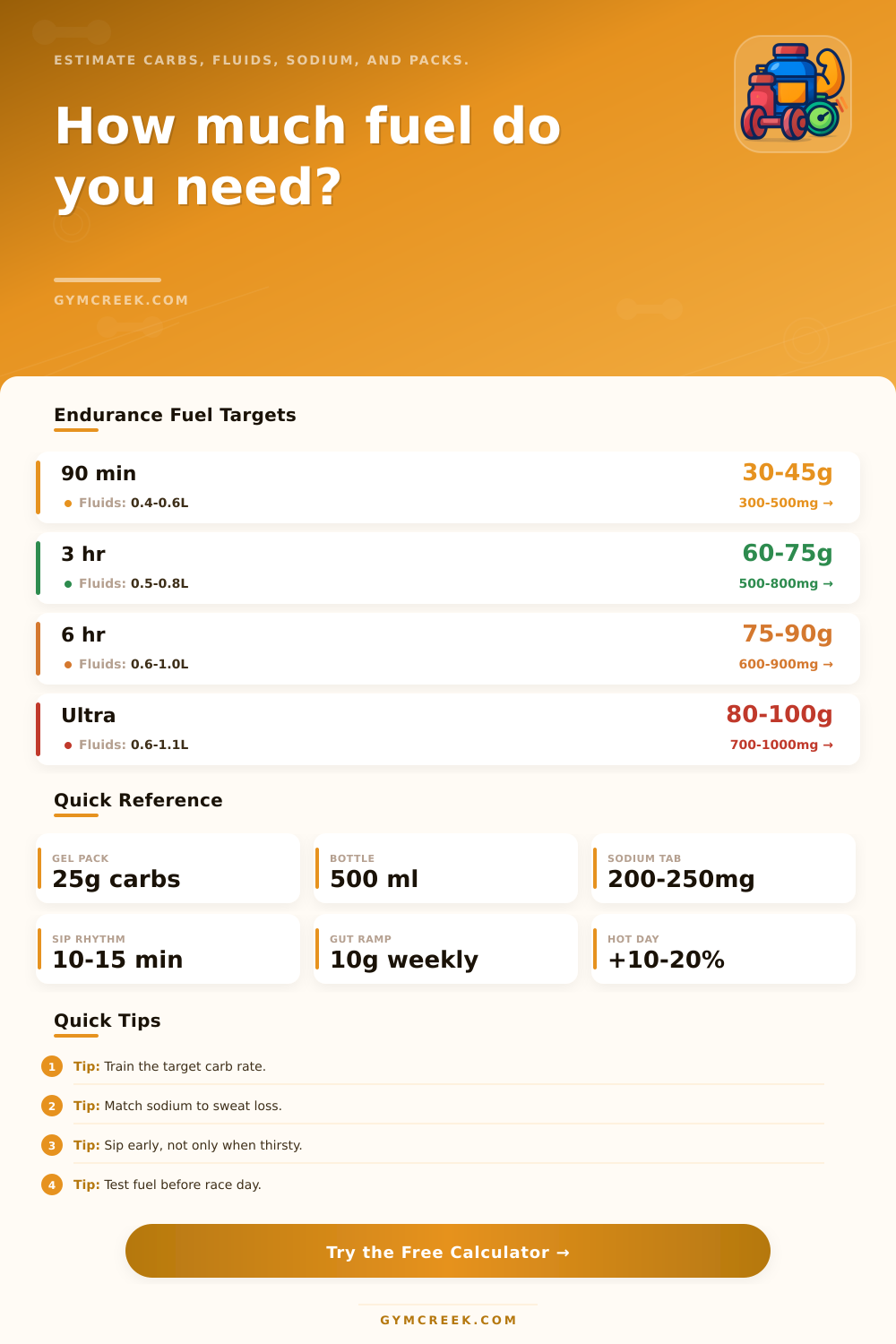
| 1-2 hours | 30-45 g/hour | 0.4-0.7 L/hour | Short race |
| 2-4 hours | 45-75 g/hour | 0.5-0.8 L/hour | Marathon or ride |
| 4-8 hours | 60-90 g/hour | 0.5-1.0 L/hour | Long endurance |
| 8+ hours | 70-100 g/hour | 0.6-1.1 L/hour | Ultra event |
| Intensity | Carb Reliance | Gut Load | Notes |
|---|---|---|---|
| Easy | Lower | Lower | Steady sipping works |
| Steady | Moderate | Moderate | Practice race rhythm |
| Hard | High | Higher | Use mixed carbs |
| Very hard | Very high | Highest | Avoid large boluses |
| Sweat Sodium | Typical Range | Hourly Focus | Watch For |
|---|---|---|---|
| Low | 300-600 mg/L | Light sodium | Over-salting |
| Moderate | 600-900 mg/L | Regular sodium | Missed bottles |
| High | 900-1200 mg/L | Planned sodium | Salt stains |
| Very high | 1200+ mg/L | Strict plan | Cramping risk |
| Fuel Item | Common Unit | Carbs | Timing |
|---|---|---|---|
| Gel | 1 packet | 20-30 g | 15-30 min |
| Drink mix | 500 ml | 20-45 g | 20-40 min |
| Chews | 1 sleeve | 35-50 g | 30-45 min |
| Soft flask | 500 ml | 40-80 g | 45-75 min |
💡Tips
Fueling during long physical effort is a necessary process, and the process of fueling during long physical efforts will determine if the individual is finish that particular movement with strength or with fatigue. Many individual attempt to fuel there bodies during long physical efforts without a specific plan. However, a specific plan is required to effectively fuel an athlete during those efforts, as the requirement of fueling an athlete depend upon a variety of different factor.
The factors include, but are not limited to, the duration of the effort, the intensity of the effort, the amount of sweat that the individual produce during that effort, and the ability of that individual’s body to properly process the fuel that is provided to that individual. The calculator that is featured on this page will target the amount of fuel that an individual should consume during a long physical effort by utilizing each of these specific variable. The duration of the effort is one of the primary variable that is utilized in the determination of the fuel target for that individual.
How to Fuel Your Body During Long Exercise
Individuals that need to exercise for longer periods will burn more carbohydrates and will burn less stored fat then individuals who exercise for shorter periods of time. Additionally, the intensity at which that individual burns calorie is another of the primary variables that must be considered. Individuals that perform at high rates of intensity will burn fuel at a faster rate than individuals that perform at low rates of intensity, and those individual will require different amounts of fuel to fuel those high rates of performance.
Additionally, variables like body weight can be used to calculate how many gram of fuel the body can absorb each hour. Using body weight in the calculation ensures that the amount of fuel calculated for that individual will not be too much for the body to absorb. In addition to the fuel requirements, there are also separate requirements for the fluids and sodium that the body will require during those performances.
Fluid and sodium intake are dependent upon the rate at which an individual will sweat and the environmental temperature. In hot environment, individuals will naturaly begin to sweat at a higher rate. Higher rates of sweating will lead to higher targets for fluids and sodium intake to supplement the body.
These targets can be adjusted according to the environment, so that athletes dont have to guess at the amount of fluids or sodium that they need to consume during those performances. Additionally, the calculator can calculate the carbohydrate tolerance of the individual to ensure that the target for carbohydrates for that individual is within the limit of the bodys ability to process those carbohydrates. High targets for carbohydrates will alert athletes to the risk of gut training, indicating that they must increase their consumption of carbohydrates over time to train their guts to accept such high amounts of fuel.
Additionally, reference table can be utilized to determine the number of carbohydrates required for events of various length. Events that last for shorter periods of time will have different requirement for carbohydrates than events that last for longer periods of time, like ultramarathons. These tables can help athletes to recognize their bodys requirement for fuel during these competitions, and to establish a repeatable rhythm of fueling their bodies.
The ability to establish such a rhythm is important for those athlete who must focus upon the terrain and their competitors during these efforts. Unfortunately, many athlete make mistakes while fueling there bodies during these efforts. For example, many athlete choose to treat fueling their bodies as an afterthought.
Waiting until they feel hunger or thirst is a mistake; they should of fuel their bodies prior to the event. Additionally, individuals may attempt to consume large dose of fuel; this can lead to stomach trouble. Instead, athletes should consume smaller dose of fuel at more frequent interval.
Additionally, many individual do not practice the fuels that they will consume during the effort; if individuals do not practice consuming these fuels, they will not know how their bodies will respond to these fuels during their competitions. An additional use of the calculator is to determine at what time during the effort the athlete will consume fuel at the aid station. By determining the number of aid stations that an athlete will pass during an effort, they can spread the fuel over time, so that the body does not reject the fuel that is consume.
These fuel plans can be used during training session to test which fuel plan works the best for the athlete. These figure that are determined by the calculator are merely a starting point. The athlete must experiment with these figure.
Only one variable should be adjusted at a time, and an athlete should track how the individual feel two hours into the effort. By tracking how the athlete feels during these efforts, the athlete can successfully formulate a fuel plan. Overall, the purpose of this fuel calculation is to ensure that the athlete’s fuel plan meets the demand of that athlete’s performance that day.