Elliptical To Running Conversion Calculator
Convert an elliptical session into equivalent running distance, pace, calories, and training load using time, body size, cadence, resistance, ramp, heart rate, and perceived effort.
📌Conversion Presets
Each preset fills a complete rider profile and recalculates the equivalent run immediately.
⚙Rider And Session Inputs
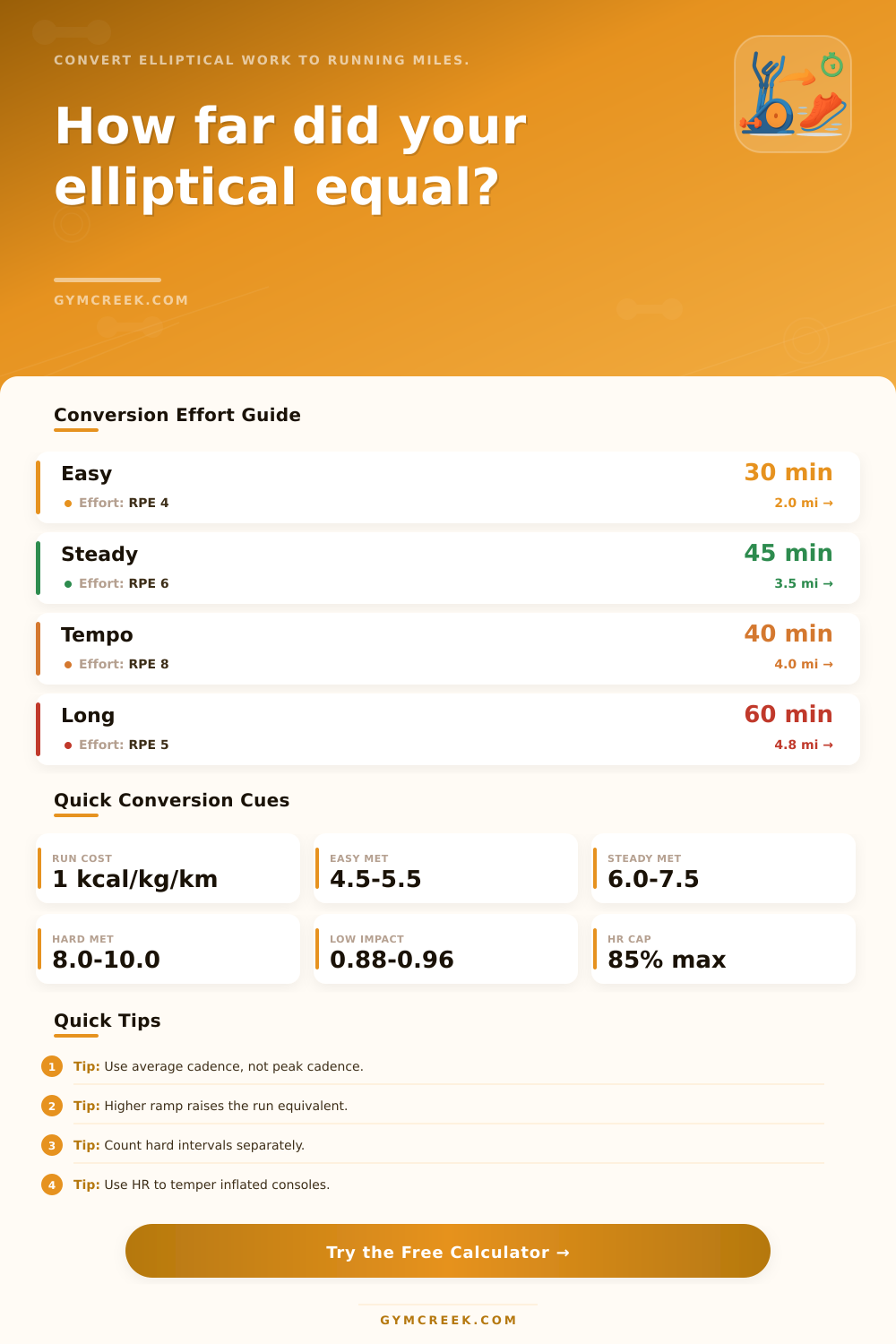
Your elliptical session equals about 3.5 running miles.
This estimate uses ACSM-style MET energy math and the common running cost of about 1 kcal per kg per km.
📊Conversion Benchmarks
📘Effort Reference Tables
| Elliptical Session | Typical Inputs | Estimated MET Range | Running Credit |
|---|---|---|---|
| Recovery glide | RPE 3-4, low resistance, conversational HR | 3.5-5.0 METs | Use 80-90% of calorie-equivalent miles |
| Easy aerobic | RPE 4-5, moderate cadence, light ramp | 5.0-6.5 METs | Good substitute for easy run volume |
| Steady endurance | RPE 6-7, sustained cadence, moderate ramp | 6.5-8.5 METs | Often close to steady run effort |
| Tempo substitute | RPE 7-8.5, higher resistance, controlled HR | 8.0-10.5 METs | Credit load more than literal pace |
| Interval session | Hard repeats with easy recoveries | 7.5-11.5 METs | Separate work and recovery for best accuracy |
| Formula | Variables | Use In This Tool | Important Limit |
|---|---|---|---|
| Mifflin-St Jeor BMR | Weight, height, age, gender | Shows daily energy context | Not a running conversion formula |
| MET calorie equation | METs, body mass, minutes | Estimates elliptical energy cost | Machine scales vary by brand |
| Running energy cost | Calories, body mass | Converts energy into run distance | Terrain and economy change the cost |
| Tanaka max HR | Age | Checks average HR intensity | Individual max HR may differ widely |
| Goal | Best Conversion Setting | What To Trust Most | What To Avoid |
|---|---|---|---|
| Injury-safe aerobic work | Conservative with recovery or easy goal | Time, HR, and RPE | Chasing exact road pace |
| Maintaining run volume | Balanced easy or steady goal | Calories per kg and session time | Giving full credit to arm-heavy work |
| Replacing tempo day | Balanced tempo goal | Sustained HR and RPE | Using short spikes as whole-session effort |
| Weight management cardio | Calorie-focused with console blend | Energy range and consistency | Overreading high console estimates |
💡Practical Notes
You may want to know how many mile of running an elliptical session can replace. You may want to know this if you are injured or if you prefer to limit the impact on your joints. Many people wants to find a way to maintain their training mileage when the weather is poor or when their schedule dont permit them to run.
Because elliptical training is not the same as running, elliptical training cannot perfectly replace running activity. However, it is possible to make an estimation of how many miles of running an elliptical session can replace if you understand how the elliptical machine measure your training effort and how many calories is burned during running. To calculate the number of miles of running that an elliptical session can replace, inputs reflect the effort that you put into training on the elliptical.
How Many Running Miles Can an Elliptical Replace
Factors such as time, cadence, resistance, ramp angle, heart rate and perceived exertion can all be used to calculate the number of miles. Cadence refer to the rate at which you turn the pedals on the elliptical machine. Resistance and ramp angle control the amount of force that you must exert with each movement of the elliptical’s pedals.
Heart rate and the measurement of perceived exertion help to reflect the effort that your cardiovascular system is putting into the elliptical training session. These input can be entered into the calculator to determine the number of miles that can be replaced by an elliptical session. Elliptical machines differ from each other in the stride length of the elliptical and the inertia of the machine’s main flywheel.
As a result, two people may burn the same amount of calories on elliptical machines of different make and models. Therefore, using heart rate and the measurement of perceived exertion as a measurement for the effort that one puts into elliptical training can help to catch errors in the calorie counts that the elliptical machine displays on the elliptical machine’s console. If a person’s heart rate and perceived exertion levels are significantly lower than the number of calories that are burned during elliptical training, then the elliptical machine is underestimating that individual’s calorie consumption during that training session.
In these cases, the elliptical console underrepresents the number of miles of running that can be replaced by the elliptical session. Elliptical training is useful for individuals that are either recovering from an injury or wishing to maintain their aerobic fitness without the impact of running. For these types of training sessions, it is not necessary for individuals to maintain the same cadence and impact as when they are performing running activities.
Elliptical training sessions that burn the same amount of calories as that of an individual’s running and have the same impact on the body as that of running can replace the number of easy miles that are normally covered during running activities. Furthermore, because elliptical training does not place the same loads on the muscle as running, elliptical training does not cause the same damage to those muscles with each session of training. However, elliptical training cannot replace downhill running or racing activities.
Activities that require the muscles to exert less force than during running can be performed on an elliptical machine, but activities of high force require different levels of stiffness in the muscles than running activities. An individual’s weight is a factor in the calculation of the number of miles of running that can be replaced by an elliptical training session. The more an individual weigh, the more calories are burned during running activities.
Therefore, the number of miles of running that a training session on an elliptical machine replaces will be less for an individual that weighs more than another individual. Furthermore, the elliptical exercise calculator accounts for this variable in its calculation. In the same way, age and gender is other variables in the calculation of the number of miles of running that can be replaced by an elliptical training session.
Age and gender impact the resting metabolism and maximum heart rate of an individual, which are variables that are used to calculate the number of calories that are burned during elliptical training. Another variable that may impact the calculation of miles of running that may be replaced by an elliptical training session is the use of the elliptical. If individuals push and pull on the arms of the elliptical, that burns additional calories.
However, you should not credit those miles of running with those additional miles. The same concept applies to individuals that perform recovery training with the elliptical. Recovery training sessions do burn calories, however they are not as similar to running as more intense elliptical training.
The elliptical exercise calculator allow for adjustments for both of these scenarios so that the measurement of training effort is accurate. Individuals often make the mistake of considering the distance traveled on the elliptical as the same as the distance covered on the treadmill. The distance covered on the elliptical and the distance covered on the treadmill are two different measurement.
Elliptical machines may feature displays of distances traveled, but these distances are not based off the actual movement of an individual. Treadmill distances are based upon the movement of the treadmill belt. The distance traveled on the elliptical may be more accurate if effort variable like cadence, resistance and heart rate are considered.
It is important not to ignore the difference between average values of measurements and the peak values of those measurements. For instance, an elliptical training session that may feature intervals of high intensity training will feature a high peak heart rate reading. However, the average heart rate during that training session may be lower.
The average heart rate should be used as a calculation variable. Furthermore, the elliptical exercise calculator should use the average cadence. Average cadence is a more accurate representation of performance than the peak cadence that is achieved during only a few moments of training on the elliptical.
The elliptical exercise calculator accounts for these variables so that the measurements are accurate and honest. Some variables of the training session may affect the number of miles of running that can be replaced by an elliptical training session. For instance, when running, individuals encounter the effects of the wind, hills and different type of running surfaces.
Elliptical training does not include these variables. While an individual can use elliptical training to maintain their aerobic fitness, they may not feel prepared for a race on a hilly course. Elliptical training has its place in the life of a runner, but it does not have the same benefits for runners during specific race preparation periods.
Elliptical training may be used during base building or recovery periods, but it should not be used in place of specific race preparation activities. The reference tables help to illustrate the differences between elliptical training and running activities. These tables illustrate how many miles of running can be replaced by elliptical training at different level of effort.
By reviewing these tables, individuals can determine whether or not an elliptical training session should be credited with full miles or partial miles replaced. Furthermore, the tables also allow individuals to understand why interval training is treated differently than recovery training on the elliptical. The value of the elliptical exercise calculator is in its consistency.
By using the same variables and by utilizing the same logic that is explained in the text of the elliptical exercise calculator, individuals will find similar results. Furthermore, individuals can use elliptical exercise calculators to compare elliptical training sessions with running activities. Even if elliptical training does not feel like the same as running, elliptical training may be beneficial to incorporate into an individual’s training regime.
The elliptical exercise calculator allow individuals to focus upon the goals that they have for their training.