Elliptical Stride Length Calculator
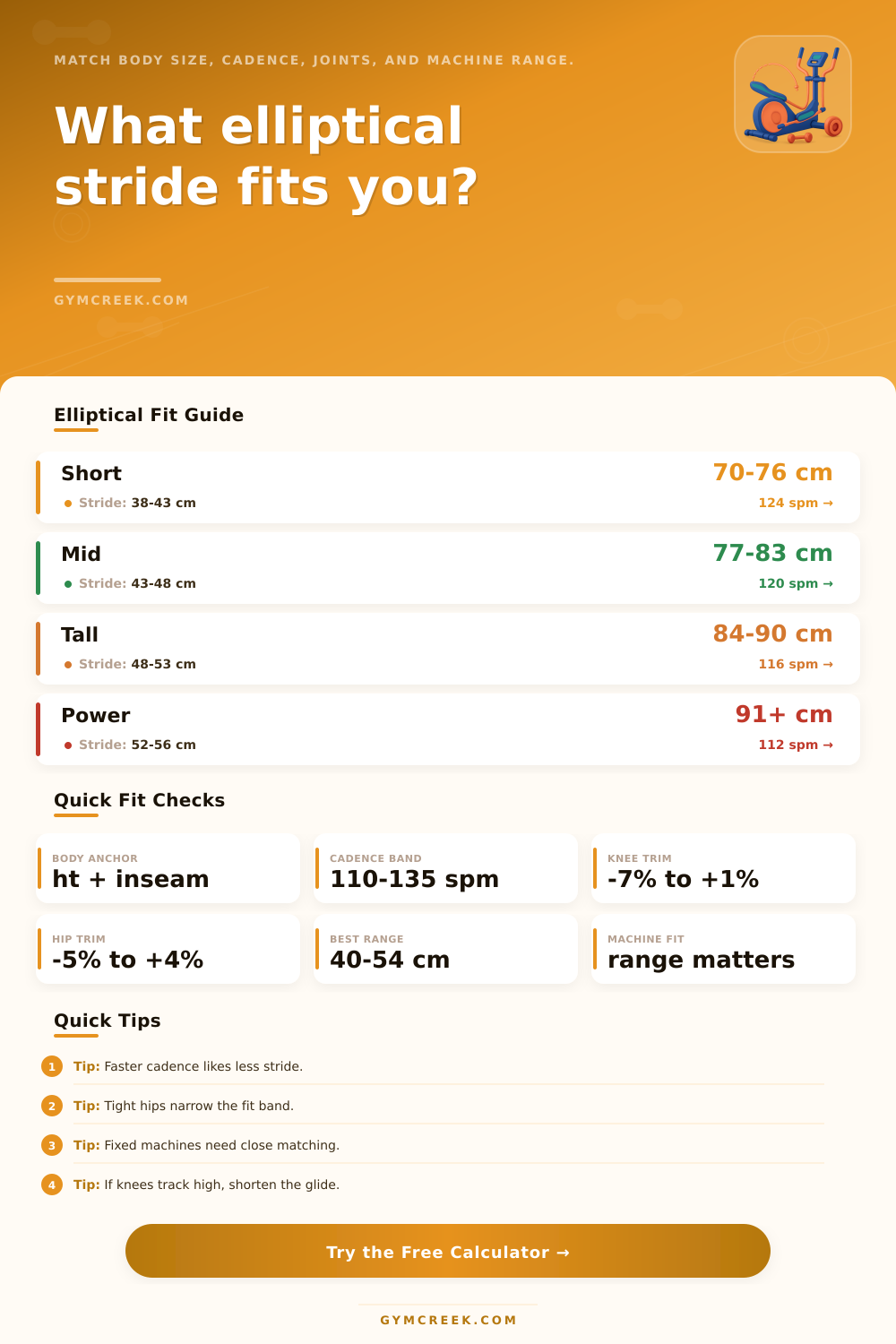
Estimate an ideal elliptical stride from height, inseam, cadence comfort, knee tolerance, hip mobility, and how adjustable your machine is so the motion feels smoother and less forced.
📌Preset Rider Setups
These nine presets cover compact home machines, gentler joint-focused setups, taller users chasing longer glides, and quicker interval rides where cadence comfort matters more than a big stroke.
⚙Elliptical Fit Inputs
Recommended stride window
Enter body and machine details to compare your ideal stride target against the actual range your elliptical can deliver.
📊Quick Fit Metrics
📑Reference Tables
| Rider size | Height | Inseam | Usual stride |
|---|---|---|---|
| Compact | 155-165 cm | 68-76 cm | 38-43 cm |
| Average | 166-178 cm | 77-84 cm | 43-49 cm |
| Long leg | 179-190 cm | 85-92 cm | 48-54 cm |
| Tall power | 191+ cm | 93+ cm | 52-56 cm |
| Cadence | Feel | Stride cue | Best use |
|---|---|---|---|
| 100-110 spm | Heavy glide | Longer | Climb feel |
| 111-122 spm | Balanced | Mid range | Daily cardio |
| 123-134 spm | Quick flow | Shorter | Intervals |
| 135+ spm | Very quick | Compact | Fast finish |
| Joint note | Common feel | Stride trim | Why |
|---|---|---|---|
| Cautious knee | Tight top | -4% to -7% | Limits deep knee bend |
| Balanced knee | Neutral | -1% to -2% | Maintains smooth tracking |
| Limited hip | Front pinch | -3% to -5% | Reduces overreach |
| Open hip | Easy extension | 0% to +4% | Allows longer arc |
| Machine type | Usable spread | Best rider | Limitation |
|---|---|---|---|
| Fixed compact | About 1 cm | Close body match | Least forgiving |
| Two-position | About 4 cm | Mixed household | Coarse steps |
| Fine-adjust rail | About 8 cm | Shared training | Needs setup time |
| Floating arc | About 10 cm | Broad fit range | Brand variance |
| Scenario | Cadence | Likely stride | Read |
|---|---|---|---|
| Compact commuter | 124 spm | 40-43 cm | Needs short smooth arc |
| General fitness rider | 118 spm | 44-48 cm | Most home machines fit |
| Tall endurance rider | 114 spm | 49-54 cm | Prefers open hip travel |
| Interval rider | 128 spm | 42-47 cm | Quick turnover beats reach |
| Layer | Math idea | Input used | Purpose |
|---|---|---|---|
| Body anchor | 0.15 x ht + 0.27 x inseam | Height, inseam | Starting stride target |
| Cadence trim | Ref minus actual | Goal, cadence | Match turnover comfort |
| Mobility trim | Percent multiplier | Knee, hip, age | Reduce forced range |
| Machine fit | Closest point gap | Setting, machine type | Show fit margin |
💡Fit Tips
If your heel rises early or your knees feel crowded at the top of the ellipse, trim stride before adding resistance. Crowding is often a fit problem rather than a conditioning problem.
Use cadence and stride together. A machine can feel awkward because the glide is too long for your preferred rhythm, even when the published stride matches your height on paper.
Stride length refer to the distance that your feet travel during one complete cycle on the elliptical machine. Stride length is measured from the front of the pedal path of an elliptical machine to the back of the pedal path. The stride length on an elliptical machine is a critical factor to consider when using the exercise machine.
An incorrect stride length for each individual may lead to discomfort in the knees or the hips of the individual using the elliptical exercise machine. Many individuals experiences discomfort in their knees when using elliptical exercise machines due to the stride length of the elliptical machine not matching there body proportions. An individual’s body proportions will determine the ideal stride length for there body.
How to choose the right stride length on an elliptical machine
Furthermore, the inseam of an individual is a more critical measurement than the total height of an individual when determining stride length. The inseam measurement for an individual is important because this measurement will determine how the pedals of the elliptical machine must swing to avoid jamming the knee or stretching the hips of the individual using the exercise machine. An individual who is tall with long legs may require a longer stride length on the elliptical machine to avoid feeling uncomfortably in their legs.
Individuals who are shorter in stature or who have tight hips may require a shorter stride length on the elliptical machine. Elliptical exercise machines include an elliptical path in which the legs of the individual will move in addition to the horizontal movement of the machine. Cadence is a measurement of the number of steps that an individual take during a minute on the elliptical machine.
The cadence at which an individual uses an elliptical exercise machine should also be considered in relation to the stride length of the machine. An individual who selects a high cadence for their elliptical machine may feel discomfort with a long stride length for the machine. An individual who selects a lower cadence for the elliptical machine may find comfort with a long stride length for the machine.
An individual must coordinate the cadence and stride length of the elliptical machine to ensure that the movement of their legs on the elliptical machine is smooth and comfortable for that individual. The type of exercise that an individual perform on the elliptical machine may require a different stride length of the machine. For example, interval training may require an individual to use a shorter stride length on the elliptical machine.
Alternately, steady-state exercises may require an individual to use a medium stride length on the elliptical machine. An individual’s joint history may require an adjustment to an individual’s stride length on the elliptical exercise machine. For example, an individual who has issues with their knee may require a stride length that does not close those joints as much as an individual without joint problems.
The same concept can be applied to individuals who have joint issue with their hips. The design of the elliptical exercise machine may impact the stride length of an individual. For example, elliptical exercise machines that are fixed models will not allow an individual to change their stride length on the exercise machine.
Elliptical exercise machines that contain adjustable rail, however, will allow an individual to change the stride length on the elliptical machine to their personal preference. Front-drive elliptical exercise machines will allow for the stride length of an individual to be stacked in vertical movement on the machine, while the stride length of individuals on rear-drive elliptical exercise machines will be required to move horizontal. An individual can determine their stride length by performing a warm-up exercise on the elliptical machine.
An individual should note how their knees and hips moves when performing the warm-up exercise on the elliptical machine. When determining stride length, the individual should begin with the lowest setting of resistance for the elliptical exercise machine. Furthermore, by tracking the number of elliptical machine sessions that an individual performs each week, an individual can determine how stride length affect their body.
Using the proper stride length for an elliptical exercise machine will increase the efficiency in which that individual can perform the exercise. Using the proper stride length will allow an individual to more effective recruit their glutes and hamstrings, but will prevent overuse of the quadriceps of that individual. Using the proper stride length will also reduce the shear stress that is placed upon the joints of an individual, which can lead to fewer ache within the body of that individual after performing the elliptical exercise.
When purchasing an elliptical exercise machine, an individual should compare the stride length requirement of an individual’s body to the stride length capabilities of the elliptical machine. Elliptical exercise machines with high adjustability may be best for individuals whose body proportions are not the average of all individual. Finally, prior to purchasing an elliptical exercise machine, it is beneficial for individuals to test the elliptical machine in person.
By achieving the proper stride length for an individual, that individual will maximize the efficiency with which they can use there body and the elliptical exercise machine.