Electrolyte Intake Calculator
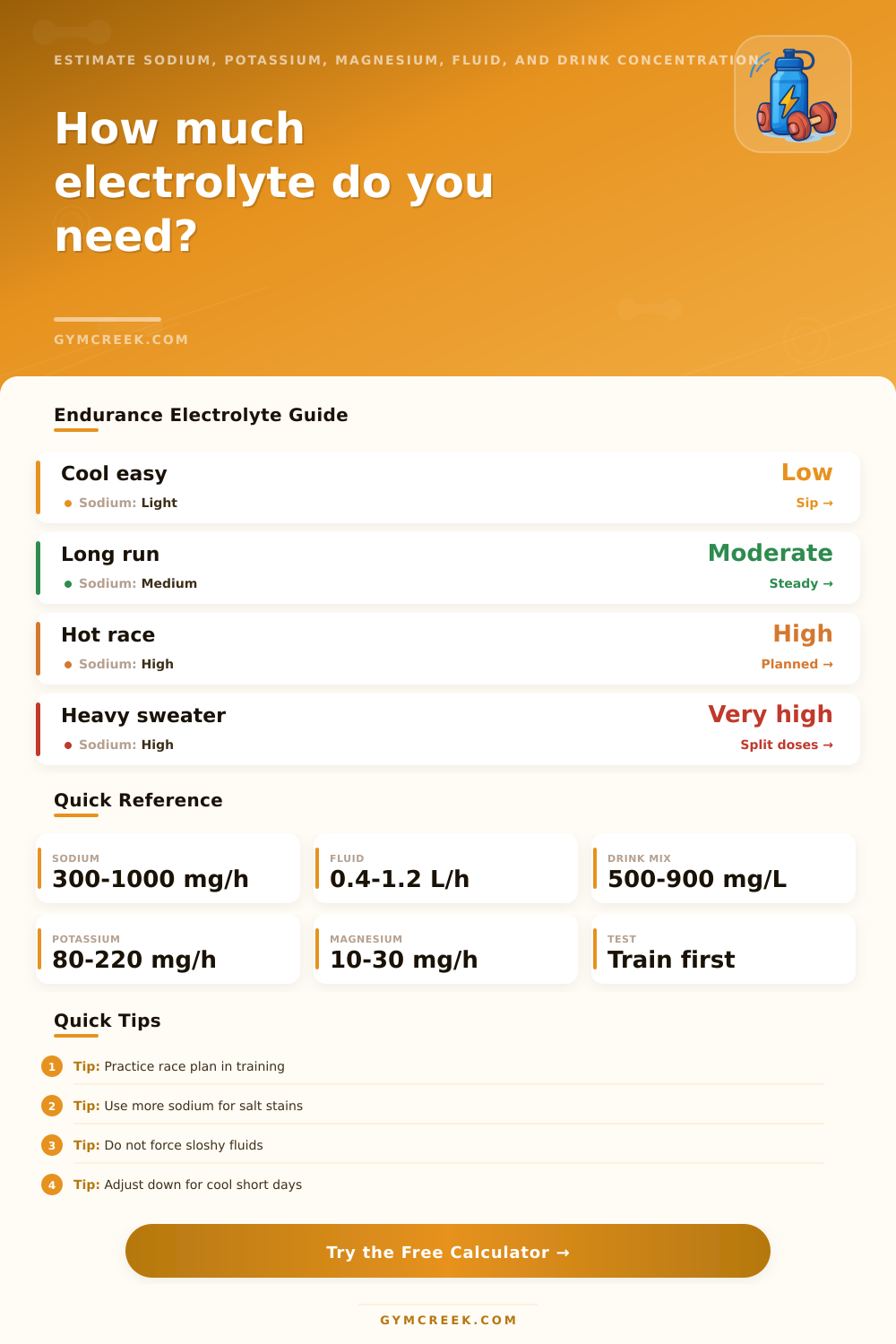
Estimate sodium, potassium, magnesium, fluid target, and drink concentration for endurance sessions, hot-weather training, races, and heavy-sweat workouts.
🏁Endurance and Heat Presets
Presets load realistic sweat, sodium, heat, humidity, and intensity assumptions. Use your own sweat test and sodium test when you have them.
⚙Calculator Inputs
Electrolyte snapshot
Enter session details to estimate fluid and electrolyte targets.
📊Metrics Grid
📘Calculation Rules
📑Electrolyte Reference Tables
| Session | Common sodium range | Best fit | Watch point |
|---|---|---|---|
| Under 60 minutes | 0 to 300 mg/hour | Cool or easy training | Plain water may be enough |
| 1 to 2.5 hours | 300 to 700 mg/hour | Moderate endurance | Increase if sweat is salty |
| 2.5 to 5 hours | 500 to 1000 mg/hour | Long races and rides | Split doses across bottles and gels |
| Ultra or extreme heat | 700 to 1200 mg/hour | Heavy sweaters in heat | Practice before using high doses |
| Sodium concentration | Interpretation | Use case | Adjustment |
|---|---|---|---|
| Under 400 mg/L | Light electrolyte drink | Cool sessions or low sweat sodium | Add sodium if cramps or salt stains appear |
| 400 to 700 mg/L | Moderate mix | Most long training sessions | Works with gels or salty foods |
| 700 to 1000 mg/L | High sodium mix | Hot weather and salty sweaters | Test gut tolerance |
| Over 1000 mg/L | Very concentrated | Special cases only | Often better split into capsules and fluid |
| Electrolyte | Typical in-session range | Why include it | Note |
|---|---|---|---|
| Potassium | 80 to 220 mg/hour | Supports fluid balance and normal muscle function | Food often contributes enough |
| Magnesium | 10 to 30 mg/hour | Small support amount in some mixes | High doses may upset the gut |
| Calcium | Usually low priority | Sometimes included in mixes | Not estimated by this calculator |
| Sodium | Primary target | Main electrolyte lost in sweat | Individual sweat sodium varies widely |
| Sweat rate | Category | Planning cue | Example |
|---|---|---|---|
| 0.3 to 0.7 L/hour | Low | Small bottle strategy | Cool easy run |
| 0.8 to 1.2 L/hour | Moderate | Regular sips and sodium | Long run or ride |
| 1.3 to 1.8 L/hour | High | Planned bottles and salt | Hot race day |
| Over 1.8 L/hour | Very high | Do not try to replace every drop | Large athlete in humid heat |
💡Electrolyte Tips
Electrolytes are mineral that are lost in the process of sweating, and electrolytes are necessary for the body due to the fact that electrolytes impact the bodys ability to retain fluid. Additionally, electrolytes impact how muscle in the body function and how the body can recover from the exercise that is performed. Because fluid replacement with water alone may not be enough to balance the bodys fluids if electrolytes are lost in the process of sweating, fluid and electrolyte replacement is recommended.
Furthermore, because the amount of electrolytes lost in the process of sweating vary for each individual and from day to day for each individual, there is no one rule for electrolyte replacement that will work for all individual. The electrolyte calculator require three different pieces of information in order to calculate the amount of electrolytes that an individual should replace. The three pieces of information that are required are the planned duration of exercise, the measured sweat rate of the individual, and the sodium concentration in the sweat of the individual.
How to Replace Electrolytes When You Exercise
These three pieces of information are used in creating the calculation of the amount of fluid and electrolytes that should be consumed by the individual during exercise. Temperature and humidity is also a factor in the calculation of the amount of electrolytes that an individual should consume during exercise. High temperatures and humidity causes the body to produce more sweat in order to cool itself.
Finally, intensity of the exercise is also a factor in the calculation. High intensities cause an individual to lose more sodium with each liter of sweat produced compared to low intensities of exercise. Body weight is one variable that is used in the calculation as a safety measurement.
Body weight can help an individual to determine if the amount of fluid that it calculate for the individual is too high. If an individual’s fluid deficit reaches a level of more than two percent of there starting body weight, they are likely experiencing dehydration and their fluid plan is not sufficient. The type of sport that an individual performs can also impact the targets of fluid that an individual should consume during exercise.
For instance, runners and triathletes cannot consume the same amount of fluid as cyclist. Consuming too much fluid too quickly can lead to stomach discomfort. By comparing the amount of fluid that an individual is currently consuming to the target amount calculated in the calculator, an individual can determine if they should increase or decrease their fluid intake.
The reference tables provide examples of the amount of electrolytes that many athlete use during exercise. For instance, the table indicates that a light electrolyte mix that contains less than 400 mg of sodium per liter may be sufficient for an individual that is performing easy runs. However, that same amount of electrolyte is not sufficient for an individual that is performing more intense runs in high temperatures.
Additionally, the reference tables also indicate that the needs for potassium and magnesium are low. This is due to the fact that an individual can get the potassium and magnesium that they need from food. Thus, the calculator estimates the amount of potassium and magnesium that an individual should consume and recognizes that these amounts are secondery to the sodium targets.
Many variables can impact the amount of electrolytes that an individual should replace during exercise. For instance, humidity, heat acclimation, medications, illness, and carbohydrate intake are just a few of the factors that can impact an individual’s need for electrolyte replacement. Heat acclimation will reduce both the amount of fluid that an individual needs to sweat as well as the sodium concentration in their sweat.
Thus, the current measurement of an individual’s sweat and sodium levels could be inaccurate for that individual. Furthermore, medications, illnesses, and high carbohydrate intake can impact the amount of concentrated electrolyte drink that an individual can consume due to the effect that these variables can have on the body’s ability to tolerate the drink. Thus, an individual can use indicators of sodium loss such as salt stains on their clothing or muscle crams.
These are common indicators of too much loss of sodium in an individual’s body. One of the most common error in the use of the electrolyte calculator is treating the output of the calculator as the final answer to the variable of electrolyte consumption. However, if an individual finds that the amount of electrolyte that the calculator suggest is not able to be tolerated by an individual’s stomach, the individual should find a middle ground between consuming fluids with electrolytes and electrolyte capsules.
Thus, the goal is to find a way to consume enough fluid and electrolytes to function as a balance for the body’s loss during exercise, but there is no need to perfectly replace each milligram of sodium that the body lost during exercise. Another of the most common error with the calculator is to ignore the difference between the individual’s current fluid intake and the target amount of fluid that is calculated by the electrolyte calculator. If an individual’s current fluid intake is significantly below the target amount that is calculated by the calculator, then the individual can become dehydrated during exercise.
Additionally, excessive dehydration can lead to high concentration of sodium in the blood. High levels of sodium in the blood can cause nausea, leading to individuals to mistakenly believe that the individual feels nauseated due to the heat that they experienced during exercise. It is recommended that the electrolyte calculator is used to create a plan prior to the individual begins their key exercise session.
Additionally, the individual should test the plan during a training day when their training session is similar to their conditions during their exercise session. Finally, the individual should only adjust one variable at a time, and note how the individual feels at the end of that exercise session. By adjusting one variable at a time, and noting how the individual feels after each adjustment, the electrolyte calculator will be able to provide the individual with a strategy that can be used to ensure that electrolyte replacement occurs during their exercise sessions.