Electrolyte Calculator
Estimate fluid, sodium, potassium, sweat loss, and drink concentration from session length, sweat rate, heat, intensity, and replacement goal.
📌Presets
Presets load realistic sweat-rate, sodium, potassium, heat, and duration assumptions so you can compare different training conditions quickly.
⚙Calculator
Electrolyte snapshot
Enter your sweat rate, electrolytes, and session length to estimate a practical replacement plan.
📊Hydration Metrics
📑Reference Tables
| Sweat rate | L/hr | fl oz/hr | Use |
|---|---|---|---|
| Low | 0.3-0.6 | 10-20 | Cool gym or easy walk |
| Moderate | 0.6-1.0 | 20-34 | Steady endurance |
| High | 1.0-1.5 | 34-51 | Heat, racing, heavy sweater |
| Very high | 1.5+ | 51+ | Needs careful practice |
| Sweat sodium | mg/L | Common cue | Planning note |
|---|---|---|---|
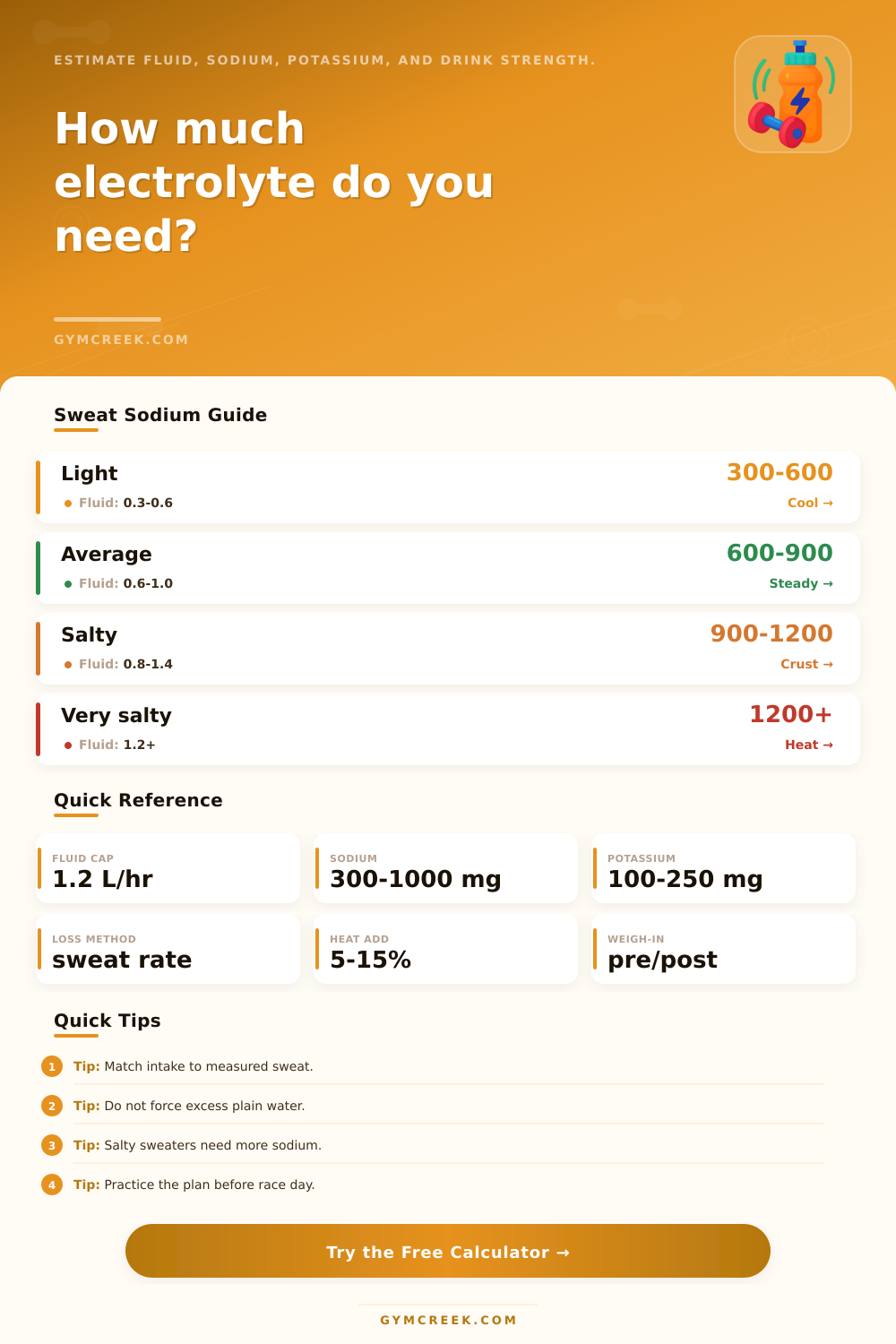
| Low | 300-600 | Few salt marks | Light sodium drink |
| Average | 600-900 | Some salt marks | Moderate replacement |
| High | 900-1200 | White kit lines | Higher sodium mix |
| Very high | 1200+ | Salt crust | Test plan in training |
| Session length | Fluid focus | Sodium focus | Potassium focus |
|---|---|---|---|
| Under 45 min | Thirst led | Usually low need | Usually low need |
| 45-90 min | Replace part loss | Useful in heat | Small amount |
| 90-180 min | Plan hourly intake | Match sweat loss | Track in bottle |
| 3+ hours | Practice pacing | Watch total sodium | Keep modest |
| Formula | Variables | Result | Why it matters |
|---|---|---|---|
| Sweat loss | Rate x hours | Total L | Sets fluid baseline |
| Fluid target | Loss x goal | Drink L | Avoids overdrinking |
| Sodium loss | Loss x mg/L | Total mg | Guides electrolyte dose |
| Drink strength | mg / volume | mg/L | Builds bottle mix |
💡Tips
That’s the part of a long August run where it feels like you have lead weights strapped to your ankles. It’s more than thirst, your body is working hard to keep cool and that leads to decreased blood volume. You get dehydrated and your legs feels heavy. When you sweat off water you typically replenish with water, which isn’t what you lose.
Electrolytes becomes a useful strategy instead of abstract science. Once you input your variables into the calculator up top it does all the math for you. No more guessing at how much potassium or sodium should be in your bottles.
How to Drink the Right Amount
Most folks think they’re average sweaters when in fact biology doesn’t conform nicely to a neat little bell curve. Some guys barely sweat even with a wet shirt while other guys can go out and put white rings around their gear within twenty minutes. Knowing where you fall will change your approach. You don’t want to drink three liters of water if you lost one liter an hour and have high levels of sodium. That could make your blood plasma too diluted and dangerous.
What’s important is what goes in, as that will be based off your personal requirements. To know how salty your sweat is, you have to weigh yourself before and after exercise (provided no food or water intake between times). That number represent the amount of fluids lost. Next, calculate the sodium content. Are their tell-tale salt rings? If so, you’re at the high-end of the scale, which indicates that you need a more salty drink than what typical sports beverages offer.
It adjusts according to intensity and climate, since these both increase losses while having minimal impact on the underlying chemistry. Pounding out a fast-paced workout raises your body temperature and depletes your stored energy reserves more quick. Your heart pumps harder to circulate cooler blood to your skin and away from your muscles, which stresses them further and requires careful refueling to prevent bonking sooner then rather later.
This all sounds great, except most of us neglect potassium. The conversation usually centers around sodium, which holds water to prevent dehydration and regulates blood pressure to keep people alive. In contrast, potassium regulates nerve signal and muscle contraction from within cells. Although you excrete less potassium relative to sodium, it’s the ratio that helps you stay strong and avoid cramping. That’s why the calculator records both; you’re not just running after sodium blindly, but getting the whole picture.
It converts raw milligrams into bottle strengths. It is handy whether you want to shop for pre-mixed powders or make your own back home. Not everyone wants to be a chemist to know whether one scoop will fill up half the bottle or the entire thing.
The stomach is a physical vessel and it will only hold so much. You might be able to drink at a rate of one litre per hour, though this is rarely comfortabley. Often replacing all your sweat loss is not the best idea. You slow yourself down more in trying to digest and process fluids than you do from any mild dehydration. Instead, go for partial replenishment, say, seventy percent of what you lose… So as to remain light and comfortable. This maintains energy levels while avoiding lugging around liquid mass that your body can’t keep up with.
Humidity makes things a bit more complicated as it stops efficient evaporation of sweat, which only makes your body want to produce more fluid so that it can cool itself. Your total losses goes up substantially. Accounting for this variable will keep you from underestimating and help you plan accordingly. You can then test your assumptions safely in training and adjust if needed. Do this prior to race day, where there is no time or space for error.
It’s not so much about perfecting hydration, but about making little bits better all along. Little shortcomings add up silently until they show up as big problems at the end of the race. Knowing your numbers, honoring your limits and drinking your fluid like fuel gets the simple things right. Data plus experience equals refinement. The best mix becomes second nature without having to look at your screen each step of the way.