Eating Window Calculator
Plan fasting hours, meal spacing, workout overlap, protein distribution, and sleep buffer from your schedule, body stats, activity level, and goal.
◎Presets
Presets load realistic eating windows, training times, body stats, and nutrition targets, then recalculate instantly.
⚙Calculator
Eating window snapshot
Enter your schedule to calculate fasting hours, meal spacing, and training fit.
▣Fitness Metrics Grid
▤Reference Tables
| Pattern | Eating window | Fasting window | Planning note |
|---|---|---|---|
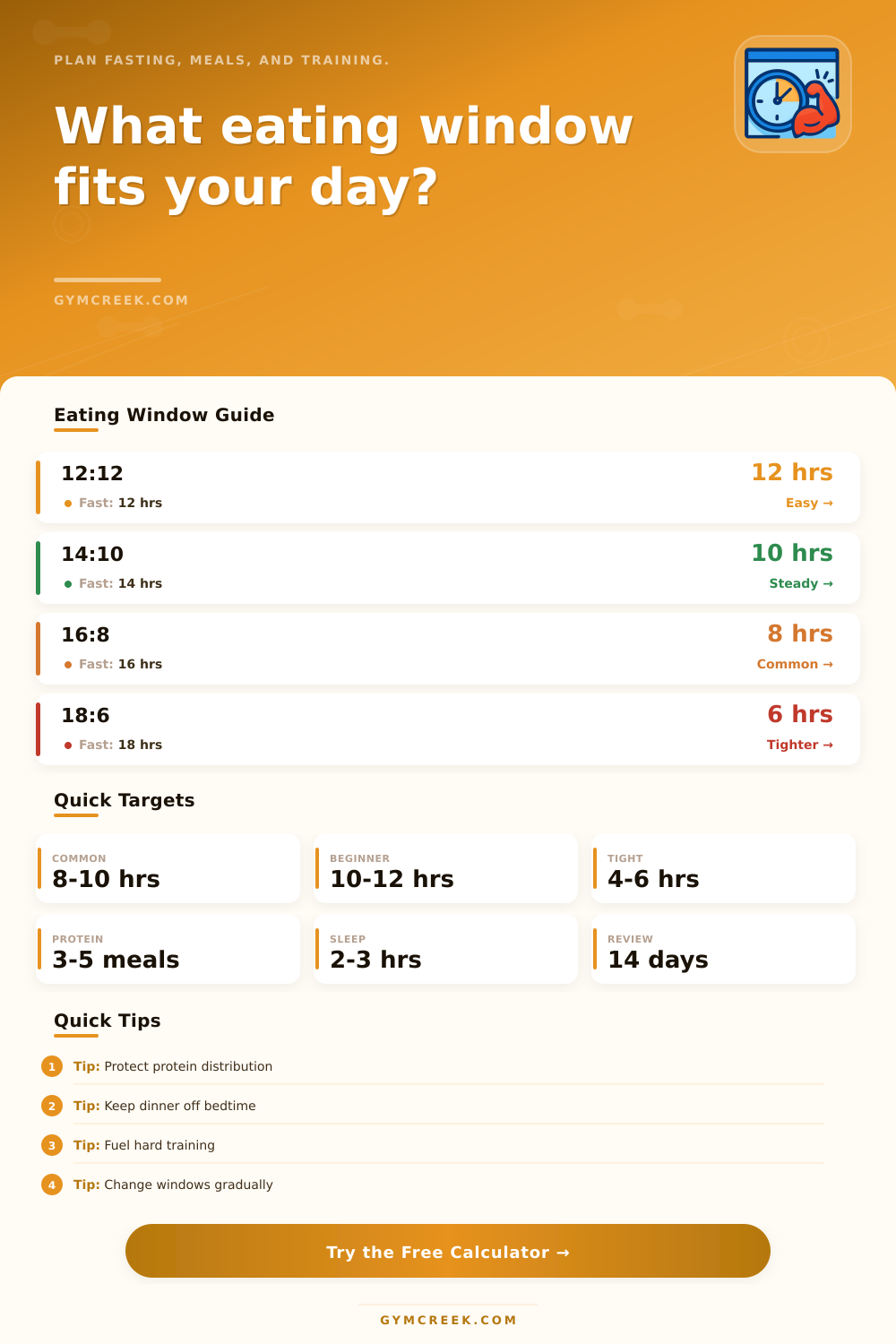
| 12:12 | 12 hours | 12 hours | Gentle starting point with broad meal flexibility |
| 14:10 | 10 hours | 14 hours | Moderate compression for routine structure |
| 16:8 | 8 hours | 16 hours | Common balance of fasting and meal distribution |
| 18:6 | 6 hours | 18 hours | Tighter window that can make protein harder to spread |
| Goal | Practical window | Meal count | Watch point |
|---|---|---|---|
| Fat loss | 6-10 hours | 2-4 meals | Keep protein and training fuel adequate |
| Recomposition | 8-12 hours | 3-5 meals | Protect protein distribution and performance |
| Maintenance | 8-12 hours | 3-5 meals | Choose consistency over a tighter window |
| Lean gain | 10-14 hours | 4-6 meals | Short windows can make calorie intake harder |
| Workout placement | Fuel fit | Recovery fit | Adjustment |
|---|---|---|---|
| Inside window | Strong | Strong | Place a meal 1-3 hours before or after |
| Just before window | Moderate | Strong | Open the window soon after training |
| Just after window | Strong | Moderate | Move last calories later if sleep buffer allows |
| Far outside window | Lower | Lower | Widen the window or move training time |
| Output | Formula | Inputs | Purpose |
|---|---|---|---|
| Eating window | Last calorie minus first calorie | First and last calorie time | Shows available feeding time |
| Fasting window | 24 hours minus eating window | Window length | Compares with fasting target |
| BMR | Mifflin-St Jeor or Katch-McArdle | Body stats and body fat | Energy context for schedule fit |
| Meal spacing | Window divided by meal gaps | Window and meal count | Protein distribution planning |
◇Tips
When you start your fast, you have the best of intentions. The internet says fasting for sixteen hours will trigger some sort of metabolic benefit, so you decide to do that. Plus, fasting during a narrow eight-hour eating window should makes a quick change to your biology, right? Wrong. You wake up and skip breakfast. You drink coffee at nine, then wolf down all your day’s calories into three hasty meal from one o’clock until seven. You get through Wednesday feeling cranky, weaker in the gym, and munching snacks every other hour due to brain fatigue.
Intermittent fasting isn’t the issue. It’s normaly a matter of poor planning. Your eating window isn’t a binary “on” or “off” switch (though most of us treat it that way). There’s more complexity to fitting food around a busy day. Actual hunger cues. Sleep schedules. Protein distribution. You must also consider when you work out. What time you eat has nothing to do with any one thing, but everything to do with all of them.
How to Plan Your Fasting Schedule
That’s what the tool above lets you map: how your body deals with fuel at certain moments in relation to your workouts and rest periods. And then the calculator does the math for you to tell whether or not your plan is plausible, before you get hangry and go through with it.
Second: consider protein. Want to lose fat but maintain muscle? You’ll need a certain total amount of protein each day. And you have to do it throughout the day (in multiple meals). It’s better to spread out the same total protein intake then to slam all of it at once during dinner. As you narrow down your window, spreading out protein becomes more difficult as shown by reference table on the page. If you shorten your eating window to about 4 hours, you might have to eat an uncomfortable 60 grams of protein in each of your three or four meals. You can quickly visualize this tradeoff using the calculator: it divides your window into your meal count.
The other frequent mistake is training at the wrong time. For example, someone might find it “disciplined” to train fasted first thing in the morning at 7 AM, but then not open their eating window until noon. This means that they’re exercising on an empty stomach way too long, which isn’t good for either recovery or performance. The tool lets you see how your workouts fit with respect to your food intake. So say you do your weight-lifting session at six PM, and close your eating window at five. You’re fasting during your body’s largest stressor of the day. That is a recipe for burning out. In this case, perhaps you’d want to move your last meal later into the evening. You could also try opening your eating window sooner, even though it goes against your instinct to skip breakfast.
Let’s talk more about sleep. Most of us don’t realize how important sleep actualy is. Blood-flow and energy are diverted toward digestion. When you chow down on a big meal within an hour of bed, your body’s putting in some work as you attempt to drift off to sleep. That interferes with good sleep, spikes up your cortisol levels, and makes it tougher to lose weight. There’s a sleep buffer in the calculator. It keeps your last-calorie intake far enough from bedtime so you have time to digest everything properly. Sounds like a small point, but this is what stops countless diets being ruined by middle-of-the-night indigestion.
No one does it perfectly. Some find they do best with a 12 hour window. Some find that 16 hours of fasting works best for them so they can get up earlier in the morning. Consistency is more important than being rigid. There are some days when I work shifts or travel where my schedule varies a bit. But using the flexibility settings helps me make changes as needed so I don’t lose everything useful while trying to fix one thing. It doesn’t matter if you hit an exact number each day, you’ll still see the benefit from it. Just pick something that fits your sleep quality, energy level and schedule.
Enter in what you do now. Then identify what’s missing. Are meals spaced too far apart? Adjust them by incorporating a snack here and there or pushing one of them earlier/later. Does training not fit? Nudge the clock times slightly. You’re not trying to suffer under some random fast. You are trying to determine a flow for your day/week/month that works with your life and feeds your body. After seeing how the parts connect, you stop making wild guesses. Instead, you make plans, stick to ’em, and begin noticing change.