Dumbbell to Barbell Conversion Calculator
Estimate the barbell load that matches your dumbbell set, then choose a conservative first barbell weight for the same movement pattern.
📌Conversion Presets
Presets load realistic dumbbell sets and conversion assumptions. Use them as quick starting points, then adjust the fields to match your own set quality.
⚙Calculator
Barbell conversion snapshot
Enter your dumbbell set to estimate a matching barbell load.
📊Fitness Metrics Comparison
📑Reference Tables
| Dumbbell Lift | Closest Barbell Lift | Typical Ratio | Reason |
|---|---|---|---|
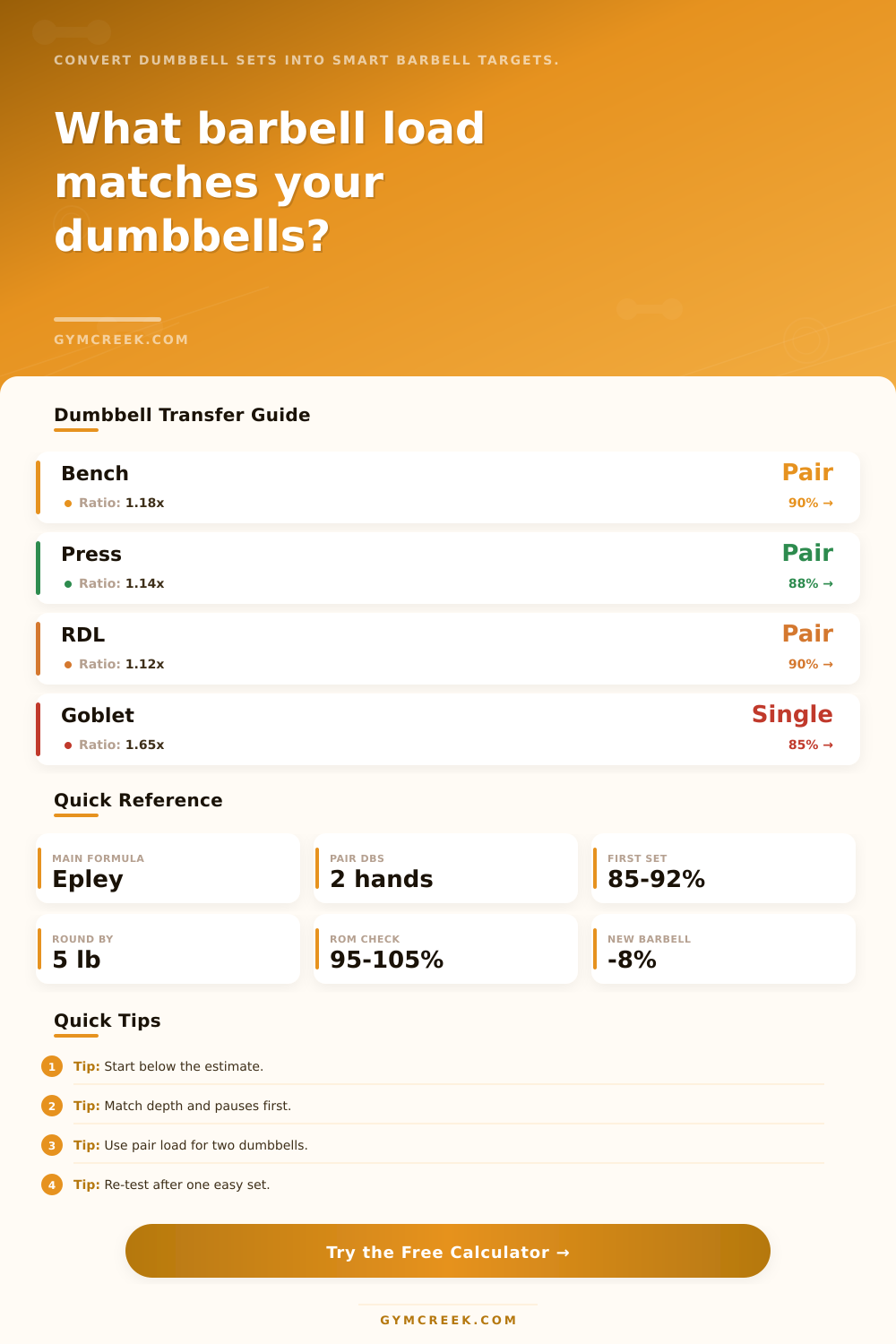
| Flat dumbbell bench | Barbell bench press | 1.10-1.25x pair load | Less stabilization on barbell |
| Incline dumbbell press | Incline barbell press | 1.08-1.20x pair load | Shoulder angle lowers transfer |
| Seated dumbbell press | Barbell overhead press | 1.08-1.18x pair load | Path changes and bracing matter |
| Dumbbell RDL | Barbell Romanian deadlift | 1.08-1.18x pair load | Bar path and grip are steadier |
| Goblet squat | Barbell back squat | 1.50-1.85x load | Back squat loads hips and legs more |
| Barbell Familiarity | First Set Factor | Use When | Adjustment |
|---|---|---|---|
| New to barbell version | 82-86% | Setup or bar path is unfamiliar | Practice before loading heavy |
| Occasional practice | 86-90% | You know the lift but lack rhythm | Leave reps in reserve |
| Comfortable setup | 90-94% | Technique is repeatable | Work closer to estimate |
| Advanced and stable | 92-96% | Skill transfer is proven | Warm up and verify speed |
| Dumbbell Pattern | Load Basis | Transfer Effect | Example |
|---|---|---|---|
| Two dumbbells together | Two-hand total | Best direct transfer | 80s bench = 160 lb pair |
| Alternating reps | Two-hand total | Slightly lower transfer | Alternating press or curl |
| One side at a time | Side doubled for comparison | Technique-specific transfer | One-arm row to barbell row |
| Single centered dumbbell | Single implement load | Depends on lower-body lift | Goblet squat to back squat |
| Formula Step | Formula | Variable | Purpose |
|---|---|---|---|
| Dumbbell 1RM | Load x (1 + reps / 30) | Adjusted reps | Estimates max from rep set |
| Transfer load | DB 1RM x lift ratio | Exercise type | Maps dumbbells to barbell |
| ROM correction | Estimate x ROM % | Range match | Penalizes short reps |
| Target reps | 1RM / (1 + reps / 30) | Barbell reps | Finds working weight |
💡Tips
To use the calculator, simply enter your current dumbbell workout result into the fields below. It will calculate everything else. You do not need to do any conversions or use coefficients and there is no guesswork needed. First it estimates your one-rep max (the maximum weight you could theoreticly lift) via the Epley formula, a common way to predict an athlete’s strength level given their reps-per-set results.
But dumbbells require much greater stability than a barbell. Especially near the bottom of the lift, you have to work hard to prevent two separate weights from sliding away from each other. This requires far more shoulder engagement. Transitioning to the barbell removes that stabilization load from your smaller muscles. It shifts straight over to your main muscles; such as triceps and pecs. That advantage allow most people to lift heavier loads when moving to the bar.
How to Use the Calculator
How much? It depends on the exercise(s) and your personal experience. Range of motion matter here as well (mentally convert it). For instance, a strict barbell press might not allow you to get as low as a dumbbell bench press does. This is especially true if you use an incline bench with wider set pins. That added length creates greater strength across a longer range of movement. If you do your dumbbell work all the way down and then move up to the bar where you just barely touch the bar right below your chest, odds are good you’ll be cautiously estimating a 1RM. So you should of compensate accordingly. To do so, you can input a range of motion match percentage to compare how deep you went with the dumbbells versus how deep you will go with the bar.
The other huge variable with changing transfer ratios has to do with stability. Did your most recent shoulder press workout feel unstable? Were they kind of all over the place? Your rotator cuffs, core, and whatnot was working hard to keep your torso upright. Take away some of that lateral instability by sitting down while you press. Now you’re able to handle more weight.
But wait, maybe you just started using the barbell variation of a movement like the Romanian deadlift. Maybe you have a ton of raw leg strength but your back positioning and grip endurance haven’t adapted yet. That’s why it’s important to start with a conservative weight. Use enough weight to trigger adaptation, but do not sacrifice your form while you are still in the initial stage of neural adaptations. Jumping right to the estimated max is an overestimation of most people’s barbell strength. Think of it as a ceiling instead of a floor.
For your initial workout, start around 90% of the estimate. If you’ve never used a barbell before, even lower it until you have grooved the movement pattern. Then load up some heavy plates. The table I put together on the page outlines common transfer ratios across different lifts. Bench press doesn’t transfer the same way squats or deadlifts do because of joint angles and use of equipment. Take those numbers as guides, not gospel.
In short, believe in what you’ve built, be patient with the mechanical shift, and trust your base. You have developed the muscle. It’s time for your nervous system to learn to fire it when exposed to a different kind of load. Stay tight to form, take it slow on that initial set. Let your form decide how many reps you do rather than letting the number decide your form. The sense of control you experienced with the dumbbells will reappear, only this time with heavier iron on the bar.