Dumbbell Shoulder Press Calculator
Estimate dumbbell shoulder press 1RM per hand, total pair strength, target working loads, training max, shoulder-to-shoulder balance, and repeatable progression benchmarks.
📌Presets
Presets load realistic dumbbell press tests for different training ages, goals, unit systems, rep ranges, and symmetry patterns.
⚙Calculator
Dumbbell shoulder press estimate
Enter a recent clean shoulder press set to estimate strength and target loads.
📊Strength Metrics
📑Reference Tables
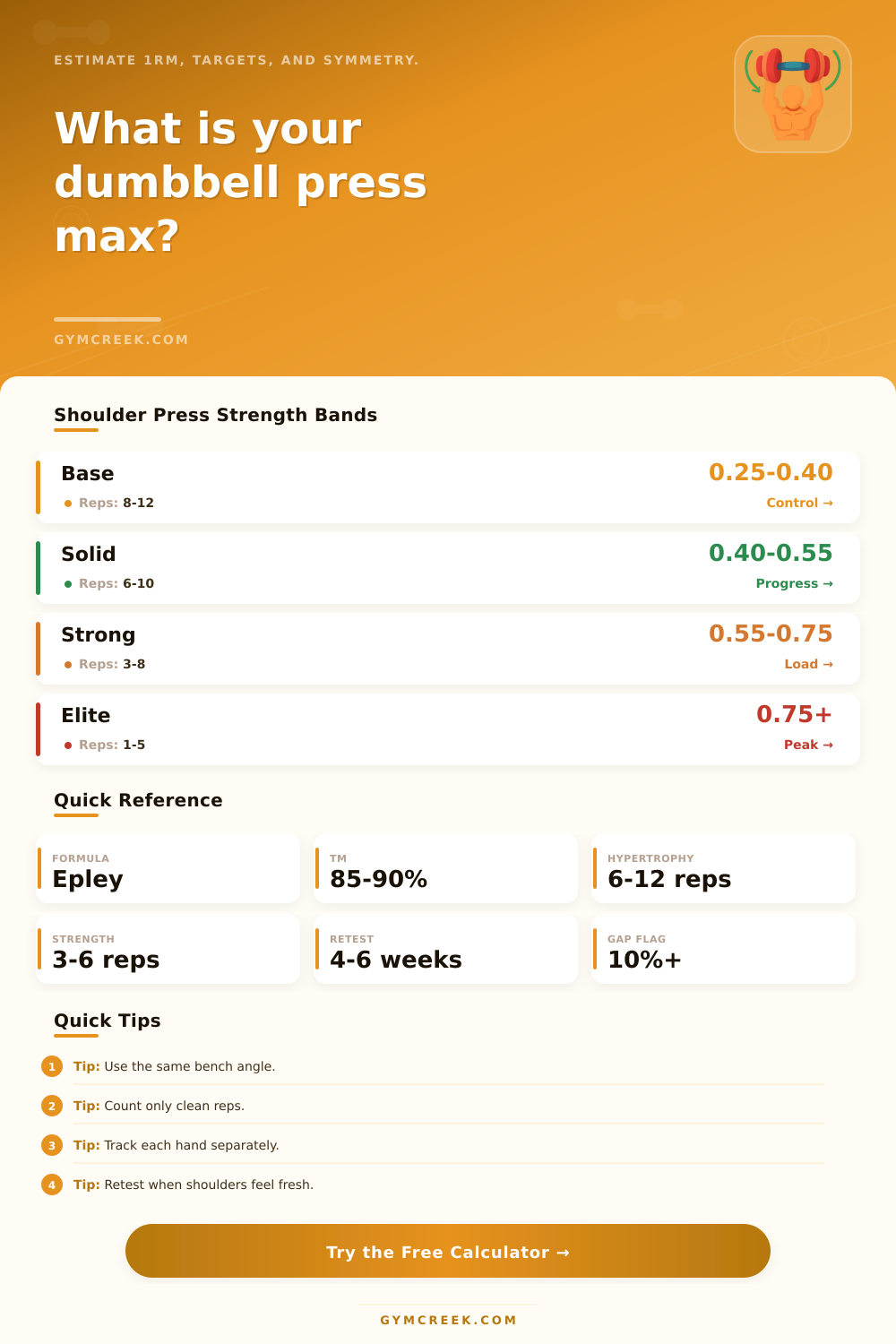
| Band | Total pair 1RM / body weight | Typical rep work | Main cue |
|---|---|---|---|
| Base | 0.25-0.40 | 8-12 controlled reps | Own the bottom position and press evenly |
| Solid | 0.40-0.55 | 6-10 hard reps | Add load after clean full-range sets |
| Strong | 0.55-0.75 | 3-8 focused reps | Keep ribs stacked and avoid back arch |
| Elite | 0.75+ | 1-5 heavy reps | Use strict setup and conservative jumps |
| Goal | Rep range | Percent of 1RM | Best use |
|---|---|---|---|
| Strength skill | 1-3 reps | 88-95% | Heavy practice when fresh |
| Max strength | 3-6 reps | 80-88% | Primary strength blocks |
| Hypertrophy | 6-12 reps | 65-80% | Most shoulder muscle work |
| Volume base | 12-20 reps | 50-65% | Technique and tolerance |
| Input | Why it matters | Higher factor means | Compare only with |
|---|---|---|---|
| Bench angle | Changes shoulder versus chest demand | More vertical pressing | Same angle |
| Range of motion | Changes strength specificity | More complete reps | Same depth |
| Tempo | Filters bounce and momentum | Cleaner force output | Same cadence |
| Stability | Captures trunk and scapular control | More repeatable estimate | Same setup |
| Formula | Variables | Output | Purpose |
|---|---|---|---|
| Epley e1RM | Load and reps | Estimated max | Primary lifting estimate |
| Brzycki e1RM | Load and reps | Estimated max | Cross-check under 10 reps |
| Lombardi e1RM | Load and reps | Estimated max | Moderate-rep comparison |
| Mifflin-St Jeor | Sex, age, height, weight | BMR | Body context only |
💡Tips
When you start to track your strength with an dumbbell shoulder press calculator, you can start to see how strong each of your arms is. A set of dumbbells at a given weight will tell you that you performed a set of shoulder press, but it will not tell you if you are strengthening your weaker side (or if that weaker side is lagging behind the other). A dumbbell shoulder press calculator will allow you to see how strong each of your arms is, and to plan your next set of pressing work based off that measurement.
To use the calculator, you must input the weight that each of your arms press and the number of repetitions that you performed with each arm. Additionally, you must note how many more repetitions that you could of performed with each arm prior to fatigue. The calculator works best with those inputs that is performed with the middle of your strength range, with the effort to perform as honest a measurement of your pressing as possible.
How to Use the Dumbbell Shoulder Press Calculator
If you performed your set with true failure, the calculator will produce an inaccurate measurement of your one-rep maximum (1RM), but if you performed your set with a few more repetition remaining in your tank, the calculator will produce a more accurate measurement. Based on the measurement of your pressing strength with each arm, the calculator will provide a measurement of the strength of your weaker side only. This is because if you used your stronger side with the calculator, the calculator would mask any differences between your shoulder’s strength.
Shoulders and scapulae dont typically develop at the same rate, so it is important to recognize when one side of your body may be lagging behind the other. If there is a gap in the pressing strength of more than ten percent between your sides, your weaker side need to be provided with more training volume than your stronger side. Some of the factors that influence the calculation of your pressing strength include the angle of your bench and your range of motion.
The angle of the bench will impact the amount of strength required of your shoulders with each pressing motion, as well as the amount of strength required of your upper chest muscle. The range of motion that you perform with each pressing motion will influence the amount of force that is exerted during that pressing motion. Additionally, the number of pressing sets that you performed in the past will also impact the force that you were able to produce during your pressing sets.
Based on the estimate of the one-rep maximum of your pressing strength, you can determine the loading of your sets. Most training sessions use repetition ranges between six and twelve for muscle growth, while strength training sessions use repetition ranges between three and six. The calculator will show the load of each set of dumbbells that you should use for your training, rounded to the nearest available dumbbell.
Thus, the calculator eliminates the need for mental math calculations while performing your pressing sets. Another use of the dumbbell shoulder press calculator is to provide a means of tracking your strength. By performing the same test every four to six weeks, you can use the calculator to determine if your training is helping your weaker side to catch up with your stronger side.
If your weaker side is gaining strength in comparison to your stronger side, your training is effective. If your weaker side continues to lag behind your other shoulder, it is important to continue to use that weaker side in your pressing sets to ensure that each of your shoulders is performing the same ranges of motion. In addition to providing a measurement of your pressing strength relative to the other shoulder, the calculator will also provide you with a measurement of your strength-to-weight ratio.
This measurement will provide information regarding your absolute strength and how it compares to your body weight. Additionally, your strength-to-weight ratio will allow you to compare your pressing strength relative to the other lift that you have performed with your body. Should your pressing strength ratio be lower than the rest of your lifts’ ratios, your shoulders may be lagging behind the remainder of your upper body.
Reference tables are included near the calculator that will provide information regarding your strength-to-weight ratio. These tables will include information regarding the different strength ratios of lifter of all levels, and how many repetitions of pressing that lifters can typically perform with their sets. A base strength lifter will be learning pressing techniques of even pressing with both arms at the same time, while a strong upper body lifter will be focusing on maintaining their ribs in a stacked position.
These tables are not rules that must be followed with your pressing sets, but they do provide reference points for your pressing strength. Following the same logic as the remaining calculations of the calculator, your training maximum will likely not be set to 100% of your calculated one-rep maximum. Most training will occur somewhere in the 85% to 90% range of your one-rep maximum.
The calculator will calculate the percentage of your estimated one-rep maximum, and round that number to the nearest available pair of dumbbells. Using this percentage allows for a conservative calculation of your pressing strength, which is best for ensuring that you can make the steady progress that you desire. In addition to the variables included in the calculator, the total volume of your pressing sets is also important to your training program.
The number of sets, the weight of the load, and the number of repetitions that you can perform will allow you to determine the total volume of pressing sets that you are performing each week. Too little volume may cause your pressing strength to plateau, while too much volume without adequate recovery will lead to exhaustion of your pressing muscles. The number that is provided from the calculator is not a prescription for the amount of sets that you should perform each week, but it does provide a figure against which you can compare the feeling of your different joint.
Some of the most common mistakes with dumbbell shoulder pressing include performing pressing sets after performing heavy pressing sets on your chest muscles. In addition, some individuals change the angle of their bench set each week. Additionally, some individuals focus on their stronger side with each pressing set.
These mistakes will show up in the calculator in that pressing sets will be different in strength between the two shoulders. However, the calculator allows you to input the same information to view the changes in each set over time. One of the most important aspects of using this calculator is to ensure that each set of pressing is performed under the same conditions.
Regardless of how strong each of your arms are, the pressing sets should be performed under the same angle on the bench, to the same depth in the standing position, and at the same level of strength and freshness in your pressing muscles. Each pressing set should be recorded, the calculator will calculate the numbers, and the results can be compared with your other pressing sets. Over time, the calculator will allow you to recognize whether your pressing sets are beginning to even out between the two shoulders.
The primary benefit of the dumbbell shoulder press calculator is that it allows you to enter the gym with a chosen weight and a training plan. The mathematics of the calculator removes the guesswork in determining your pressing strength with the dumbbells. Additionally, the mathematics of the calculator provide you with a training plan with your pressing goal in mind.
Thus, the calculator allows you to make decisions regarding your pressing sets and training, but it provides the data necessary to make those decision.