Drop Set Calculator
Plan hypertrophy drop sets with load steps, rep targets, RIR drift, fatigue cost, density, and total training volume.
📌Drop Set Presets
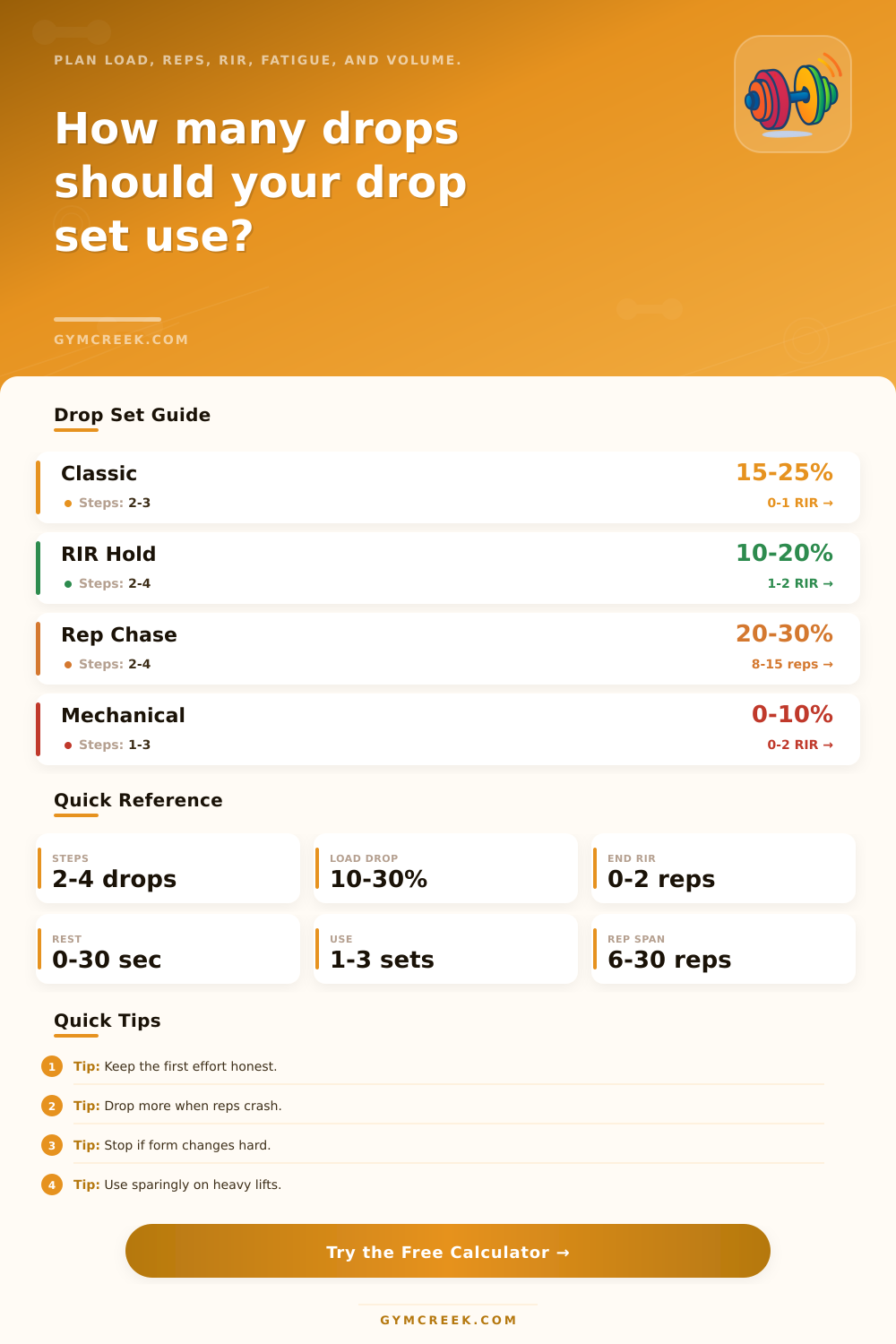
Presets model different hypertrophy uses: pump work, high-rep isolation, machine backoff sets, RIR-preserving drops, rep-chase drops, and mechanical advantage changes.
⚙Calculator
Drop set snapshot
Enter a starting load, drop strategy, step count, reps, RIR, and rest to plan the sequence.
| Step | Load | Target Reps | RIR | Volume |
|---|---|---|---|---|
| --- | --- | --- | --- | --- |
📊Drop Set Metrics Grid
📑Reference Tables
| Strategy | Best Use | Typical Drop | Fatigue Cost |
|---|---|---|---|
| Classic percent drop | Simple machine or dumbbell hypertrophy | 15-25% each step | Moderate to high |
| Fixed plate drop | Selectorized stacks and barbells | One usable jump | Moderate |
| RIR preserving drop | Keep quality reps across steps | 10-25% as needed | Moderate |
| Rep target chase | Hold a rep zone after fatigue rises | 20-35% if reps crash | High |
| Mechanical advantage drop | Change angle, grip, or assistance | 0-10% plus easier setup | Moderate |
| Exercise Type | Drop Set Fit | Useful Rep Range | Safety Note |
|---|---|---|---|
| Machine press | Strong fit for chest volume | 8-20 reps | Keep shoulders set |
| Leg press | Strong fit for quad volume | 10-30 reps | Avoid depth changes |
| Cable row | Good fit for back density | 8-20 reps | Hold torso position |
| Lateral raise | Excellent isolation option | 12-30 reps | Stop swing reps |
| Hack squat | High stimulus but costly | 6-15 reps | Use fewer drops |
| Finish RIR | Training Signal | Best Placement | Recovery Demand |
|---|---|---|---|
| 3-4 RIR | Technique and pump | Warm-up bridge | Low |
| 1-2 RIR | Hypertrophy quality | Main accessory | Moderate |
| 0 RIR | High effort finisher | Last set only | High |
| Failure every step | Maximum fatigue | Rarely needed | Very high |
| Sequence Size | Common Setup | Best Match | Volume Guardrail |
|---|---|---|---|
| 1 drop | First effort plus backoff | Heavy compounds | 1-3 extended sets |
| 2 drops | Three total efforts | Balanced hypertrophy | 1-2 extended sets |
| 3-4 drops | Long pump sequence | Machines or isolation | Usually 1 set |
| 5-6 drops | Strip-set finisher | Advanced, low risk lifts | Use sparingly |
💡Tips
A drop set is a training method that requires an individual to perform a set of repetitions with a given weight, then reduce the weight and perform more repetitions. The process of dropping the weight and perform more repetitions without taking a break is repeated until the desired amount of repetitions is performed. Individuals often use Drop sets as a way to perform more muscle-building stimulus in a shorter period of time.
However, drop sets can be misused if the weight an individual drops isnt managed correct. If the weights that are dropped are too low, an individual may not be effectively performing the required number of repetitions to create benefits to those muscle. If the weights that are dropped are too high, an individual may not have enough time to perform the required amount of repetitions.
How to Plan and Use Drop Sets
The drop set calculator require an individual to input several pieces of specific data regarding the desired drop set. An individual must input their starting weight, the size of the weight reduction, the number of weight reduction desired, and the target Reps in Reserve (RIR). An individual’s starting RIR will help to determine the effort to be placed into the first set of a drop set.
An individual’s final RIR will help to determine the effort to be placed into the last set of a drop set. The amount of rest to be taken between weight reductions must also be selected, as this will have an impact upon the density of that drop set. Higher densities indicate shorter rests, and drops sets with less rest will create more fatigue to the body.
Many individuals mistakenly use drop sets as an unplanned addition to their workouts. An individual’s fatigue from performing drop sets may negative impact the remainder of their workout or that individual’s training for that week. To combat this issue, the drop set calculator also includes the frequency selector to allow an individual to track the number of times that they performs these movements.
For instance, performing three drop sets on a leg press exercise twice a week will create more fatigue in the body then performing three sets of the same exercise twice a week. Therefore, an individual must manage the frequency with which drop sets are performed such that the fatigue created by those sets does not prevent the body from recovering from those sets. The tables that are provided within the tool can explain which drop set strategies are appropriate for different types of exercises.
For example, a mechanical drop set is effective for exercises like triceps extensions, where an individual changes his or her body position to make the exercise more easy. A fixed plate drop set is effective for exercises like cable rows, where the individual moves the weight in increments. Finally, the tables also explain the relationship between the final RIR (ratio of reps performed to reps possible) and recovery.
For instance, if an individual sets the final RIR to zero, the individual will perform the exercise until total failure, which will require more recovery time than other RIR values. An individual must consider a few different factors prior to determining whether a drop set should be included in the workout that is performed. For example, how an individual sleeps, how he or she eats, and how strenuous the lift performed in the most recent workouts can all impact the fatigue that is created from performing drop sets.
While the drop set calculator can help an individual to determine the possible benefits of including drop sets in his or her workouts, the calculator does not account for how an individual feel on a given day. Thus, an individual must decide if the benefits of performing drop sets justifies the fatigue that they can create for the body. While drop sets may be able to replace several sets with the same muscle group for some individuals, other individuals may find that they can better recover from their workouts if they only include drop sets for isolation movements of the muscle.
An individual should decide the purpose of the drop sets prior to beginning to perform the exercise that incorporates those sets. For example, if the purpose of the drop sets is to increase the pump of a muscle, the individual should reduce the weight for each drop set to mid-range levels, and the final RIR should be set to a value of one or two. In contrast, if the purpose of the drop sets is to increase the total volume of the exercise performed with a muscle group, the individual should create more aggressive drop sets to accomplish this goal.
It is also important for an individual to ensure that the inclusion of drop sets makes sense as part of the total workout session. Additionally, an individual should review the drop set strategy every few weeks to adjust the strategy according to how the body is recovering from the workouts. For example, if an individual finds a strategy to be too difficult to incorporate into the workout, the intensity of the exercise should be reduced, and if the strategy is too easy, the intensity should be increased to ensure that the body is recovering apropriately from the sets.