Drop Jump Contact Time Calculator
Estimate jump height, reactive strength index, contact quality, and next drop height from contact time and flight time.
📌Presets
Each preset loads a realistic contact-time and flight-time profile, then recalculates RSI and drop height guidance.
⚙Calculator
Drop jump snapshot
Enter contact time and flight time to calculate reactive output.
📊Reactive Metrics
📑Reference Tables
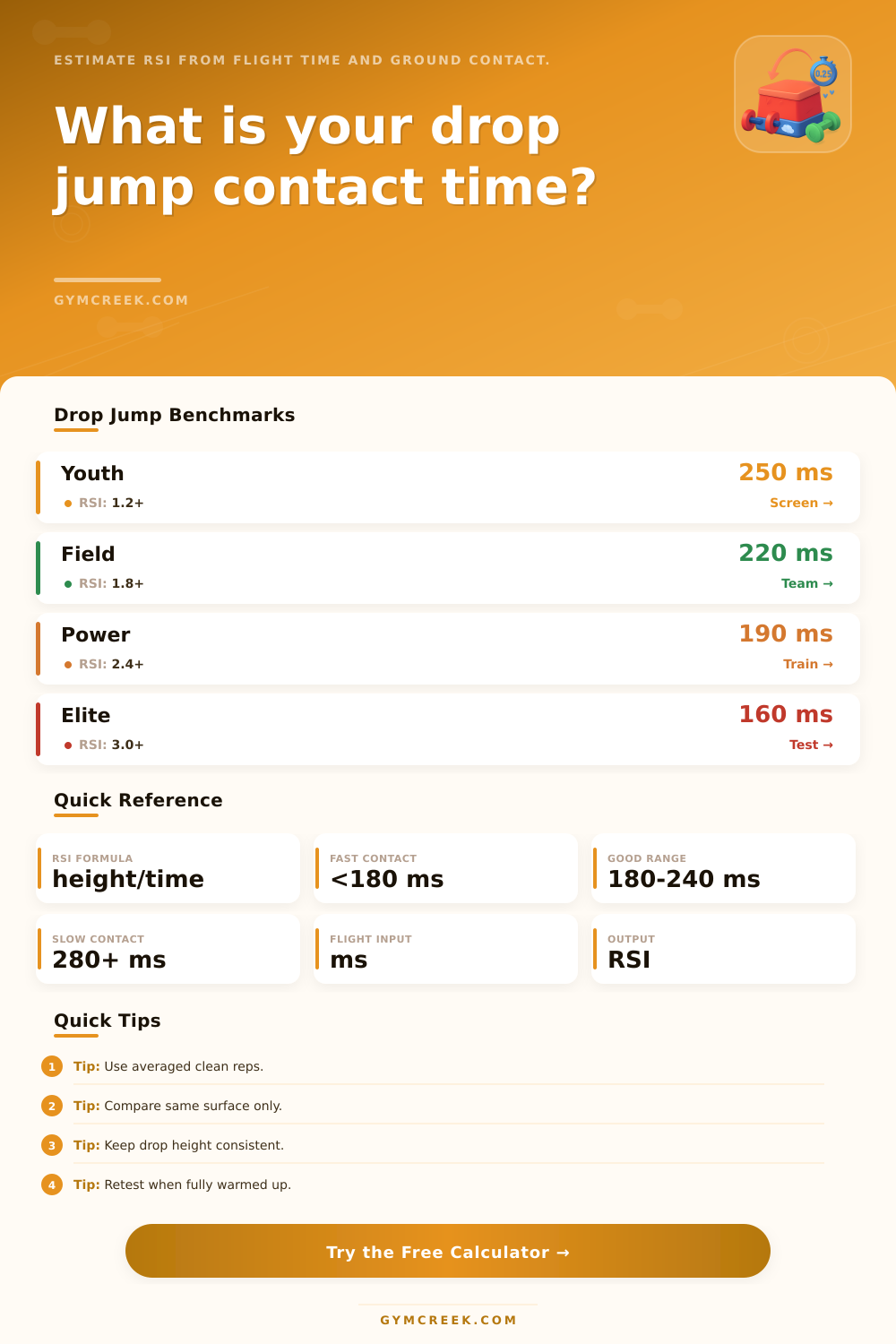
| Athlete Level | Contact Target | RSI Target | Interpretation |
|---|---|---|---|
| Youth or beginner | 240-300 ms | 1.0-1.5 | Build landing skill first |
| Developing athlete | 220-260 ms | 1.4-2.0 | Useful team screening range |
| Field sport athlete | 180-230 ms | 1.8-2.6 | Good rebound quality |
| Advanced power athlete | 160-210 ms | 2.4-3.2 | Strong elastic response |
| Elite reactive athlete | 130-180 ms | 3.0+ | Very fast ground exchange |
| Drop Height | Best Fit | Contact Goal | Watch For |
|---|---|---|---|
| 6-12 in / 15-30 cm | Beginners, rehab checks | Controlled contacts | Landing stiffness and symmetry |
| 12-18 in / 30-45 cm | Most team testing | Fast but stable rebound | Consistent foot placement |
| 18-24 in / 45-60 cm | Power athletes | High RSI without collapse | Contact time drifting upward |
| 24-30 in / 60-75 cm | Advanced testing only | Maintain short contact | Excessive knee bend |
| Timing Method | Confidence | Adjustment | Best Use |
|---|---|---|---|
| Force plate | Very high | 0% | Primary testing and research |
| Contact mat | High | 2% | Team testing sessions |
| Timing gates | Medium | 3% | Field testing with setup control |
| Phone video | Medium-low | 6% | Consistent coaching review |
| Manual estimate | Low | 10% | Rough session notes only |
| Result Signal | Contact Time | RSI Pattern | Next Step |
|---|---|---|---|
| Progress | Below target | At or above target | Add a small drop height |
| Hold | Near target | Near benchmark | Repeat the same box height |
| Reduce | Too long | Below benchmark | Lower the drop height |
| Retest | Inconsistent | Large rep spread | Average more clean trials |
💡Tips
A second after you take off, you hit the ground, drop off your box and, boom! (you’re in the air). In this split-second transfer lies reason for speed, as well as injury potential, if you don’t get the physics right. Many times the dividing line between recreational jogger and elite sprinter have more to do with how stiff their legs can be without snapping in two. It is a fine line to walk and you must measure it carefully if you want to up your game safely.
Height is the easiest to see, so most coaches start there. That said, simply knowing how tall someone can jump tell you absolutely nothing regarding there efficiency. You might be able to jump really high while sinking down low into your knee joint and spending half a second pushing yourself back up off floor. This actualy works against the intent of a reactive strength test. A drop jump isn’t merely about how high you go; it’s also about speed of action. Ideally, you want to lightly touch the floor and then get off it. You should of do this before momentum has enough time to turn into tissue stress. Contact time is far and away more important then straight-up vertical distance during this test.
What Is Reactive Strength?
So now you understand what these numbers mean. Contact time is how fast your nervous system recruit this force. And flight time is how much force you produced relative to gravity. If you plug these into the calculator above it will do the math for you, but knowing what they mean will alter how you train. RSI stands for Reactive Strength Index. What does that mean? It’s a high number if you are both fast and powerful at the same time. That’s what athletes want when they need to be able to sprint faster or change directions quicker. It differentiates between someone with just muscle and someone that can use it instanly.
Each number, however, changes context. Dropping from six inches require a stiffer leg than dropping from twenty-four because force of impact is proportional to height. When it’s too much too fast, your body doesn’t fail you, it does what it must in order to protect itself: increase contact time to cushion the impact. That’s why it’s important to look at reference table on the page where they match expected benchmarks with athletes and their corresponding safe drop heights. You can understand whether your slow contact time is really a smart bodily response to avoid danger instead of just being weak.
The floor also plays a bigger role than we all acknowledge. You’ll get nice clean numbers when tested on force plate. However, test it on a hardwood gym floor or artificial turf and now you’re adding variables which will either soften or harden the impact. Softer surfaces can result in an artificially high contact time. The ground absorbs some of the energy that your legs is supposed to reflect back into the system. If you’re going to use this as a way to monitor progress over the course of several months, consistency in testing environment are required. You can’t go from a number on a padded mat and compare it to a number on a concrete floor and hope for truth.
These metrics warp with fatigue as well, and faster than anything else. Regardless of how strong you actually are, if you’re tired your contact time will increases. In this way, they measure readiness just as well as they measure peak performance. Any dramatic spike in contact time during practice is usually an indication that your nervous system has been cooked and adding more volume will result in nothing but junk reps or injury. It’ll save you weeks of rehab later on if you listen to that signal.
But there’s another wrinkle: Arm swing matters. A lot. The faster your arms move, the more upward pushing force is generated, not by the legs, but rather from arm action. Letting them go free will give you more time in the air and appear to improve your RSI performance. But it obscures how reactive your lower limbs truly are. Hands-on-hips isolation forces the legs to do all the work and offers a truer look into muscle activity. It is awkward for a few minutes, then you get honest feedback applicable to sport-specific actions in which fast-twitch leg activity drive success.
Don’t confuse this training for reactive strength with being able to jump higher each day. Reactive strength is controlling how hard you stretch and how quickly you shorten during the stretch-and-shorten process. Keep contact times short. Move fast. Start low and gradually build height as you learn to stiffen your legs enough to allow rapid turnover. Step down if the contact time lingers. Rushing the progression will lead to shin splints and Achilles problems. Patience helps avoid those issues.
The little dance we do with gravity becomes second nature and carries into everything else. It makes moving around in space feel effortless. You stop fearing falling down because you know that your legs will take care of you. This gives you big-time power when those danger spots occur. You complete one clean rep after another.