Drafting Energy Savings Calculator
Estimate how much effort, power, and fuel a draft can save during cycling, running, skating, or wheelchair racing at a chosen speed and distance.
📌Presets
Presets load realistic endurance drafting scenarios and calculate the saved watts, calories, effort percentage, and same-effort time effect.
⚙Calculator
Drafting energy snapshot
Enter your activity, speed, distance, wind, and draft position to estimate energy savings.
📊Fitness Metrics Comparison Grid
📑Reference Tables
| Draft Setup | Typical Drag Reduction | Best Match | Reliability |
|---|---|---|---|
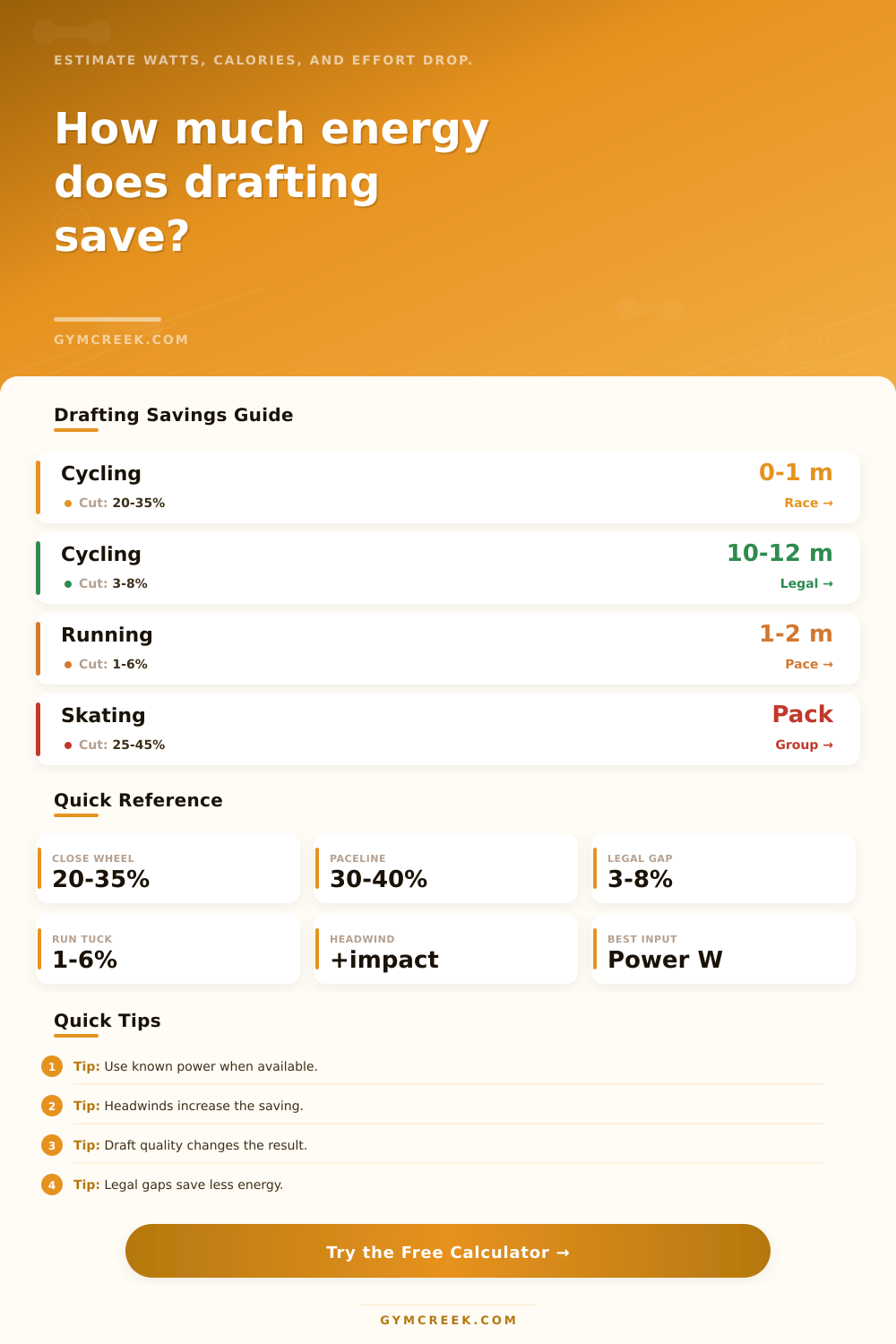
| Legal long gap | 3-8% | Triathlon spacing | Low but useful |
| Loose group | 8-15% | Casual group rides | Moderate |
| One meter behind | 18-25% | Road race wheel | High if steady |
| Tight wheel | 25-35% | Skilled road drafting | High risk |
| Paceline | 30-40% | Rotating pulls | Very high |
| Large pack | 35-50% | Peloton shelter | Variable |
| Activity | Main Solo Load | Draft Benefit | Formula Focus |
|---|---|---|---|
| Road cycling | Aero drag above speed | Large | CdA and air speed |
| Running | Body mass over distance | Small to moderate | Aero share only |
| Inline skating | Aero plus rolling | Large in packs | Draft and Crr |
| Wheelchair racing | Aero plus rolling | Meaningful | CdA and rolling |
| Climbing | Gravity | Reduced | Grade dilution |
| Scenario | Speed | Draft Cut | Expected Result |
|---|---|---|---|
| Club wheel | 20-24 mph | 20-30% | Clear watt drop |
| Legal gap | 22-28 mph | 3-8% | Small saving |
| Runner pacer | 10-14 mph | 1-6% | Small energy aid |
| Inline pack | 18-25 mph | 25-45% | Large shelter |
| Headwind group | Any fast pace | Higher effect | More valuable |
| Formula | Variables | Output | Use |
|---|---|---|---|
| Aero power | 0.5 x rho x CdA x v air cubed | Watts | Drag load |
| Rolling power | Crr x mass x g x speed | Watts | Wheel load |
| Grade power | mass x g x grade x speed | Watts | Climbing load |
| Saved watts | aero watts x draft cut | Watts | Draft benefit |
| Saved kcal | work / efficiency | Calories | Fuel spared |
💡Tips
The power meter goes down, but speed doesn’t change, so your legs feels lighter and you’re borrowing some air space from guy in front of you. It feels like cheating because it is, in a way. It’s like removing air resistance which normally slows you down allowing you to cut it out and turn an ordeal into a doable thing.
The thing most athlete forget is the price you pay to move through the air: The faster you go, the harder you has to work. Air drag increases with square of speed; you have to apply four times the force to simply push air out of the way if you double your speed. Because of this relationship, drafting becomes more important at twenty-five miles per hour then at ten.
How Drafting Helps You Save Energy
By entering in raw weight and speed numbers, the calculator takes care of fluid dynamics, and converts those figures into real-world watts saved. There’s no need to memorize drag coefficient equations; you only need to know that space behind someone else gets more valuable as your speed increase.
Truth is, nothing in real life ever lines up with what happens in the lab (though, there are some inputs that demand an honest assessment of yourself). Air density does have a lot to do with it (wind), but so does frontal area; similarly, gravity and rolling resistance has a lot to do with it (body weight), but so does size of your body (height and torso position alters how much of your surface area comes into contact with the breeze). To account for all this, tool estimates what it would take for each person to ride alone at their own pace then applies a reduction factor based off their group placement.
A tight wheel will save much more energy than a loose gap enough to make or break you during the final climb. At ten miles per hour, air resistance doesn’t play such a small part (your speed is lower), so the running discount’s only about as big as it would of if you were walking rather than running. But that one percent of savings can add up over a marathon distance. When your tank’s run dry in those last few miles, it means saved glycogen stores.
Somewhere in between are activities with wheels, like inline skating and wheelchair racing. These has less rolling resistance because of the wheels, but they require high speeds. This breaks out by activity type in reference tables on the page, showing for each what the biggest return on investment from drafting looks like.
That said, don’t count on having a perfectly sheltered ride if the guy in front is weaving a bit. Cross winds, swerves, and surges destroys the protective bubble. If the lead bike rocks side-to-side (which most do), you’ll be blasted by full drag every other second. That’s why we have a quality adjustment included in our calculator.
If it gets chaotic out there (or at least bumpy) knock down that percentage to keep your estimate real as opposed to optimistic. A lot of people over-estimate their cost-savings since they’re assuming ideal conditions which never actualy happen on a busy road.
Your relative air speed soars in headwinds, dramatically multiplying their benefit: What feels like riding at twenty miles per hour into a twenty-mph headwind actualy feels more like you’re pedaling through forty-miles-per-hour winds. Drafting is not merely efficient but essential for survival; tailwinds diminish its value because the wind’s already blowing with you. When nature opposes you, the physics favor shelter.
But when you climb it shifts the equation again. Aerodynamics drop out of the discussion as gravity decides the power required on steeper grades. Lifting your bodyweight against gravity overwhelms the small benefit gained by drafting uphill. The tool accounts for grade so that you don’t anticipate magical saving on mountain stages; air drag pales in importance to getting yourself over the hill.
That’s primarily where it comes into play; on flatter terrain and gentle rolling hills where you can maintain consistent speed. That leads into use of those insights in terms of smart pacing. When it’s flat out or the wind starts biting, you save your energy early on so you have it available for the times when drafting isn’t possible (steep climbing, surprise attacks), etc. This doesn’t mean riding slowly. It means riding smarter, saving your limited calories for what matters most. By the time you cross the finish line, your legs should of been spinning easily.
The next time you go on a group ride, try it. Look for that sweet spot just behind someone else’s wheel. Trust the physics. Let your body feel the resistance slip away. When the air gets thin and the miles begin to pile up, your lungs will thank you.