Downhill Running Pace Calculator
Estimate downhill pace, finish time, flat-equivalent effort, time gain, braking load, and pacing risk from flat pace, descent grade, surface, technicality, fatigue, and runner confidence.
📌Downhill Run Presets
Presets fill realistic descent profiles. Use them to compare smooth downhill speed, technical trail slowdown, eccentric braking load, and fatigue-sensitive pacing.
⚙Downhill Pace Inputs
Downhill-adjusted pace
Enter a flat pace, descent profile, footing, fatigue, and confidence to estimate a practical downhill pace.
📊Descent Metrics
📋Calculation Tables
| Factor | Input | Effect | How to read it |
|---|
| Grade | Typical feel | Pace behavior | Control cue |
|---|---|---|---|
| 1-3% | Gentle help | Often faster | Relax shoulders |
| 4-6% | Quick descent | Fast if smooth | Shorter contacts |
| 7-10% | Braking begins | Depends on skill | Cadence first |
| 10-15% | High load | May slow down | Control stride |
| 15%+ | Technical stress | Usually slower | Protect form |
| Condition | Speed help | Brake load | Best use |
|---|---|---|---|
| Dry road | High | Low-med | Race pacing |
| Packed gravel | Moderate | Medium | Training descents |
| Smooth trail | Variable | Medium | Effort practice |
| Technical trail | Low | High | Skill control |
| Wet or loose | Low | High | Cautious pacing |
| Piece | Formula idea | Why it matters | Output |
|---|
💡Downhill Running Tips
The downhill portion on any run are distinct; it’s not like any other part of the training loop or race. You’re trying to move quicker while having less control, with gravity pushing you down and earth forcing up against your knees and quads. For most runners, downhill mean free speed. For those who finish strong, downhill running is a calculation that starts the moment their foot leave the hilltop. But how much of that pull can you apply?
If the road is clean and has a gentle grade, your stride will open up. You will have little need for further braking. Your effort will stay near what you would maintain on the flats. As soon as surface gets rougher or the incline steeper, however, advantage dissapears quickly. You begin to absorb force rather than convert it, and despite seeing a faster split on your watch, the effort creep upward again.
How to Run Down Hills Safely and Well
To do the math for you, simply plug your expected flat pace, the grade you can sustain, and length of descent into calculator above. Most folks don’t think about this, but surface also makes a difference. While loose rock or wet trail make what was an easy roll down the hill into a perpetual sequence of microrrections, the correction each one take is a bit more energy in quad muscles, which get loaded with eccentric load.
But fatigue alter things as well. When fatigued, feet cannot make quick placements or keep the braking light. What seemed like a runnable section at the start become more like falling while trying to control it. The inputs for confidence and fatigue allow the tool to alter estimate, rather than requiring you to guess how much more a tired runner has to pay.
The result also depend on skill and intent. A mountain goat can coast downhill on steeper slope where a recreational runner must brake hard. In a race situation you’re willing to take more load for a limited time; when descending during training you want to be more cautious with your legs to protect them for what comes after. That tool packages up all these factor and returns the answer based off the real-world conditions you provided instead of an averaged score for every runner out there.
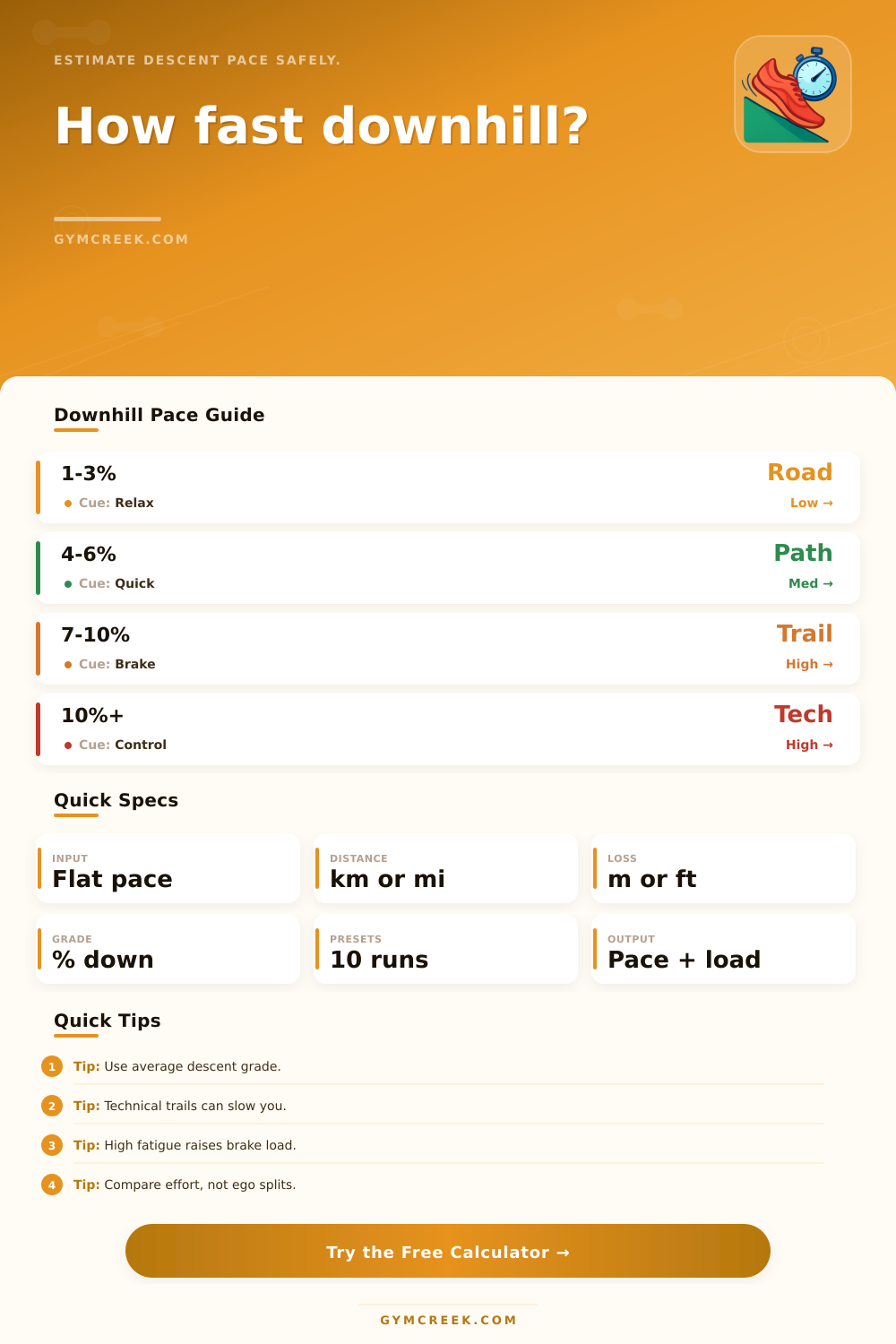
Those are reference tables on page. There are no rules, just a fast feel for what’s usually expected from the trade-offs between grade, surface, and technicality. Does your intended pace fall within a reasonable range or is it pushing your legs to do more then they can maintain? Try various views, such as being careful versus racing, to compare how much a given descent change based on your decision to go all in trying to get down there quickly or protecting the legs.
How it actualy feels beneath your feet on that day cannot be expressed in numbers. A few factors like heat, wind, or not running down hills much lately can shift the outcome. But plugging the inputs into the calculator helps you find the right number better than just hoping gravity will save you.
You’re not looking for fastest possible split on that stretch. You’re looking to finish it so you still have something left to continue moving well when terrain flattens back out.