Double Progression Calculator
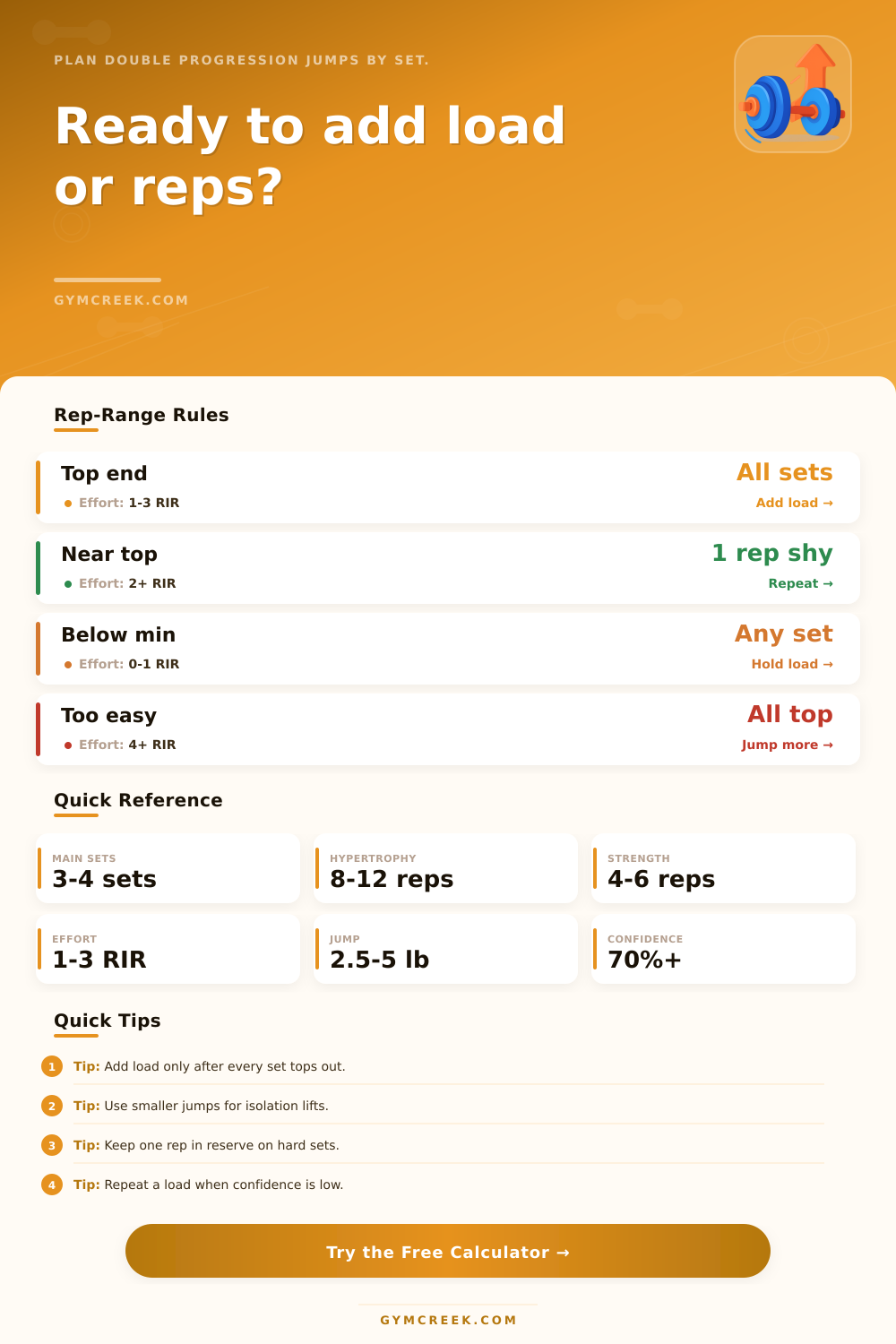
Plan when to add reps, when to repeat the same load, and when a full rep-range completion earns the next weight jump.
📌Double Progression Presets
Each preset fills a real rep-range situation with load, set count, current reps, effort, confidence, and exercise type.
⚙Rep-Range Planner
Progression snapshot
Enter your sets to decide whether the next workout should add load, add reps, or repeat.
📊Fitness Metrics Comparison
📑Reference Tables
| Status | Set Pattern | Effort Check | Next Session |
|---|---|---|---|
| Progress | Every set reaches the ceiling | Usually 1-3 RIR or RPE 7-9 | Add the planned jump and return near the floor |
| Repeat | One or two reps short of the ceiling | Technique is stable with 1+ RIR | Use the same load and chase the missing reps |
| Rebuild | Any set falls below the floor | Effort is high or bar speed drops early | Hold load, reduce set targets, or use more rest |
| Overshoot | All sets pass the ceiling easily | 4+ RIR or RPE below 7 | Consider a larger jump only on stable exercises |
| Exercise Type | Common Range | Typical Jump | Progression Note |
|---|---|---|---|
| Upper compound | 6-10 or 8-12 | 2.5-5 lb | Bench and press usually need smaller jumps |
| Lower compound | 5-8 or 6-10 | 5-10 lb | Squat and deadlift can jump more when technique holds |
| Isolation lift | 10-15 or 12-20 | 1-5 lb | Keep form strict before increasing weight |
| Machine or cable | 8-15 or 10-20 | 5-10 lb | Stack jumps may be coarse, so repeat more often |
| Bodyweight plus load | 4-8 or 6-10 | 2.5-5 lb | Bodyweight changes affect the real external demand |
| Rep Range | Main Use | Load Feel | Good Double Progression Rule |
|---|---|---|---|
| 3-5 | Max strength practice | Heavy and skill-limited | Add load only when all sets are clean and fast |
| 5-8 | Strength with volume | Heavy but repeatable | Progress after the ceiling is hit without grinding |
| 8-12 | General hypertrophy | Moderate and measurable | The classic add-reps-then-load range |
| 12-20 | Isolation or joint-friendly work | Lighter and fatigue-driven | Use smaller jumps and protect technique quality |
| RPE | Approx RIR | Progression Signal | Use In This Calculator |
|---|---|---|---|
| 6-7 | 3-4 reps left | Load may be too easy if reps are topped | Raises readiness when reps are complete |
| 8 | About 2 reps left | Strong target for most working sets | Supports a normal planned jump |
| 9 | About 1 rep left | Acceptable near the end of a hard block | Allows progress only when reps are complete |
| 10 | No reps left | Max effort or failure | Adds caution even when reps are high |
💡Progression Tips
Double progression is a method of weight training. However, double progression is a method that many people dont uses. Many people perform a few sets of the exercises that they have chosen to train with.
However, people do not know whether they should increase the weight that they are using or whether they should continue with the same weight. If the individual decide to guess at the required weight for the sets that they will perform with, they may stall there training, or they may find that they cannot perform the sets as they may fall out of there required repetition ranges for that specific exercise. The concept of double progression allows an individual to read the data from there training to allow them to decide whether or not they should increase the weight that they are training with.
Double Progression: When to Increase Your Weights
The concept of double progression is very simple. The concept of double progression involve using a specific repetition range for the exercises that you are performing. You must determine the repetition range that best match your training goals.
You will have to train with the same load of weights until you have reached the top of the repetition range for that exercise. Only after you have performed all of your working sets until you have reached the top of the repetition range will you begin to increase the weight that you are training with. This method allows for you to earn the increase in the weight that you are training with and prevents you from increasing the weight based off how you are feel during training.
This specific training method can become difficult for individuals because it is possible for some of your sets to reach the top of the repetition range while others does not reach the top of the repetition range for that exercise. In this case, you will have to take a close look at the differences between each of your sets to determine whether or not you should increase the weight with which you are training. A calculator can assist you with your training with double progression by asking for specific inputs from the trainee.
The trainee can enter the current load that you are training with with the weights into the calculator. Additionally, the repetition range floor and ceiling will allow you to input the repetition range that you have trained with for each exercise. The number of counted set will allow you to input the number of sets that you will train with during a specific period of time.
In this specific calculator, you will input the number of repetitions that you have performed with each set. Based on these repetitions, the calculator will determine whether you cleared the repetition range and whether you have some sets that are lagging behind from others. This calculator will also use your repetitions in reserve and your rating of perceived exertion in determining whether you should increase the load that you are training with.
Although effort and confidence are two factors that can be used in the calculation of whether or not you should increase the load that you are training with for each exercise, many individuals ignore these factors. For example, if you are able to complete all of your sets to the ceiling of the repetition range but have two repetitions left in the tank and have a high confidence in your ability to complete each of your sets, you should increase the load that you are training with. However, if you have the same number of repetitions as others but you have a lower confidence in your ability to complete the sets or if you have a high rating of perceived exertion for your sets, you should not increase the weight that you are training with.
This calculator will blend the repetitions that you have performed with your effort and confidence so that it can make a determination of the load that you should be training with. The type of exercise that you are performing will also have an impact upon your determination of the load that you should be training with. For instance, if you are performing upper body compound exercises, you will have more smaller increases in the weights that you use for those exercises than for lower body exercises.
This is due to the smaller margin for error with upper body compound exercises and in the slow rate of recovery of strength for those types of exercises. Isolation exercises will have the same type of impact, but even more so because the loads that are used for isolation exercises are even lower and a breakdown in technique can occur if the loads are too great for those specific exercises. This calculator will also incorporate a stress check for the type of exercise that you perform so that the suggested increase in load will be realistic.
Some of the mistakes that individuals make when using the method of double progression are related to the treatment of the method as a rule instead of a system that incorporates various factors into its determination of the load that individuals should train with. For instance, one mistake is to immediately add weight to each set after you reach the top of the repetition of one set while other sets may not have reached the top of the repetition range for that exercise. Another of the mistakes is to remain on the same load for many weeks of training instead of adding weight and increasing the load for which you are training.
In this instance, the method of double progression allows for the individual to decide whether to add weight, to repeat the load for which they are training to achieve the repetition range, to hold the load steady until the repetition range is established for the exercise, or to adjust the size of the jump in weight for that specific exercise. One of the benefits of the method of double progression is that it can lead to the individual gaining strength with the addition of modest amount of weight while also allowing for a pattern of slow progress to be made in your training program. For example, you might train with the same load for three or four sessions before you earn one modest increase in the load of weights that you use for the exercise.
This increased load can then be used to train with at the bottom of the repetition range with that exercise, and this method can be sustained for many month. Such a load can be entered into the calculator to determine the load that you should be training with. The value of the method of double progression can be recognized by the fact that you are able to move more weight with the same effort into performing the exercises.