Dip Calculator
Estimate your weighted dip strength, bodyweight benchmark, training max, and work-set load from reps, depth, tempo, assistance, and added weight.
📌Dip Strength Presets
Each preset loads a specific dip-strength profile and recalculates the estimated added 1RM, training max, work sets, and benchmark tier.
⚙Dip Inputs
Dip strength snapshot
Enter reps and load to estimate your weighted dip strength.
📊Fitness Metrics Grid
📑Reference Tables
| Level | Total Load Ratio | Strict Reps | Strength Note |
|---|---|---|---|
| Base | 0.90-1.00x BW | 3-8 reps | Bodyweight control |
| Solid | 1.10-1.25x BW | 8-15 reps | Ready for small load |
| Strong | 1.30-1.55x BW | 5-10 reps | Weighted strength |
| Advanced | 1.60-1.85x BW | 3-8 reps | High relative strength |
| Elite | 1.90x BW+ | 1-5 reps | Specialized dip focus |
| Goal | Work Reps | Load Target | Weekly Sets |
|---|---|---|---|
| Max strength | 3-6 | 80-90% 1RM | 6-10 sets |
| Hypertrophy | 6-12 | 65-80% 1RM | 8-14 sets |
| Skill | 3-8 | 60-75% 1RM | 6-12 sets |
| Endurance | 12-20 | 45-65% 1RM | 10-16 sets |
| Return | 5-12 | 40-60% 1RM | 4-8 sets |
| Dip Style | Load Share | Difficulty | Best Use |
|---|---|---|---|
| Parallel bar | 93% BW | Standard | Testing strength |
| Straight bar | 95% BW | Harder | Skill carryover |
| Ring dip | 90% BW | Unstable | Control and skill |
| Machine dip | 93% minus assist | Scalable | Progression work |
| Bench dip | 60% BW | Limited | Light accessory |
| Formula | Used For | Input | Output |
|---|---|---|---|
| Epley | 1RM estimate | Load and reps | Total max load |
| Training max | Planning | 90% of 1RM | Conservative max |
| Rep target | Work sets | 1RM and reps | Set load |
| Load ratio | Benchmarking | Total load / BW | Relative strength |
| BMI | Context only | Weight, height | Body-size context |
💡Tips
During a training cycle, you want to know where you’re at. Today the weight belt weigh you down and you hang from the bars with flaring elbows. Should you add another five pounds? Does it make you stronger or hurt your shoulder mobility? Your answer depends upon your ability to understand the relationship between your external load and body weight.
In most cases, people view added weight as an absolute number. Calisthenics strength, however, is actualy a ratio. Moving the same forty pounds when you weigh one-hundred and fifty pounds is more different than moving that weight when you weigh two hundred pounds. The calculator turns your external load and rep count into an estimated one-rep maximum expressed as a standardized value. This take body weight out of the resistance equation and eliminates any guessing.
How to Measure Your Dip Strength Correctly
Dips are simple: they’re very specific regarding form but input matter more to the athlete than he realizes. Leverage curve change with depth. The deeper the dip, the more force required. A strict shoulder-below-elbow descent makes for a deeper dip requiring more force production than a shallow one. If testing your strength, you have to be honest about your range of motion. This is the kind of difference the tool wants to capture in order to tweak its estimate of what load was used.
And it consider assistance and tempo too. A less effective load means using bands or assisted machines. Raw rep counts will say one thing on a set of parallel bars and something else when using other tools. Fail to account for those variables and you’ll inflate your confidence in numbers which don’t transfer into actual strength. That’s where folks go astray. They focus on high reps using shitty depth and think it’s progress, often it simply turns into endurance adaptation at a partial range.
Next, enter your estimated max into the calculator. From there it will help you establish a training max. Typically, that’s going to be about 90% of your peak load. That’s where the planning gets real. If you go to the gym every week and lift at your actual absolute maximum, you’ll burn out and get tendonitis.
Your training max establishes a conservative starting point so you can build sets based off that. For example, you might do six-to-twelve rep ranges for hypertrophy, or three-to-six for raw strength. It will calculate exactly what amount to hang from your belt during those workouts. It will break down volume per week required for sustained progress while avoiding joint breakdown. It will tell you how many sets is possible given your current activity level and recovery capacity.
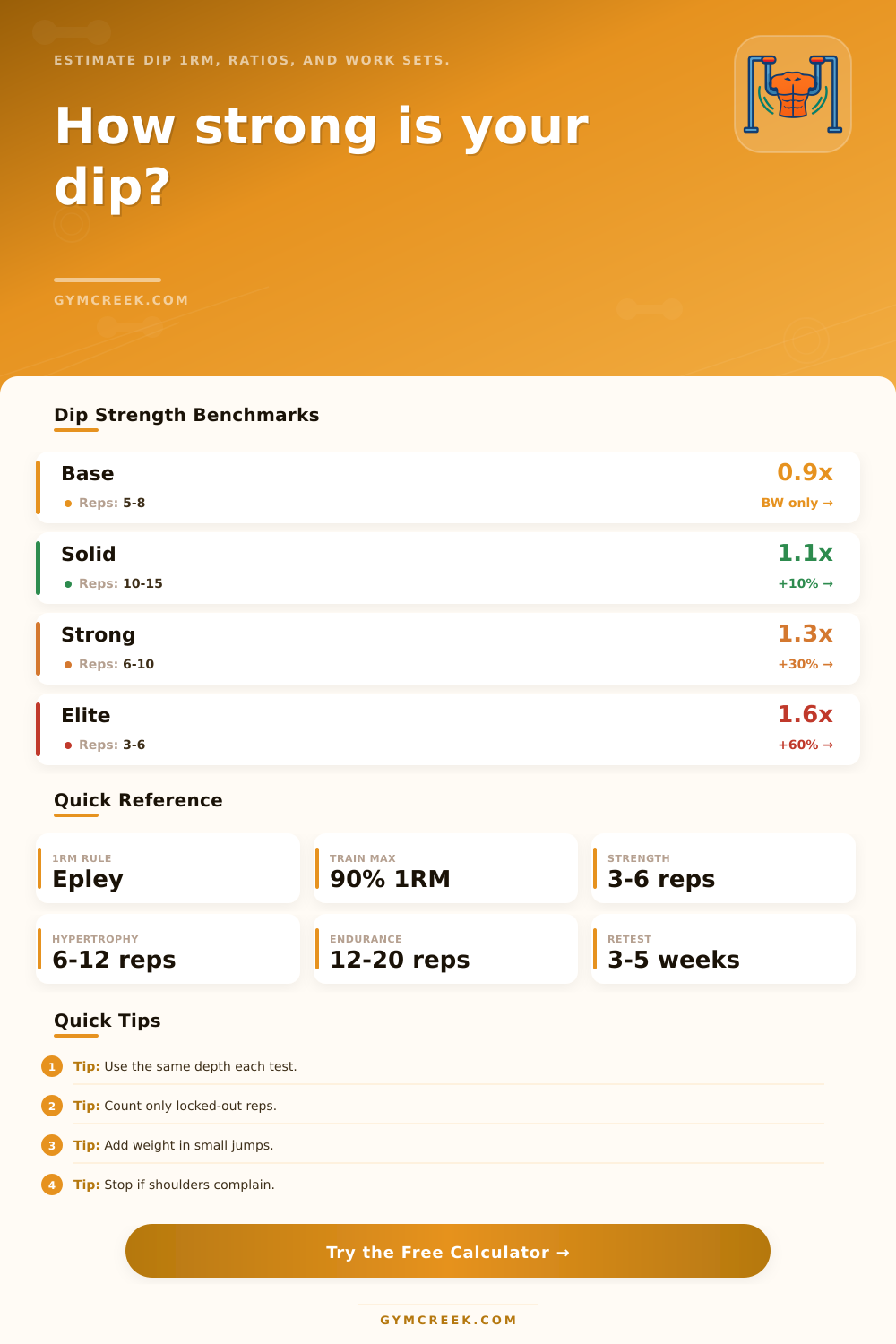
Now some context for all this: If your strength ratio is a one-point-three multiplier of your bodyweight, you’re on solid ground compared to most gym goers. Elite performers will get to one point six or higher. And those reference tables gives you an instant benchmark to know how you stack up against the rest of the group.
If you’ve taken some time off from the bar, the return-to-bars program lets you ease back into it safely and lightly. It reminds you that over time consistency trumps intensity. Adding too much too soon will have your shoulders complaining. Small increments help. Add weight only when your range of motion is full and reps remains clean.
Your push strength will be reflected by the dip. Squatting can mask weaknesses in your core stability, anterior delts and triceps. But it’s the tool that gives you structure to improve yourself in a fair way. It requires you to do every rep at the highest possible level. Control the descent. Squeeze your body tight. Finish with authority on lockout.
When you begin treating the dip like a skill instead of yet another exercise, the numbers will begin to reflect what you’re truly capable of. No longer do you have to guess if you’ve gotten stronger; the data will show you that. Your workouts won’t feel like a bunch of ego stuff anymore; they’ll become engineering progress. That switch in perspective would of been worth more than any max weight you ever lifted.