Fiber Calculator
Estimate a daily fiber target from age, sex, body size, activity, calories, current intake, and tolerance, then see the gap, ramp pace, soluble fiber range, and meal split.
📌Fiber Presets
Presets load realistic intake gaps and training contexts so the calculator can show different fiber targets, ramp weeks, and per-meal targets.
⚙Calculator
Fiber target snapshot
Enter your stats and current intake to estimate a daily fiber target and ramp plan.
📊Fiber Metrics
📑Reference Tables
| Group | Age range | Adequate intake | Calculator use |
|---|---|---|---|
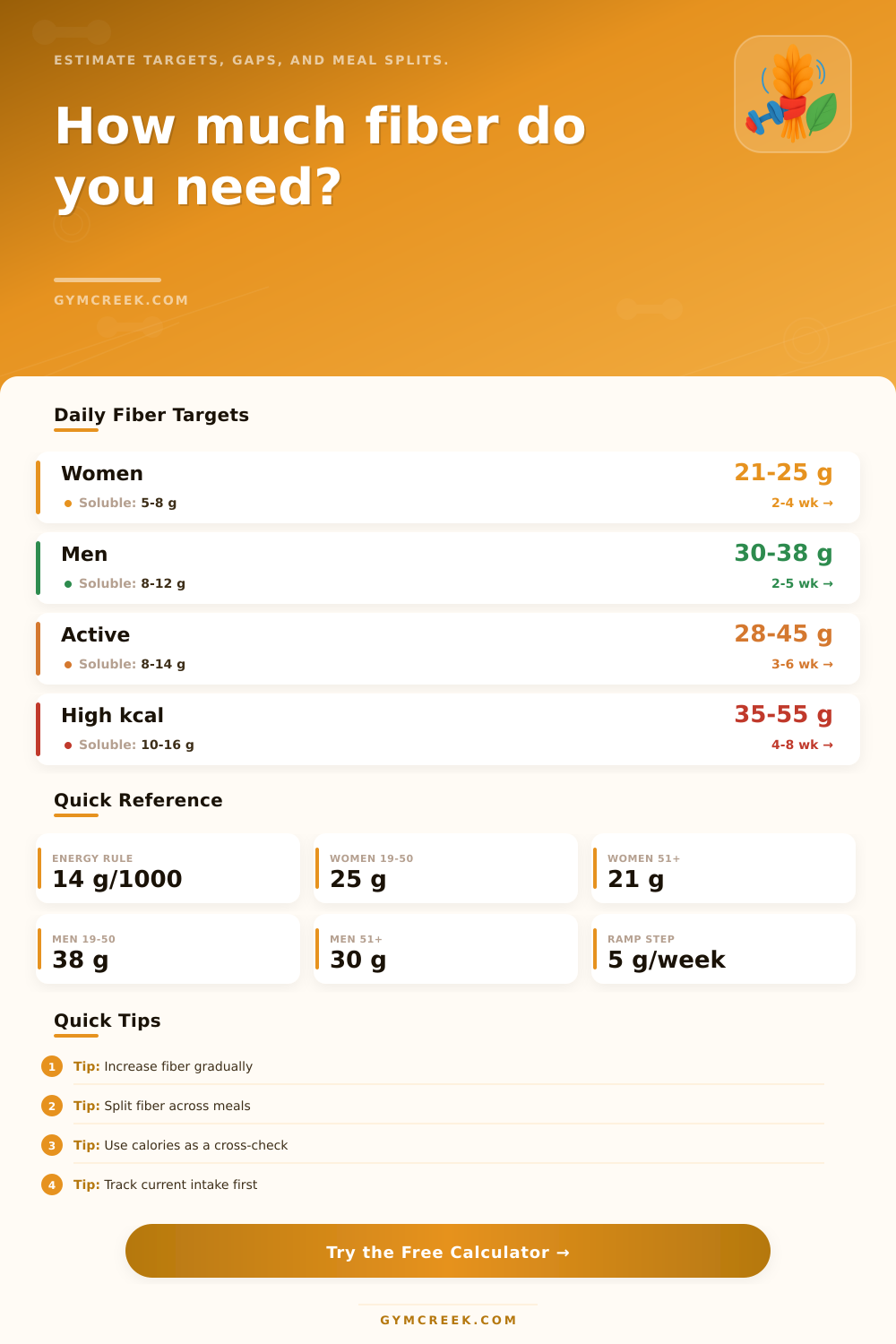
| Female | 19 to 50 | 25 g per day | Baseline before calorie check |
| Female | 51 and older | 21 g per day | Lower adult baseline |
| Male | 19 to 50 | 38 g per day | Baseline before calorie check |
| Male | 51 and older | 30 g per day | Lower adult baseline |
| Calories | 14 g per 1000 kcal | Practical range | Use case |
|---|---|---|---|
| 1600 kcal | 22 g | 21 to 28 g | Smaller cut or lower intake |
| 2200 kcal | 31 g | 25 to 35 g | General maintenance target |
| 2800 kcal | 39 g | 32 to 45 g | Active training week |
| 3600 kcal | 50 g | 40 to 55 g | High-calorie athlete phase |
| Tolerance | Add per week | Best fit | Calculator note |
|---|---|---|---|
| Sensitive digestion | 3 g per week | Large gap or low current intake | Longest ramp |
| Standard ramp | 5 g per week | Most adults increasing intake | Default pace |
| Experienced high fiber eater | 8 g per week | Already near target | Fastest pace |
| Maintenance | 0 g per week | Current intake meets target | Hold steady |
| Step | Formula | Variables | Output |
|---|---|---|---|
| BMR | Mifflin-St Jeor | Sex, age, weight, height | Resting calories |
| TDEE | BMR x activity | Activity multiplier | Daily calories |
| Fiber rule | Calories x 14 / 1000 | Estimated or custom kcal | Calorie target |
| Ramp | Gap / weekly step | Current intake and tolerance | Weeks to target |
💡Calculation Notes
The calculator compares age and sex reference intakes with the calorie rule, then limits extreme outputs so a high-calorie day does not create an unrealistic first target.
If your current intake is low, adding the full gap at once can be uncomfortable. The ramp output shows a smoother weekly increase.
Fiber is an important nutrient for teh body. Fiber is necessary for maintaining steady blood sugar level, is necessary for regular bowel movement, and fiber also help to ensure that a person does not feel hungry and eat too many snacks between meals. Many adult dont eat enough fiber in there diets.
Most adults do not meet the fiber requirement that are based off a person’s size, a person’s activity level, and a person’s calorie needs. This calculator tool that help you to calculate your current fiber targets use inputs such as age, sex, body weight, height, activity level, and current fiber intake. The calculator use these inputs to determine your fiber target because each of these input is important and reflects a different constraint in your life.
How to Use the Fiber Calculator
Age is one important input because the fiber requirement drop slightly after a person turn fifty for both men and women. Body weight and height are important inputs because your body weight and height are used to calculate your estimated number of calories that you should consume in a day. Your calorie estimates determine how much fiber your system can process.
Your activity level is important because if you are much more active than someone else, then you have higher training load. Training loads mean that you need to eat more food than a person who have lower training loads. For example, if you are trying to lose fat, then you will likely have to consume less total food than if you are trying to build muscle.
A person who is losing fat and a person who is building muscle will be consuming different amount of food in order to meet the different requirements of their goal. Thus, your activity level is a crucial input to determine how much fiber you should be consuming. You have given the most accurate fiber recommendation when you provide all inputs, including your current fiber intake because if you do not provide your current fiber intake, the calculator will not be able to provide you with an accurate ramp output.
The ramp output calculate how many weeks it will take for you to reach your target fiber intake if you add a certain amount of fiber each week. For example, if you eat sixteen grams of fiber and your target is thirty-five grams of fiber, then it is not advisable that you add nineteen grams of fiber in your diet in one week. You will likely have stomach issue.
Another necessary component that you must include in the calculator is how many time you eat in a day. This value is used to distribute a person’s fiber intake so that most of the daily intake of fiber will be consumed when eating. This calculator also calculate the amount of soluble fiber and insoluble fiber that a person should be consuming.
Often, food labels will tell you how much total fiber content but will not separate out how much fiber is soluble versus insoluble. Depending on the foods that you eat, you may want to know the amount of fiber that you are consuming. For example, suppose oats or beans or fruits are the primary component of your diet.
In that case, you may want to see how much fiber from those foods you should be consuming compared to whole grain or vegetables that contain mostly insoluble fibers. This calculator also produce a fluid target. The fluid target is important because if you increase your fiber intake but do not increase your water intake, then you can increase the risk of constipation.
The reference tables that are shown on the page show the logic that this calculator tool uses to calculate the outputs that it provides. The tables show all the baselines for age and sex and show the different values for paces during the ramp up. Those who want to reach their target sooner rather than later will have to add more grams of fiber per week compared to those who take it slow.
Of course, real life contain more complexities than what this calculator tool can calculate. For example, many variable can affect your digestion from day to day. Stress can affect digestion.
Illness can affect digestion. Some people find that some foods high in fiber will cause more gas than other foods with the same amount of grams of fiber in it. You may find that other factors affect your digestion from day to day, but this tool cannot easily capture these factors.
Therefore, the tool will be most useful to you when you provide it with the correct information and then follow the tools recommendation for how much fiber to add each week. It will be most useful for you to go two weeks without adjusting your fiber intake to see how your stomach respond. Small adjustment are better than large adjustment.
Over time it will become naturaly for you to recognize which meals during the day contain enough fiber and which meals need more added grams of fiber. This tool take away any need for arithmetic so that you can just focus on which meals need more added grams of fiber or which meals may already contain enough grams of fiber necessary for your body.