Diet Break Calculator
Estimate a maintenance-calorie diet break from body stats, current intake, dieting history, training stress, and expected metabolic adaptation.
◎Diet Break Presets
Presets load complete scenarios with intake, deficit duration, adaptation estimate, break length, training load, protein, and carb strategy. Change any field after loading one.
⚙Calculator Inputs
Diet break snapshot
Enter your current cut details and calculate a maintenance target.
▦Fitness Metrics
▣Reference Tables
| Situation | Typical Length | Calorie Target | Check |
|---|---|---|---|
| Short cut | 5-7 days | Maintenance | Hunger |
| 8-16 week cut | 7-14 days | Maintenance | Weight trend |
| Lean phase | 10-21 days | Maintenance | Training |
| Plateau reset | 7-14 days | Conservative | Waist average |
| Level | Multiplier | Typical Week | Break Note |
|---|---|---|---|
| Sedentary | 1.20 | Desk based | Small step-up |
| Light | 1.375 | Steps plus gym | Monitor hunger |
| Moderate | 1.55 | Train 3-5 days | Standard fit |
| Very active | 1.725 | Daily training | Fuel sessions |
| Macro | During Break | Why | Watch |
|---|---|---|---|
| Protein | Keep steady | Lean mass | Consistency |
| Carbs | Raise first | Training fuel | Water weight |
| Fat | Use a floor | Diet quality | Calories |
| Fiber | Keep similar | Digestion | Scale noise |
| Formula | Inputs | Use When | Output |
|---|---|---|---|
| Mifflin-St Jeor | Age and size | Most users | BMR |
| Katch-McArdle | Lean mass | Body fat known | BMR |
| Activity factor | BMR and level | Daily needs | TDEE |
| Adaptation | TDEE and cut | Diet break | Target range |
◇Tips
When you start a weight-loss plan, it usually goes well at first. In six weeks, you drop five pounds. Your pants is loose. You have more energy. For a few days, however, you no longer see any change on the scale. Have you reached a plateau? Has your metabolism shut down? Most people reduce their food intake even further. Drop another 200 calories. Workouts feels like dragging a car through mud. Ugh, that sucks.
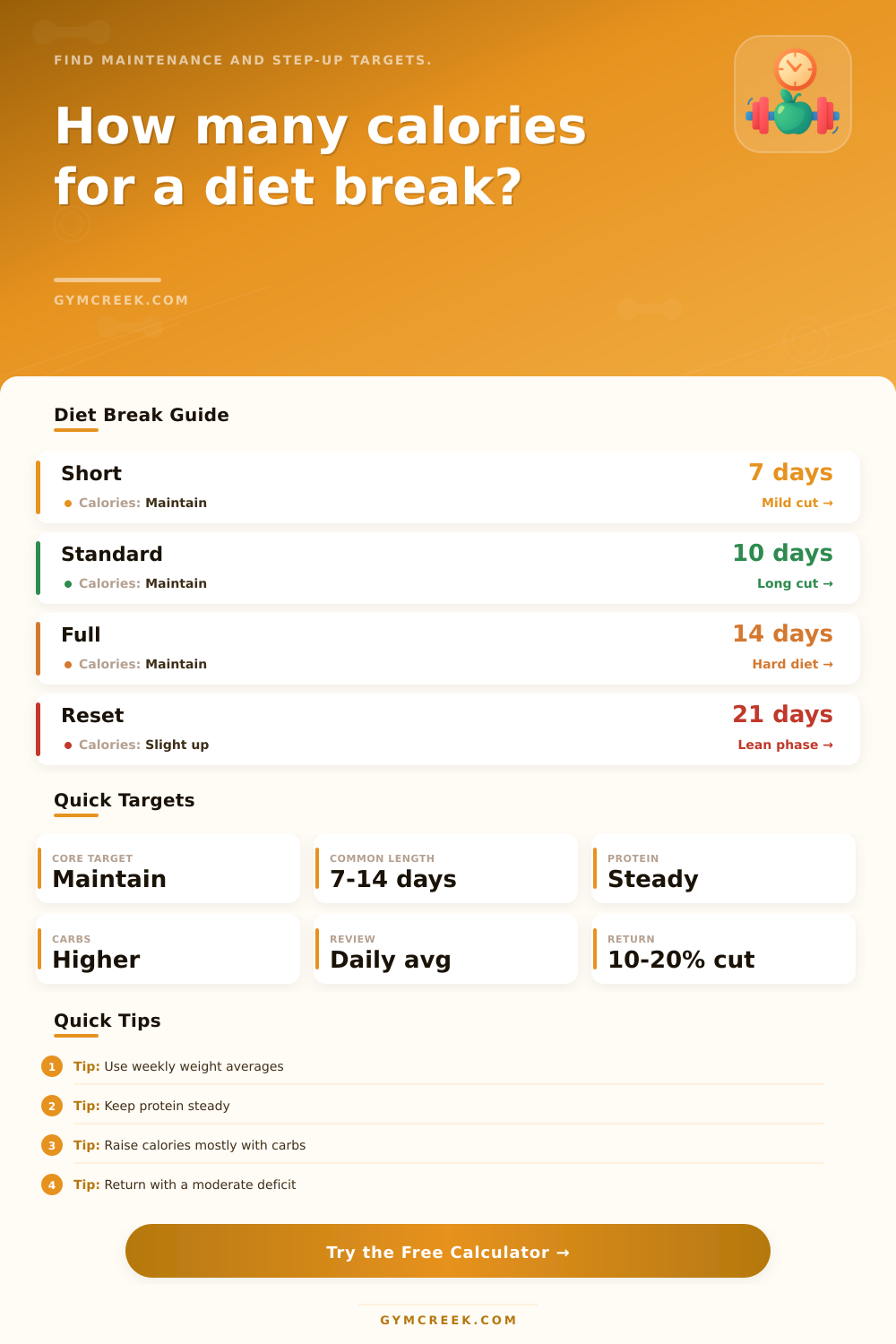
A better strategy is to put aside those scissors for a moment. Maintain current calorie levels. That’s what I’m calling a diet break, a strategic time-out during which you consume enough to maintain your weight. Resetting will restore your metabolic rate and re-settle your hunger hormones so you can get back on track to dropping pounds once more.
How to Use a Diet Break Calculator
Then all you do is plug in your numbers, and the calculator does the rest. You won’t have to guess how much your metabolism has slowed down. First, it takes into account your starting weight, height, sex, and age. Then it uses the Mifflin-St Jeor equation to estimate your basal metabolic rate. This is essentially the amount of energy required for you to sit there and have a heartbeat, also known as the “cost” of having a body.
Next, the calculator apply an activity multiplier to your BMR based off your training during the break. Why? Because training stress decreases when you’re in a large calorie deficit. Entering the intended training load helps give you a clearer idea of your current maintenance level compared to three months prior.
The estimated adaptation percentage is a tricky one to work out. That’s the difference between your maintenance calories (as calculated by the site) and actual number of calories you burn as your metabolism slows down. For example, if you’ve been cutting for 10+ weeks, your body probably reduced the calories you burn from moving around; meaning that you move around less without thinking about it. Enter this into the calculator to give it an idea and let it recommend a reasonable calorie target. It fills the hole between true maintenance and the deficit.
It’s not “eat whatever you want.” It’s “eat enough so your biology thinks things are safe.” This will give you a number of calories to consume per day, along with an estimated time off from dieting. For most people, that means anywhere from one week to two weeks. It is long enough to recover leptin levels and restore glycogen stores. But it should not be too long, so you do not gain much weight back. These estimates are all laid out in the reference table on the page according to the duration of your existing cut.
A shorter cut might only need a five-day pause. And if you’ve been through hell for the past 12 weeks, sometimes two weeks off at maintenance can help a lot. Recover, don’t reverse. The calculator also breaks out your macronutrient breakdown for you. It maintains your protein levels and gets most of your extra calories from carbs. That’s by design. Increasing carb consumption allows for muscle glycogen recovery, which enhances workout performance. You’ll feel less “flat” in the gym.
Keeping your protein level elevated helps defend against loss of lean mass. But there’s no reason to add more during the break period. Your fat levels remain low enough to still produce hormones. When reviewing the results, pay attention to your post-break deficit target. This indicates how much weight you should aim for when the break concludes. You’re not going back to your lowest-calorie level. Rather, you’ll begin a few notches above your starting point, allowing yourself to shed fat at a faster rate.
When the scale shoots up early into a diet break, don’t panic. Much of that extra weight is stored sugar and water, which isn’t new body fat. Glycogen stores water. When you fill ’em up, you’ll weigh more on the scale despite becoming better composed. Focus on average changes over time (weekly) rather than day-to-day fluctuations.
Maintain your protein consumption to help anchor fullness. Use the bonus carbs to fuel increased training intensity. The break is meant as a tool to sustain progress, not as a free pass to binge. In the end, though, a diet break is all about patience. It’s forcing yourself to get off the hamster wheel of perpetual restriction.
You can hit maintenance for a while, training hard but allowing yourself full recovery. And then, when you’re ready, you’ll be right back in a calorie deficit with your metabolism still willing to play along. Your week off might see little movement on the scale. But when you go right back at it, you should find it moving a bit quicker as well; less so because you aren’t trying to battle a starving body. It is a brief tactical pause against the risk of burning out big-time.
You should of known that diet breaks can be difficult but helpful. If you don’t follow the plan, progress will dissapears naturaly. Use this moddern method to ensure you recieve better results.