Detraining Loss Calculator
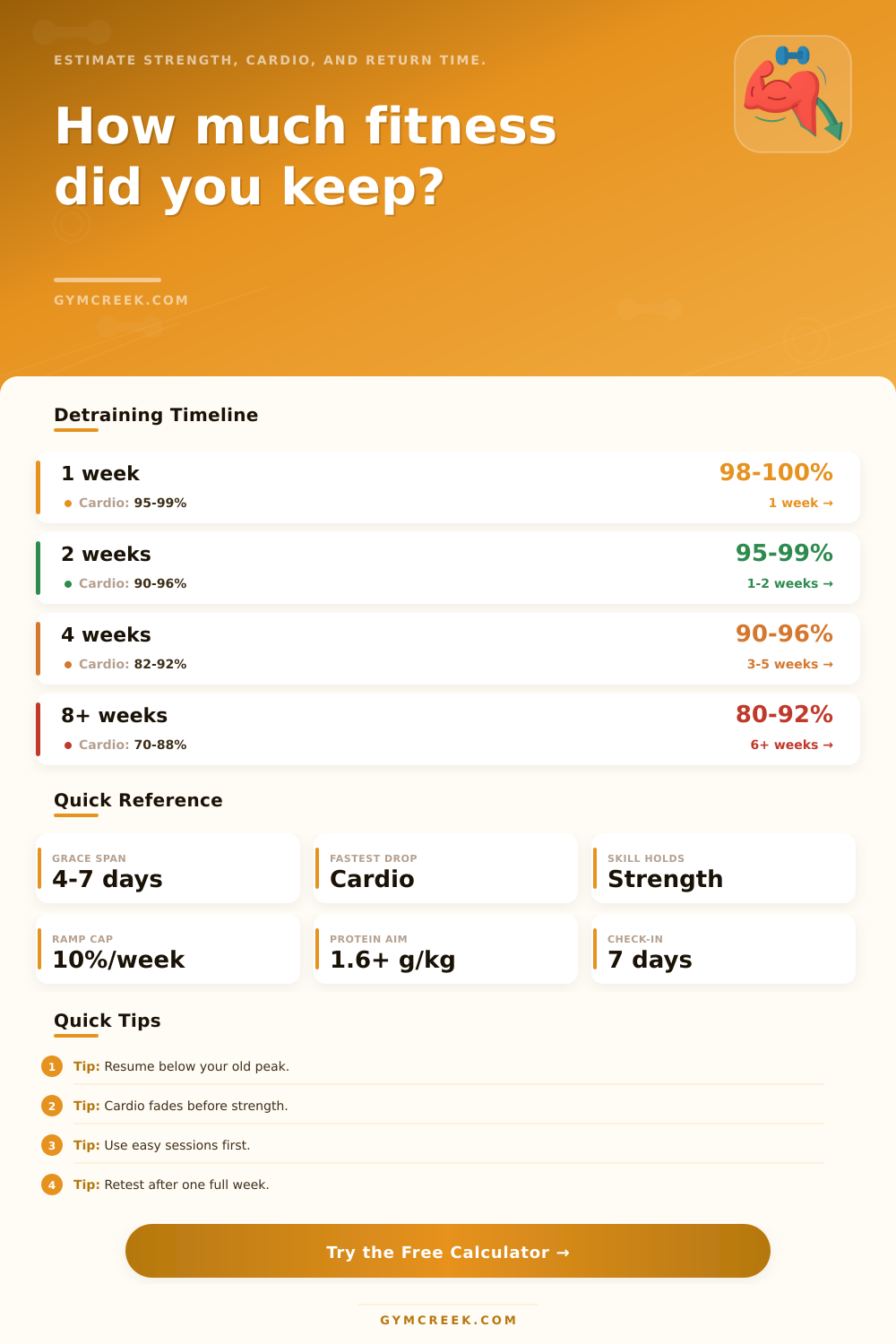
Estimate how much strength and cardio you may retain after time away, then plan a sensible return ramp from your old benchmarks.
📌Presets
Presets model common breaks from lifting, running, hybrid training, and illness. Each one loads realistic inputs and calculates immediately.
⚙Calculator
Detraining snapshot
Enter your break length, old benchmarks, and return plan to estimate retained fitness.
📊Current Estimate Grid
📑Reference Tables
| Time Away | Strength Trend | Cardio Trend | Return Cue |
|---|---|---|---|
| 1-4 days | No meaningful loss | No meaningful loss | Normal warm-up |
| 5-10 days | Skill feels rusty | Aerobic sharpness dips | Reduce first session |
| 11-28 days | Load tolerance falls | VO2 and pace fade | Ramp over weeks |
| 29-84 days | Muscle and neural drop | Endurance loss clearer | Rebuild base |
| Training History | Retention | Why It Matters | Adjustment |
|---|---|---|---|
| New lifter | Lower | Less skill reserve | Slower ramp |
| 1-3 years | Moderate | Some movement skill | Normal ramp |
| 4-8 years | Good | Better motor memory | Steady ramp |
| 8+ years | High | More durable skill | Watch fatigue |
| Return Risk | Signals | First Week | Progression |
|---|---|---|---|
| Low | Short break, good sleep | 80-90% of old work | 5-10% weekly |
| Moderate | 2-4 weeks off | 65-80% of old work | 5-8% weekly |
| High | Illness or poor sleep | 50-70% of old work | Hold if sore |
| Very high | Long break, older age | Technique only | Retest later |
| Metric | Estimate Uses | Best Input | Retest Point |
|---|---|---|---|
| 1RM or TM | Strength retained | Recent hard set | After 2 weeks |
| VO2 max | Cardio retained | Watch or race calc | After 7-14 days |
| Sessions/week | Training base | Normal schedule | Weekly |
| Recovery | Risk band | Current status | Each session |
💡Tips
After three weeks away, you enter the gym. A familiar sight greets you: the barbell. You grab it, but it’s heavier then it used to be. Your heart pound like an enemy, and your lungs protest. It feels like you’ve lost some fitness, although in truth you haven’t lost all that much.
Before resuming training, gauge how fit you are. Knowing whether your loss is real or imagined will keep you safe and prevent giving up to early. This page is that bridge. Based off your unique break duration and history, it models your remaining strength and cardio and builds a reasonable return plan. It understand your history, how long you were away, how well you recover, and your training age (among other details). This allows it to map out progress rather than guess.
How to Get Fit After a Break
We know we have actual neural pathways that persist for a longer time after the muscle does; we call this muscle memory. If two lifters both take time off, one with eight years of experience and the other with six months of consistency will recover faster because of their background. I feel people thinks that fitness fades at an even pace. Background makes a big difference.
Aerobic fitness hinges on enzyme activity and plasma volume. Both rapidly deplete when removed from stimulation, resulting in faster cardiovascular marker loss than muscular strength. Muscular strength is more resilient due to its reliance on structural integrity and neural drive, both of which takes longer to deteriorate. VO2 max estimates drop at a greater rate relative to lifting benchmarks early on (as evidenced by the calculator).
A person who performed 5 cardio workouts weekly prior to cessation will experience a stronger reaction than an individual who walked 3x/week. Why? This is because frequency connect with systemic dependence, which is how reliant your system became on outside volume for balance.
These numbers are also heavily influenced by nutrition. When you stop working out and you’re in calorie deficit, you’ll lose muscle at a quicker rate, without any stimulus for it to be retained. Eating plenty of protein will reduce that to a degree. That’s why it asks about your dietary habits during the break. This way, when it estimates how much muscle you’ve retained or lost, it accounts for those factors to give you a true picture of where you stand. Without accounting for diet, what you see written down on paper (your training logs) is half the story.
For example, the tool’s reference tables gives clues to risk assessment for typical scenarios such as traveling, or getting sick, and allow you to visualize how your scenario aligns with general body norms. For instance, a brief deload doesn’t really result in meaningful loss, whereas a month of injury mean rebuilding your endurance before resuming peak power lifts. This difference helps avoid returning too early to prior intensity levels setting you back and cancelling gains made so far.
But take it easy if/when you do begin loading up again. This isn’t a test to see what you can handle; it’s a week or two of relearning how your body moves and finding where things might be sore. Don’t add more if your joints is achy for two consecutive days, just do the same amount the following workout. It goes against everything in us to slow down after wanting to reach our best self again, but you’ll preserve your gains better by being patient than by ramping too aggressively. Your strength will come back through training, but only once your actual physical tissues has recovered.
You should of trusted the process over the numbers. It’s only a recalibration; not a loss. Even if your body forgets how to do it today, it still remembers what it could do. These are estimates, they’ll guide you home while guarding against backward movement.
This isn’t about erasing the pause. It is about making the pause part of the bigger picture without stopping your forward motion. Ease yourself back in, take the ramp with respect, and let things reconnect naturaly over time. You’ll be weighing thing again before you know it.