Depth Jump Box Height Calculator
Estimate a practical drop height from rebound jump height, ground contact time, RSI, landing quality, and progression readiness.
📌Presets
Each preset loads realistic jump height, contact time, and landing values so you can compare progression outcomes quickly.
⚙Calculator
Depth jump snapshot
Enter jump height and contact time to estimate the next box height.
📊Depth Jump Metrics
📑Reference Tables
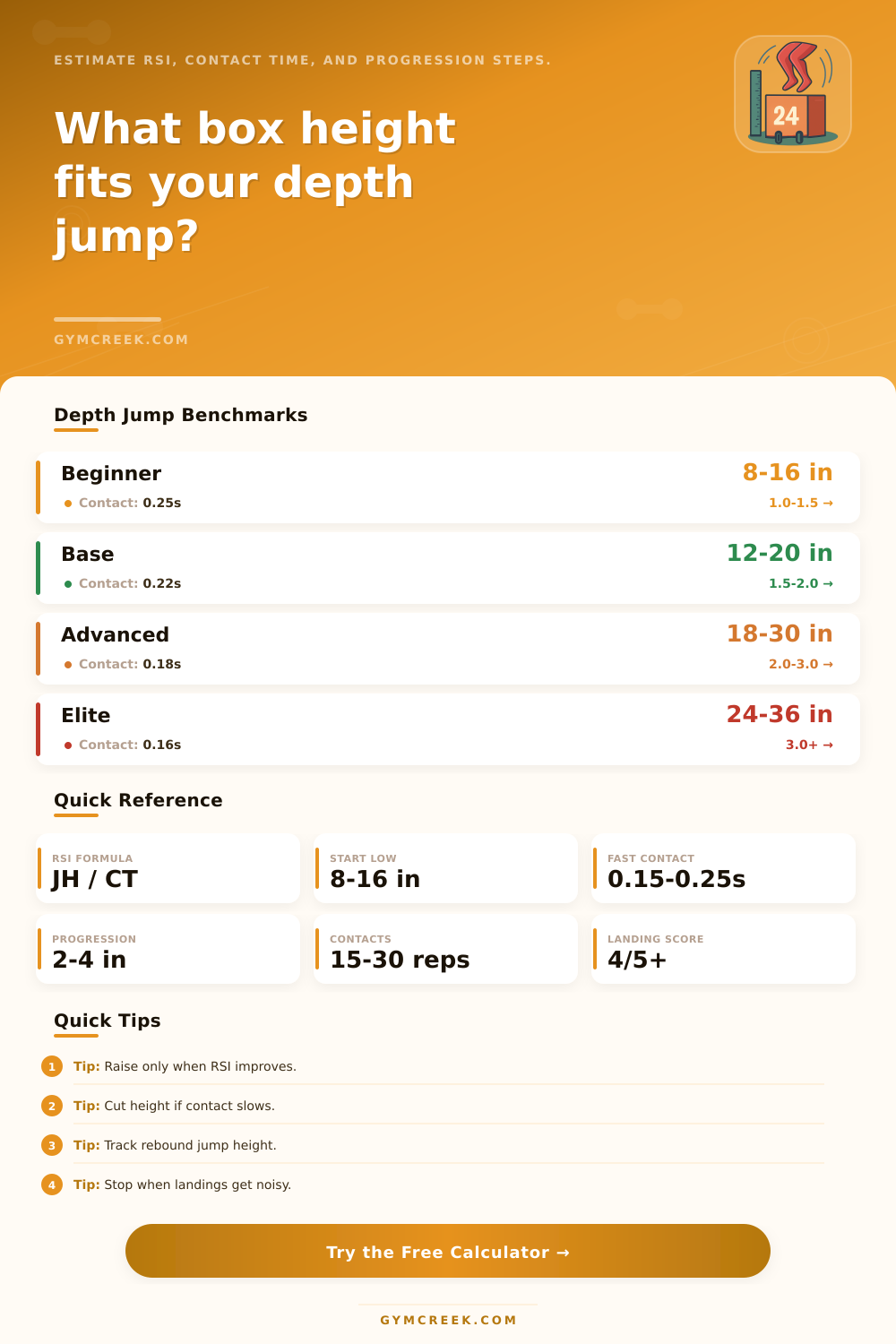
| Level | Starting Box | Target Contact | Useful RSI |
|---|---|---|---|
| Beginner | 8-16 in | 0.22-0.30 sec | 1.0-1.5 |
| Intermediate | 12-24 in | 0.18-0.25 sec | 1.5-2.2 |
| Advanced | 18-32 in | 0.15-0.22 sec | 2.2-3.0 |
| Elite | 24-40 in | 0.12-0.18 sec | 3.0+ |
| Goal | Box Strategy | Contact Focus | Progression Rule |
|---|---|---|---|
| Landing base | Low box | Quiet control | Add height slowly |
| Reactive speed | Moderate box | Short contact | Raise only if RSI rises |
| Jump power | Moderate-high | Keep rebound tall | Watch retention |
| Return to play | Conservative | Symmetric landing | Progress after clean reps |
| Signal | Green Light | Hold Height | Reduce Height |
|---|---|---|---|
| Contact time | Under 0.20 sec | 0.20-0.25 sec | Over 0.25 sec |
| Retention | 80%+ | 70-79% | Below 70% |
| Landing score | 4-5 | 3 | 1-2 |
| Session contacts | 12-24 | 25-36 | 37+ |
| Formula | Inputs | Output | Use |
|---|---|---|---|
| RSI | Jump height, contact | m per sec | Reactivity score |
| Retention | Rebound, vertical | Percent | Drop quality |
| Drop ratio | Box, vertical | Percent | Height context |
| Step rule | RSI, landing, fatigue | Next box | Progression call |
💡Tips
In the world of strength training, there’s this lingering misconception: Bigger is always better. You know those athletes who stands on high platforms, looking down at everyone who won’t jump from at least two feet up? They think if the box isn’t scary, then the stimulus can’t be sufficient. For roughly 10 minutes, their rationale makes sense until the laws of physics smother them with concrete.
There is only so much force our bodies can handle in terms of absorbing impact and changing it into upward velocity. Anything beyond that point only adds height, not power. You’re loading yourself with stress without reaping any return in performance benefit. It’s like bashing your joints instead of training your muscles.
Why Bigger Boxes Are Not Always Better
So the way to look at it is: Instead of picking out a box height by the numbers or habit or ego, and then measuring your contact time against some arbitrary benchmark, you should reverse it. You first calculate the RSI (reactive strength index), which is simply your jump height/ground contact time. This let you know how your tendons are behaving as springs. If you’re moving up a level and that number has dropped off dramatically, that means the spring is breaking. You’ve lost retention. To compare your standing vertical to your rebound jump, the tool helps you spot the disconnect before it becomes an injury. Are you not jumping nearly as high after the drop than you are from a standstill? Then that load is too heavy for your current stiffness.
Perhaps the single most misunderstood metric in plyos is ground contact time. Shorter is supposed to be better. But not always. There’s such a thing as a sweet spot, where the foot is down long enough to create force, but doesn’t linger on the ground. Spending 1/4 of a second on the ground is probably too much time for someone, they’re either hesitating or absorbing some energy back into their body. Not spending at least 1/10th of a second? They are probably slipping or not loading there legs correctly. The table on the page makes it clear: beginners require more time to stabilize, while elites perform at lightning speed. These things can’t be faked. Timing reveals what the body do.
Most programs fail at progression. “I didn’t feel anything so I must be ready” is the reasoning behind an athlete jumping to the next box up. Pain is a lagging indicator. Leading indicators are contact time and landing quality. If your landings get noisy and thud heavily rather than stick quietly, you’ve already gone too far. The calculator suggests adjustments based off these subtle signals by looking at your planned session contacts and your current fatigue level. Based on how fatigued you are, and how many contacts you plan for during a session, it will tell you whether you should remain stationary or step up. Two inches may not sound like much but in terms of reactive strength, it can double the amount of force your shins experience. Patience isn’t a virtue here, it’s a mechanical necessity.
The age of your tissues isn’t determined by a clock; it’s determined by training age. If you’ve lifted weights for five years but have no experience jumping off boxes or throwing yourself into the air, then you’re a novice when it comes to plyometrics. Your tissues are not used to rapid stretching and contracting. You’ll get beat up if you start too high; far more different than any other exercise. A veteran athlete coming back from an injury, however, must rebuild that tissue stiffness from scratch. The presets in the tool accommodate these scenarios, providing aggressive pathways for the peaker and conservative pathways for person rebuilding. It removes the guessing game and hands you a clear signal.
Finally, this is a game of depth jumping, not volume. Efficiency matters. Less is more. More bang for your buck. So, seek out the highest box where you can jump higher than you could pre-drop while also being quieter. When you find that ceiling, shut it down. This ain’t survival mode; this is springback from the fall. And you’re looking to leave in better shape than when you came.
Keep that first myth above in mind. Height was never realy the point. Speed was, and speed comes from the right box, not the wrong box.