Deficit Deadlift Load Calculator
Estimate deficit deadlift max, rounded working weight, floor-pull equivalent difficulty, plate loading, and total session tonnage.
📌Presets
Each preset fills a complete deficit deadlift scenario and recalculates using the selected unit system.
⚙Calculator
Deficit deadlift snapshot
Enter your deadlift and deficit setup to calculate a working load.
📊Fitness Metrics Comparison
📑Reference Tables
| Deficit Height | Typical Difficulty | Common Load Change | Best Use |
|---|---|---|---|
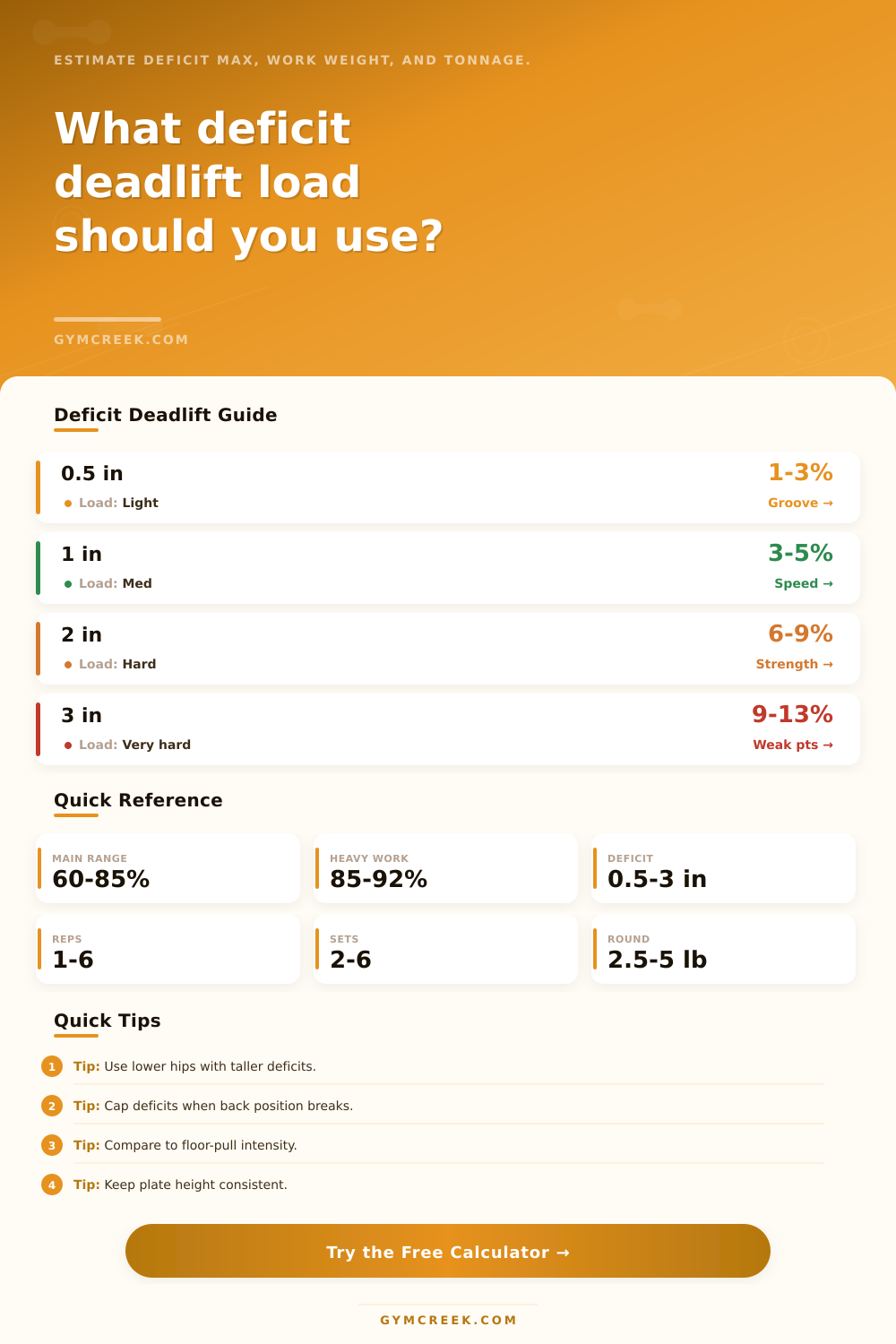
| 0.5 inch / 1.3 cm | Small change in start position | About 1-3% below floor pull | Groove work and mild off-floor practice |
| 1 inch / 2.5 cm | Moderate setup change | About 3-5% below floor pull | Speed work and clean volume |
| 2 inches / 5.1 cm | Clear strength challenge | About 6-9% below floor pull | Off-floor strength blocks |
| 3 inches / 7.6 cm | High mobility and position demand | About 9-13% below floor pull | Specific weak-point training |
| 4 inches / 10.2 cm | Very aggressive range of motion | About 13-18% below floor pull | Advanced lifters with stable positions |
| Training Purpose | Common Intensity | Reps | Loading Note |
|---|---|---|---|
| Technique practice | 55-70% deficit max | 3-6 | Bar path, wedge, and consistent start position |
| Speed from the floor | 60-75% deficit max | 1-4 | Fast break from the platform without hitching |
| Volume strength block | 68-82% deficit max | 3-8 | Enough load to train position under fatigue |
| Heavy strength work | 82-92% deficit max | 1-5 | Keep reps clean and stop before position collapses |
| Peaking exposure | 88-100% deficit max | 1-3 | Low total reps, high intent, full reset |
| Variable | Adjustment Used | Reason | Watch Point |
|---|---|---|---|
| Sumo stance | Extra 1.2x deficit penalty | Taller deficit can disrupt hip position | Do not force a stance that loses balance |
| Straps allowed | +1.5% load modifier | Less grip limitation during volume work | Keep lats tight even when grip is easier |
| Double overhand | -4% load modifier | Grip may cap usable load before back strength | Stop when grip changes bar path |
| Paused below knee | -3% load modifier | Pause removes momentum and exposes position | Pause without relaxing the brace |
| Full dead stop | -2% load modifier | Each rep starts from zero momentum | Reset hips and lats before every pull |
| Formula Step | Calculator Formula | Output | How to Use |
|---|---|---|---|
| Deficit penalty | Height in inches x 4%, capped at 20% | Range-of-motion load drop | Scales floor max down for deficit pulls |
| Style modifiers | Stance + grip + tempo + readiness | Usable strength modifier | Reflects setup and session conditions |
| Deficit max | Floor 1RM x total modifier | Estimated deficit 1RM | Sets the training ceiling |
| Working load | Deficit max x target intensity | Bar weight before rounding | Round to your available plates |
| Floor equivalent | Rounded load / total modifier | Similar floor-pull demand | Checks whether the set is too heavy |
💡Tips
The calculator will do all that conversion work for you if you input it (see above), saving you time. But what’s important about these inputs is where the learning occurs, because you have to learn how deficit impacts everything else. Weight and deficit should of being thought off separately.
Adding 3 inches of platform height and using your normal working weight, say with a bunch of extra plates on it, are not going to train strength. It’s gonna break you down in terms of form under fatigue, while drastically altering your bar path and hip height.
Why Deficit Deadlifts Are Harder
When most people does the deficit deadlift, they think of it as a penance for failing to hit a PR. “Oh well,” they say while dropping down fifty pounds. Most often, what’s happening here is that the lifter loads up as if standing on plates was the same thing than standing on the ground. Height added to the start position add torque on the spine and changes leverage. Your hamstrings must work harder before bar leaves your knees. A deficit is given a penalty factor that increases along with the increased height.
The tool will use your floor one-rep max to estimate your max for the deficit. If you think you can pull more from a starting point elevated, most of us are wrong. According to the reference table, going just two inches makes it harder by about six to nine percent. And that’s where the percentage loss comes into play. A floor four hundred pound pull may become a three seventy-five pound deficit pull. Attempting to reach four hundred pounds off a box will probably lead to some sloppy form and excess lower back strain.
Also keep in mind your grip choices and stance here. Conventional lifters will often suffer from lack of feeling compared to Sumo puller due to the starting point of their hip position relative to the bar. A platform adds even more discomfort for sumo lifters who is forced into a forward leaning posture that diminishes the use of their posterior chain. To compensate for this the calculator takes stance choice into account and reduces penalty accordingly. Grip is another factor. Straps allow you to get away with a little bit more in terms of load, since your forearms won’t give out before your back fails. Double overhand? Then the bar has to drop a few pounds to prevent your hands from coming off during the long lowering phase.
Another lever used incorrectly by many lifters is intensity. Most of the time deficit pulls is not about moving maximal weight. They’re more often about strengthening the first break off the floor and making tendons stiffer. To help with this, we have a “floor equivalent” metric in the output. This will tell you what that particular deficit set would feel like if pulled from the floor. It’ll help you even out your week. Your deficit session may look like a ninety percent effort on the floor. Perhaps you are overreaching ahead of your main heavy day.
The last part of the equation is consistency. If you know your preference on rounding and your readiness level, the calculator will account for those as well. This is much like what happens in the gym when training. Do you ever go down to the tenths place and get exactly eighty-two point four percent? No, you round up or down to the next five or ten pound plate. These little differences compound and can be tracked with tonnage. By tracking tonnage, you’ll have a better idea if you’re making progress or if you’ve been spinning your wheels for a while. Ultimately, you want to groove the movement pattern but not accrue any junk volume that has you sore for a week.
Start with a smaller gap and try to keep your shins vertical for as long as you can. I know it’s so tempting to extend out farther, but remember: you’re doing this to improve your position, not gain height by giving up a good position. Get familiar with the weight on the bar and find what accelerates you through the starting position quickest. Dial it back if you’re hinging over the bar or losing tension prior to the movement. You want it to be difficult but in control, not chaos. The faster you learn how to start the pull, the more this carries over into your floor deadlifts down the road. Standing on a box will teach you both patience and precision that lugging around extra weight simply cannot teach you.