Decline Bench Calculator
Estimate decline press 1RM, training max, set volume, and bodyweight-relative strength from a real working set.
📌Presets
Each preset fills a realistic decline bench setup and recalculates using the same unit labels and formulas.
⚙Calculator
Decline bench snapshot
Enter a work set to estimate decline bench strength and workload.
📊Fitness Metrics Comparison
📑Reference Tables
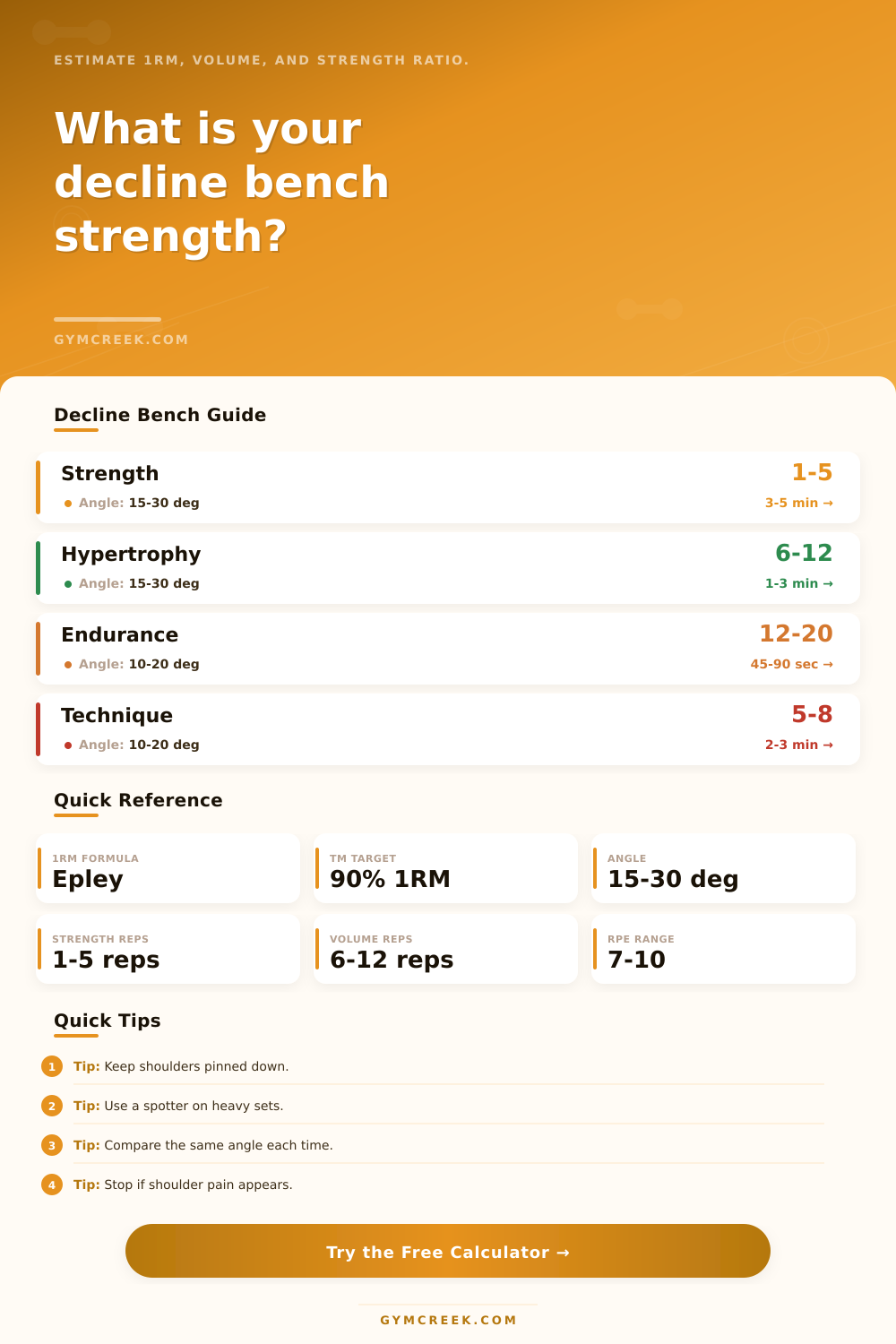
| Goal | Reps | Rest | Use |
|---|---|---|---|
| Max strength | 1-5 | 180-300 sec | Heavy neural work |
| Hypertrophy | 6-12 | 60-180 sec | Chest volume |
| Power practice | 2-5 | 120-240 sec | Fast crisp reps |
| Endurance | 12-20 | 45-90 sec | Local fatigue |
| Angle | Chest Bias | Setup Note | Risk Check |
|---|---|---|---|
| 10 degrees | Mild lower chest | Easy transition | Stable path |
| 15-20 degrees | Standard decline | Common setup | Use spotter |
| 25 degrees | Strong decline | Shorter range | Brace harder |
| 30 degrees | Steep decline | Specialized angle | Avoid sliding |
| Ratio | Male Level | Female Level | Meaning |
|---|---|---|---|
| 0.50x | Novice | Beginner | Learning pattern |
| 0.75x | Beginner | Intermediate | Solid base |
| 1.00x | Intermediate | Advanced | Strong press |
| 1.50x+ | Advanced | Elite | High strength |
| Formula | Calculation | Used For | Best Range |
|---|---|---|---|
| Epley 1RM | Load x (1 + reps/30) | Main max estimate | 1-10 reps |
| RPE reps | Reps + reserve | Submax sets | RPE 7-10 |
| Training max | 1RM x 90% | Work planning | All levels |
| Tonnage | Load x reps x sets | Session volume | Volume blocks |
💡Tips
With the decline bench press, you’ll be able to press more weight then on a flat bench. Why? Because the angle transfers the mechanical advantage to the front shoulders and lower chest. So you’re feeling like that increased weight implies a stronger press all around, but perhaps it’s simply a matter of different lever. To get the math done for you, plug in your working set into the calculator above. That way, you won’t need to guess whether that heavy-ass triple was an honest sign of strength or simply momentum carrying you through.
First thing: Look at angle setting. For starters, a typical 20-degree decline changes center of gravity relative to a flat bench. That’s beneficial because it lowers pressure on your spine; but it requires rigid control over your shoulders. You can’t pin ’em back and down? Then you’re fighting the bar path rather than driving it upward. The tool tracks that variable by requesting exact degree of incline.
How to Use the Decline Bench Press Calculator
Why does it matter? An extra 10 degrees barely changes the vector, whereas a steep 30-degree angle drastically shorten the range of motion. This also change which muscle get recruited. Switching angles from session to session without recording the change renders tracking progress pointless. In other words, consistent set-up are the backbone of strength gains.
So how do we consider the rep and load combo? Well, first you has your one-rep maximum (1RM), a value estimated from both amount of weight used and number of repetitions performed. So if I pick up 185 pounds and perform eight perfect reps, the math work out to determine my theoretical one-maximal-effort attempt. That figure serve as a benchmark but not necessarily a goal for any given day. Instead most coaches will take the estimate and set their training max at roughly nine-tenths of that theoretical number. Essentials they’re lifting below their true max in order to develop work capacity while keeping the central nervous system from being fried each workout. Lifting at this reduced intensity allow for higher volume with better form and less joint stress.
You know what? It’s easy to calculate volume. But people don’t always get it. Tonnage represent total load moved across all sets. That’s a blunt instrument for measuring anything other than overall stimulation. Stimulus isn’t always progress. For example, you could of had a nasty high-tonnage day but that doesn’t necessarily equate to much because your effort level wasn’t enough. You were just doing some sort of aerobic conditioning for your pecs. The table on the page details this nicely by matching rep ranges with goals. Long rest periods keeps strength training in the lower end of the rep range. Metabolic stress peaks at mid-rep ranges and that’s right where muscle growth shines. Higher reps with shorter rest periods pushes endurance. Knowing the goal will help you decode the number; rather than being simply driven to see higher digits.
The variables change with grip width and tool selection. For example, dumbbells force separate stabilization, typically reducing your overall max versus a barbell. Therefore, it is not an apples-to-oranges comparison, and the tool takes this into account. Wider grips create a greater chest stretch; close grips recruit more triceps. The other variable here is your level of experience. Elite competitors will have different expectations than those who are intermediate lifters. It helps avoid being discouraged if your own strength ratio fall short of the highest-level examples. Strength is relative to your body weight and training history.
Shoulder health determine how long you will last on this move. When done correctly, the wrists should line up and there shouldn’t be too much external rotation in the shoulder joint in the decline position. Don’t make pain a badge of honor. If anything is pinching or feeling sharp, maybe you’re going too steep on the angle for your own anatomy. Listen to your joints before listening to the rep count. Pushing yourself too hard just once will sideline you for weeks; a sustainable routine wins out every time.
In conclusion, the decline bench is a tool for balancing both your overall pressing strength and chest development. It’s a variation of flat and incline work instead of a replacement. Think of the estimated one-rep max as a compass for where you should start, not necessarily a destination. Go up or down depending on what your body tells you each day. Structure comes from the numbers; feedback comes from feel. Stay consistent with the angles and keep those shoulders packed. Let the data inform your progress, not dictate it. You don’t build strength with one calculation; you build it over time.