Deadlift Warm Up Sets Calculator
Build a deadlift-specific warm-up plan from your target top set or 1RM, bar weight, plate jumps, pulling style, fatigue, session goal, and preferred warm-up volume.
📌Presets
Presets show practical deadlift warm-ups for different targets, bars, readiness levels, pulling styles, and set volumes. Adjust any field and calculate again.
⚙Calculator
Deadlift warm-up plan
Enter your target and equipment to create a warm-up ladder.
📊Warm-Up Metrics
📋Calculated Set Plan
| Set | Load | Reps | Percent | Rest | Plates per side |
|---|---|---|---|---|---|
| Calculate to build your plan. | |||||
📑Reference Tables
| Stage | Percent | Reps | Purpose |
|---|---|---|---|
| Empty bar | Bar only | 5-8 | Hinge and brace |
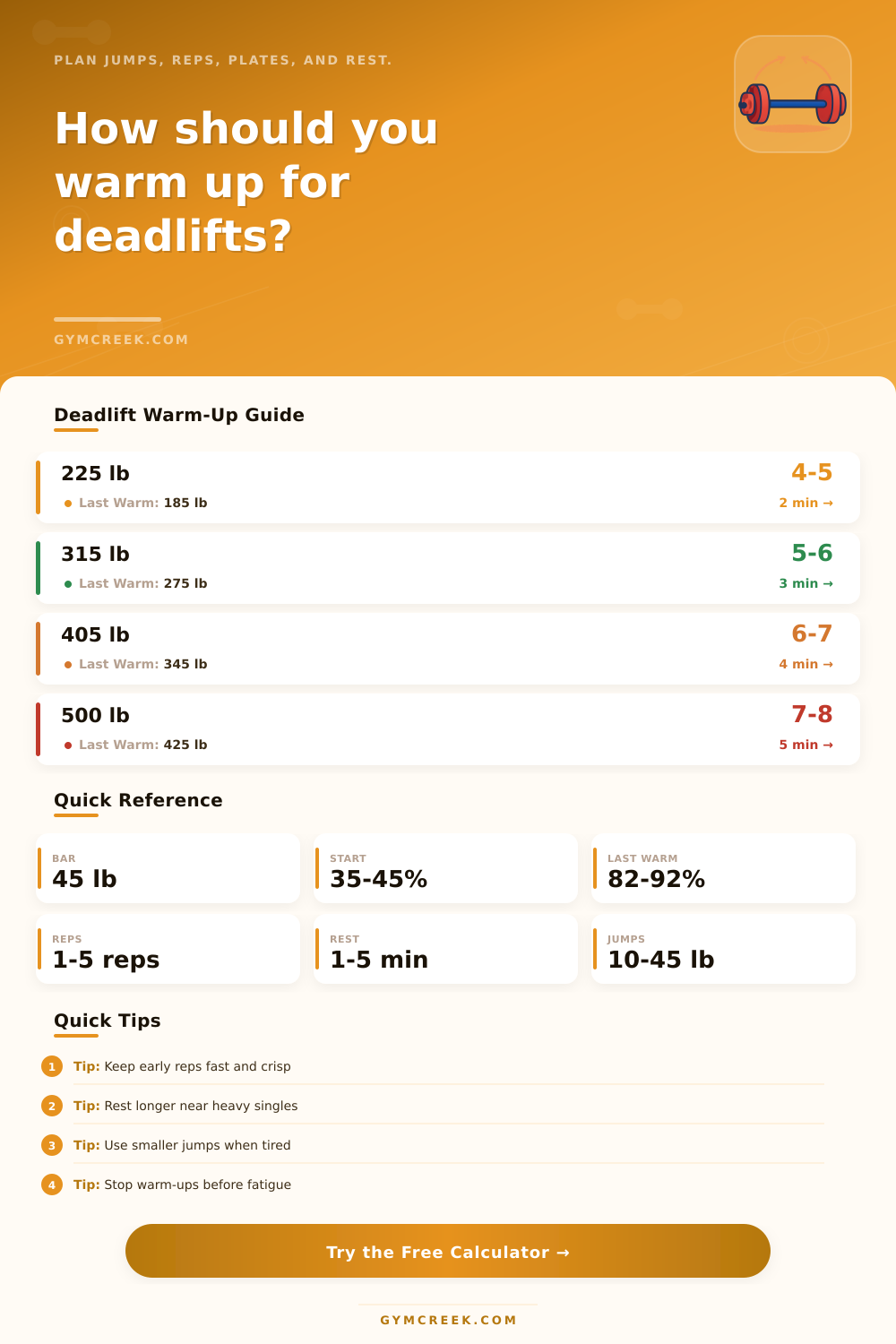
| First load | 35-45% | 4-5 | Groove setup |
| Middle sets | 55-75% | 2-4 | Build speed |
| Final warm | 82-92% | 1 | Prepare top set |
| Goal | Sets | Last warm | Notes |
|---|---|---|---|
| Volume | More sets | 78-85% | Save reps for work |
| Strength | Standard | 85-88% | Balanced ramp |
| Heavy single | More singles | 88-92% | Practice commands |
| Deload | Fewer sets | 70-78% | Low fatigue |
| Style | Warm-up bias | Jump size | Focus |
|---|---|---|---|
| Conventional | Standard ramp | Moderate | Brace and slack |
| Sumo | Extra practice | Smaller late | Position and wedge |
| Trap bar | Faster ramp | Larger | Drive through floor |
| Deficit | Conservative | Smaller | Start position |
| Equipment | Increment | Best for | Why |
|---|---|---|---|
| Full plates | 45 lb | Heavy pulls | Fast loading |
| 25s and 10s | 20-50 lb | Most gyms | Even jumps |
| Change plates | 5-10 lb | Final jumps | Less fatigue |
| Kilo plates | 2.5-10 kg | Metric gyms | Precise ramp |
💡Tips
A deadlift warm-up is a series of movements that a person perform before a heavy deadlift set. A warm-up allows a body to prepare for the weight that is to be lift during a deadlift session. A warm-up is important before a deadlift set because it allow the nervous system and the muscle to prepare for the heavy deadlift set.
If a person skips a warm-up, then the first and possibly the following heavy deadlift sets may feel slow or even unstablely. Performing a warm-up allows a body to perform the heavy deadlift set with more confidence. The calculator will provide a set of specific number for a deadlift warm-up if the individual puts in certain inputs into the calculator.
How to Plan a Deadlift Warm-Up
The lifter want to complete a deadlift set must enter the target weight into the calculator. Additionally, the individual must also enter the type of bar that is to be use for the deadlift. An individuals state of feeling that day must also be entered into the calculator.
This calculator do the math for you so that you dont have to guess as to how many rest times will be needed during a warm-up. Many individuals makes the mistake of rushing through a deadlift warm-up. A warm-up is not just a checklist for individuals looking to perform a set of heavy deadlifts.
If an individual rushes through a warm-up, it can leave the body underprepared for the actual deadlift sets to be performed. A warm-up allows the body to recruit the correct muscle required for a deadlift and allows the bodys joints to perform in their full range of motion. If the bodys joints are not warmed up properly, the heavy deadlift sets may not feel as stable.
The settings in the calculator can change based on a few different variables. The pulling style that an individual use will change the number of sets required and the jumps of plate that are required for each warm-up. The stance that is used, whether conventional or sumo, will change the number of sets required for each warm-up.
The level of fatigue that an individual feel will change the number of sets required for a deadlift warm-up. The more fatigued an individual feels, the fewer set may be required for a warm-up. The goal that an individual desire to accomplish that day can change the warm-up routine for a deadlift.
For instance, if an individual is training to perform a high volume of sets, the last few warm-up sets will be lighter. For those performing a single heavy set, the lifter will perform the warm-up with a weight closer to the actual deadlift set. The jumps of plate and the weight of the bar can change the warm-up routine.
A larger jump of plates saves an individual time but can leave them underprepared for the set. A smaller jump of plates takes more time to warm up but allow an individual to reach their deadlift set with less effort. The rest periods in a deadlift warm-up can change based on the number of sets required.
The first few sets will have very little rest between sets. As the sets increase in number and weight, the rest periods in between sets will need to increase. The calculator will provide these numbers for you automatic.
While you may have the option to choose if you are ready for the next set, the rest periods will allow you to not rush the last warm-up before the deadlift sets. While the calculator cannot provide an individual with a feeling of how their deadlift warm-up will feel, it can help individuals adjust to their body. On some days, the bar will move quickly.
On the other hand, it may feel slow and require more attention when performed. Individual can adjust the warm-up routines according to their fatigue and readiness for the sets to be performed. The set plan from the calculator may be the best for most individuals, but any adjustment should of been made if the weight of the bar changes.
Some of the most common mistake are to perform too much or too little of a warm-up routine. Performing too many warm-up sets can dull the muscle’s nervous system and force the body to use too much energy. On the other hand, performing too few sets can leave the body surprised at the heavy set that is to be performed.
The calculator includes information that will tell an individual whether too much or too little warm-up is required for the bodys sets. Conventional or deficit deadlifts require extra attention to the warm-up. Conventional deadlifts require an extra focus on bracing and removing slack from the bar.
Deficit deadlifts may require less jump in number of plates due to the fact that it is a more demanding lift. Trap bar deadlifts may allow for more jumps in number of plates than conventional or sumo deadlifts. These variations in type of deadlift will change the warm-up routine suggested by the calculator.
When planning a set of deadlifts, planning the warm-up will reduce the number of decision an individual has to make. By planning the warm-up, an individual will know the number of sets, the load for each set, and the length of rest in between sets. This will allow individuals to focus on the sets to be performed.
While the calculator will produce these numbers, the habit of planning a deadlift warm-up will become a skill that can be used in the future when performing sets of deadlifts. In the future, the goal will be to reach the heavy sets while feeling ready to pull the bar and not waste any energy on the warm-up itself.