Deadlift Level Calculator
Estimate your deadlift 1RM, bodyweight ratio, raw-equivalent level, and practical training loads from a recent pull while accounting for sex, age, style, straps, reps, and experience.
📌Presets
Presets load realistic lifter profiles with different bodyweights, styles, grip setups, effort levels, and training backgrounds so the level estimate changes for more than bar weight alone.
⚙Calculator
Deadlift strength level
Enter a recent deadlift set to estimate your level.
📊Deadlift Metrics
📑Reference Tables
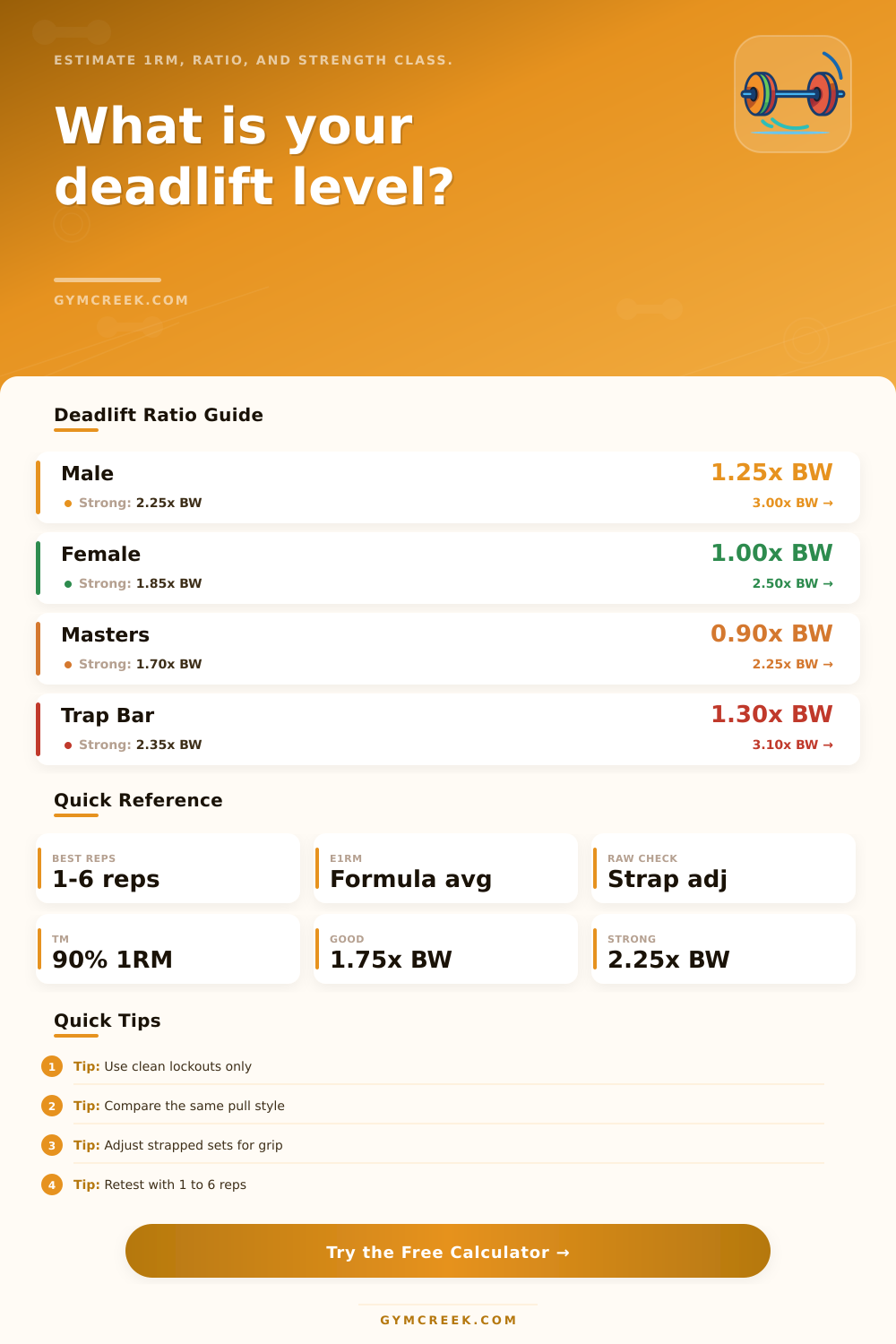
| Level | Male Ratio | Female Ratio | What it means |
|---|---|---|---|
| Beginner | Under 1.25 x BW | Under 1.00 x BW | Technique base |
| Novice | 1.25 to 1.74 x BW | 1.00 to 1.39 x BW | Regular training |
| Intermediate | 1.75 to 2.24 x BW | 1.40 to 1.84 x BW | Solid gym pull |
| Advanced | 2.25 to 2.99 x BW | 1.85 to 2.49 x BW | Strong lifter |
| Elite | 3.00 x BW+ | 2.50 x BW+ | High-level pull |
| Style | Adjustment | Best comparison | Note |
|---|---|---|---|
| Conventional | Baseline | Raw floor pull | Classic standard |
| Sumo | Baseline | Raw floor pull | Compare same rules |
| Trap bar | -5% standard | Trap bar peers | Usually shorter ROM |
| Deficit | +4% projection | Floor estimate | Harder variation |
| Block pull | -8% standard | Block pull only | Reduced range |
| RDL | +18% projection | Estimated floor pull | Not a max pull |
| Formula | Equation | Best reps | Use in result |
|---|---|---|---|
| Epley | Weight x (1 + reps / 30) | 1 to 10 | Main anchor |
| Brzycki | Weight x 36 / (37 - reps) | 2 to 8 | Conservative check |
| Lombardi | Weight x reps ^ 0.10 | 4 to 12 | Higher rep balance |
| O'Conner | Weight x (1 + .025 x reps) | 3 to 8 | Moderate curve |
| Target | Percent 1RM | Feel | Typical use |
|---|---|---|---|
| Opener | 88% to 92% | Reliable single | Meet or test day |
| Heavy triple | 88% to 92% | Hard strength | Top set work |
| Five reps | 80% to 86% | Repeatable hard | Volume strength |
| Technique | 60% to 72% | Fast and clean | Practice pulls |
💡Tips
You must understand how to use this deadlift calculator to determine your strength levels. A person can use this calculator to find a deadlift estimate, but you must first decide on the way that you will perform your deadlift test. The way that you perform the test will change the result that you recieve from the calculator.
For instance, if you perform five deadlift rep, that is not the same as if you performed the deadlift once. The calculator accounts for this by using an effective rep count that takes into account deadlift reps versus higher-rep sets and the different levels of fatigue that they causes. The calculator accounts for these types of variable in order to ensure that the estimate for an individual’s deadlift strength can be useful within the individual’s training plans.
How to Use the Deadlift Calculator and What Changes Your Result
The result from the calculator will provide an individual with their bodyweight ratio. This ratio is used to compare an individual’s deadlift to their body weight. According to the standards listed on the calculator, these ratios can define an individual as a beginner, novice, intermediate, advanced, or elite strongman.
Each of these category is divided according to the sex and age group of the individual. The bodyweight ratio accounts for the training age of the individual. Additionally, the calculator accounts for the age of the individual, as a 32-year-old and a 56-year-old individual will have different strength profile even if they have the same bodyweight ratio.
Both of these variable are accounted for in the calculator in order to produce an accurate measurement of the individuals deadlift strength. An individual’s choice of deadlift style and equipment will have a similar effect upon their estimated deadlift strength. Sumo and conventional deadlifts are similar enough that they can be compared to one another.
The exception to this is if the individual performs a trap bar deadlift, in which case the calculator will use a projection factor to account for the fact that the estimated deadlift strength should be lower. In the case of a deficit deadlift, the individual will have to account for the fact that the deadlift is more difficultly to perform due to the increased length of range of motion. In this case, the calculator will account for the additional difficulty of the deficit deadlift by adding to the individual’s estimated deadlift strength.
The same is true of a block pull or rack pull, as these exercises are considered to be easier than a floor deadlift. In this case, the calculator will adjust the individual’s deadlift strength according to the type of pull that is performed. These variables will be accounted for in the calculator to ensure that an individual does not try to use a block pull as a floor deadlift, or vice versa.
An individual’s use of straps will also change their deadlift strength. For this reason, the calculator will provide the raw-equivalent deadlift strength of an individual. This will ensure that any comparisons of an individual’s deadlift strength that incorporate the use of straps remains honest and accurate.
Another variable for an individual to consider before using the calculator is the purpose for which they would like to use their deadlift estimate. If the individual is planning to use their calculated deadlift strength as a way of meeting planning, the calculator will provide an estimate that highlights the 90-percent mark for deadlift strength. If the individual would like to use their deadlift strength as a strength block, the calculator will provide a training maximum that is lower than their one-rep maximum strength.
This strength block will ensure that the individual can incorporate this strength into their training plans in a repeatable manner. Finally, if the individual is using their calculated deadlift strength as a means of planning their training volume, the calculator will calculate a percentage that is lower than the other two options due to the increased fatigue that comes with increased training volumes. These three options will be displayed in the dropdown menu for the individual to select the correct strength percentage for their training goal.
An individual’s level of experience with deadlifting and the frequency with which they deadlift will impact the deadlift that is calculated. The more that an individual deadlift, the more reliably the strength of that individual’s calculated deadlift is. This is reflected by the confidence score that the calculator calculates.
While the experience and training frequency of the individual will have no impact upon the calculated strength of the individual, it will allow the individual to understand how much they should trust the calculated deadlift strength. There are other variable in the real world that will impact an individual’s deadlift strength. An individual’s sleep, stress, and body composition will all have an impact upon the weight that they are able to lift during their deadlift test.
An individuals body type will also have an impact upon their deadlift. An individual that has a longer torso or shorter arms will have a different leverage for their deadlift than an individual that has the body structure of the average human. While the calculator does account for body type, it is not a means of replacing the need for an individual’s coach or the review of any videos of their performances of the exercises.
To test their deadlift strength, an individual will have to perform their deadlift test a number of times. During these tests, they should use the same type of deadlift, perform the same number of reps, and use the same grip as their initial test. By performing the same test a number of times over a few months, an individual can ensure that they can accurately measure their bodyweight ratio and their distance to the next level of strength.
An individual’s deadlift strength calculated by the calculator is only as accurate as their ability to perform the same test over and over again. Therefore, they are the only individual that can control the accuracy of the calculators estimation of their deadlift strength. You should of used this tool carefuly.