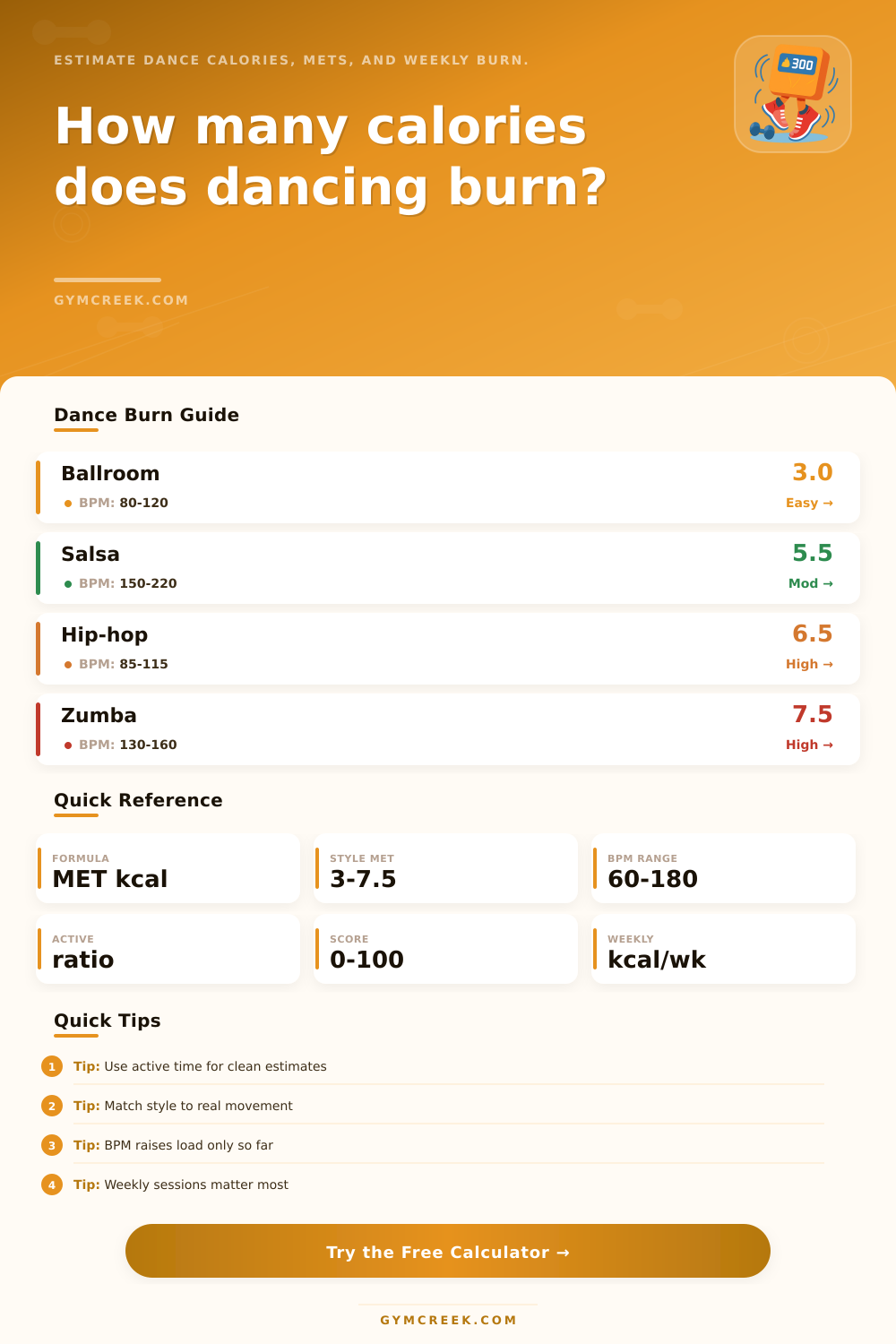
Calories Burned Dancing Calculator
Estimate dance calories from body weight, dance style, duration, intensity, song BPM, active/rest ratio, skill level, floor space, and weekly sessions.
📌Dance Presets
Presets load realistic dance sessions and recalculate automatically.
⚙Calculator Inputs
Dance calorie snapshot
Enter your session details to estimate dance calories, active time, MET band, and weekly burn.
📊Dance Metrics
📑Reference Tables
| Dance style | Base MET | Typical BPM | Use case |
|---|---|---|---|
| Ballroom or slow partner dance | 3.0 | 80 to 120 | Social dancing, waltz, basic partner steps. |
| Wedding or casual party dance | 3.5 | 90 to 130 | Mixed songs with frequent breaks. |
| Line dance or country dance | 4.0 | 95 to 140 | Repeated steps with moderate travel. |
| Ballet, barre, or technique class | 5.0 | 60 to 120 | Controlled positions and muscular endurance. |
| Salsa, bachata, or merengue | 5.5 | 120 to 220 | Partner footwork and sustained rhythm. |
| Hip-hop or street dance | 6.5 | 80 to 115 | Dynamic level changes and athletic moves. |
| Zumba or dance fitness | 7.5 | 125 to 165 | Cardio class with continuous choreography. |
| Input | Low | Moderate | High |
|---|---|---|---|
| Intensity factor | 0.86 easy | 1.00 steady | 1.22 interval |
| Active/rest ratio | Under 55% | 55% to 80% | Over 80% |
| Song BPM effect | Under 95 | 95 to 145 | 145+ |
| Cardio score | Under 45 | 45 to 70 | 70+ |
| Factor | Option | Multiplier | Why it matters |
|---|---|---|---|
| Floor space | Small space | 0.94 | Fewer travel steps and smaller movement arcs. |
| Floor space | Large floor | 1.08 | More turns, travel, and lateral movement. |
| Skill level | Beginner | 0.96 | More stopping, marking, and instruction time. |
| Skill level | Advanced | 1.07 | Higher complexity and cleaner sustained work. |
| Metric | Formula | Output | Notes |
|---|---|---|---|
| Active minutes | Duration x active ratio | Minutes | Separates moving dance time from rest or instruction. |
| Dance calories | MET x 3.5 x kg / 200 x min | kcal | Standard exercise energy equation. |
| Rest calories | 1.8 MET x kg x rest min | kcal | Counts light recovery instead of full dance effort. |
| Weekly burn | Session kcal x weekly sessions | kcal/week | Assumes similar session structure each time. |
💡Calculation Tips
Dancing can be a physical activity that burns calories, and the amount of calories that an individual dancing burns depends on several factors. Many individuals feel that dancing are a form of play rather than exercise; however, dancing does require some level of physical effort from the body. The factors that influence the amount of energy that is used while an individual is dancing include the type of dance that is performed, the length of the dance session, the tempo of the music, the skill level of the dancers, the amount of floor space available to the dancers, and the intensity of the dancing.
The type of dance that is performed can have a major influence upon the amount of energy that is expended while dancing. For instance, ballroom dancing typicaly require less physical effort from the dancers than dance forms like salsa or swing dances. Additionally, dances like hip-hop or Zumba typicaly require more physical effort than dances like ballroom.
What Affects How Many Calories You Burn Dancing
Consequently, an individual can burn more calories during a session of one dance style than another dance style. The length of the dance session may also influence the amount of energy that is burned. However, the length of the dance session must be measured in the amount of time that the dancers are actualy moving.
For instance, a dance class that lasts for sixty minutes may include several periods during which the dancers is not actually moving; dancing classes typically include time for instructors to teach new dances, to change dancing partners, and for dancers to rest beverages. Thus, the longer that an individual is actively dancing versus resting between dance sessions, the more energetic that the individual will expend. Other factors that influence the amount of energy that is burned while dancing include the tempo of the dance, the skill level of the dancers, the size of the dance floor, and the intensity with which the dancers perform their dance movements.
If the tempo of the dance sessions increases, individuals may need to perform quicker dance steps, but if the tempo of the dance music becomes too fast for the dancers, those individuals may reduce the range of their movements. Additionally, individuals that are more skilled at dancing than beginners will typicaly reduce the amount of time that they take to think about their dance movements; beginners need to take time to think about the steps that they will perform. Furthermore, if the dance floor is of a larger size than a smaller dance floor, individuals will be able to perform larger dance steps.
Finally, if the dances that are performed have a high intensity compared to dances with low levels of intensity, the body will burn more energy during those high-intensity dance movements than during low-intensity dance movements. The calculator that is provided can help an individual to understand these factors regarding the amount of energy that can be burned during dancing sessions. To use the calculator, an individual should enter their weight, the type of dance that they will perform, how long they will dance for, and the intensity at which they will dance.
The calculator will separate their dancing time spent actively dancing from time spent not actively dancing. Furthermore, the calculator will adjust for the effort that is required in the dance based off the tempo of the dance and the size of the dance floor. Finally, the calculator will calculate how many total calories will be burned each week as a result of dancing for the amount of time that the individual enters into the dance calculator.
Consistency in dancing sessions will lead to the best results for an individual over time. An individual may believe that longer dance sessions are better than shorter dance sessions; however, a shorter dance session with high levels of intensity may result in the same amount of energy burned each week as a longer dance session with lower levels of intensity. An individual may focus upon the dance style that they choose but may not consider how much of their dance session is actively dancing versus resting.
For instance, an individual may burn less energy during a ninety-minute salsa dance session with many dance breaks than they would during a forty-five minute session in which the dancers dont take any breaks. Thus, considering these different factors for dancing can change the total amount of energy that is used during dancing. Finally, dancing can impact the body in different ways.
For instance, individuals that perform steady dance moves like those in a social dance will burn less energy in their hearts and lungs than individuals that perform interval dances. While both types of dancing are beneficial for the body, they provide benefits to different parts of the body. Consequently, individuals can use the dance calculator as a planning tool to understand how different types of dance sessions may impact the results that are obtained from dancing.
Additionally, the calculator can be used to understand what may happen if an individual increases the number of dance sessions that they perform each week, or if they change the type of dance that they perform to one with a higher active-to-rest ratio. These small changes to dance sessions will result in different results for individuals over a one-month time period.