Daily Step Goal Calculator
Build a realistic daily step target from your current seven-day average, body size, workday movement, available walking time, training schedule, walking pace, and goal priority.
📌Step Goal Presets
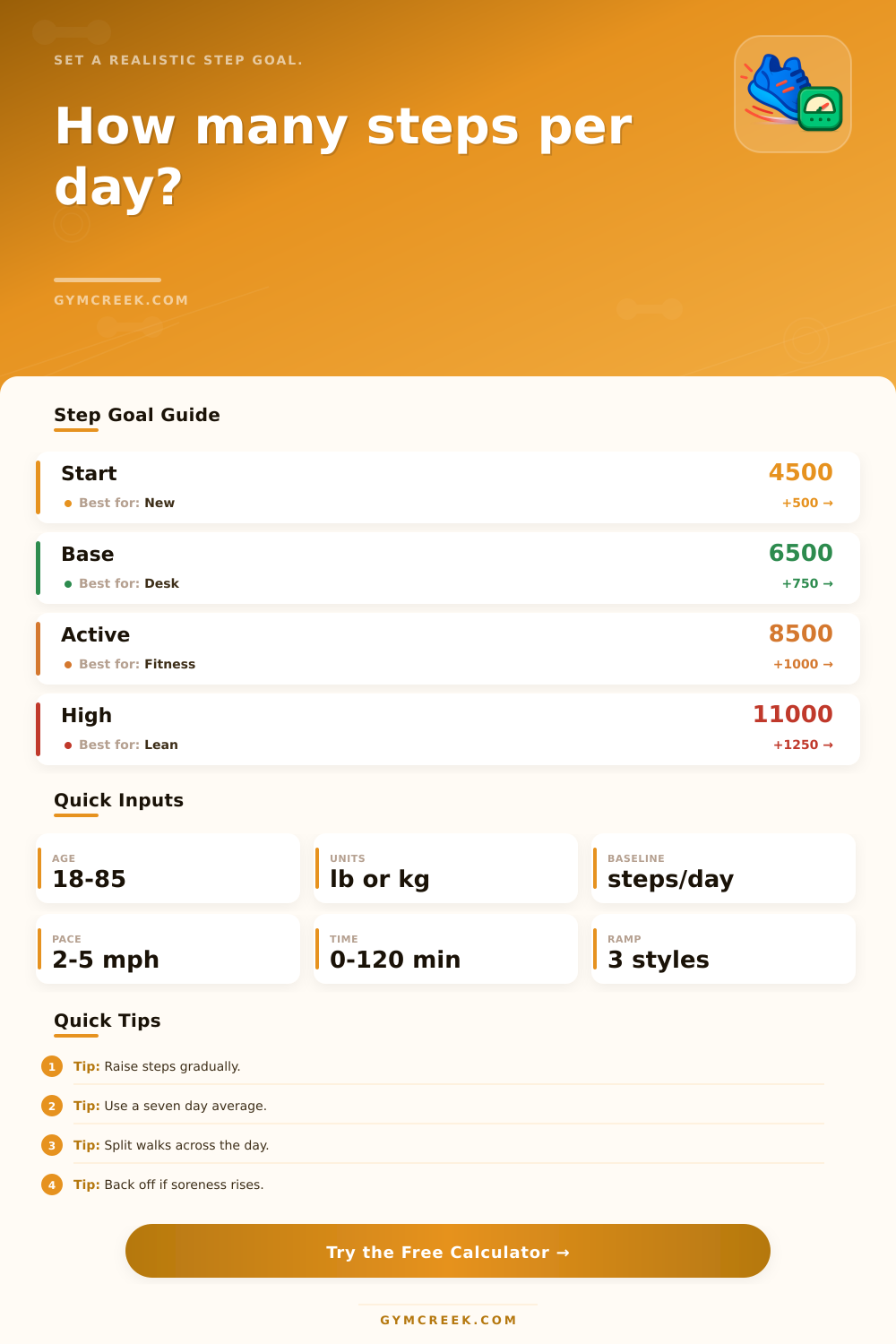
Presets fill realistic activity profiles. Use them to compare how baseline steps, available minutes, walking pace, training days, and ramp style change the final target.
⚙Goal Inputs
Daily step goal
Enter your current average, walking pace, schedule, and goal to estimate a realistic step target.
📊Calculated Metrics
📚Reference Tables
| Band | Daily steps | Typical use | Calculator cue |
|---|---|---|---|
| Low baseline | Under 5,000 | Desk-heavy or rebuilding | Start with 500 to 1,000 added steps |
| Light active | 5,000 to 7,499 | Basic health habit | Build toward 7,000 to 8,000 |
| Active | 7,500 to 9,999 | Consistent daily movement | Small increases usually work best |
| High active | 10,000 to 12,499 | Fat loss or endurance support | Protect recovery around training days |
| Very high | 12,500 plus | High activity lifestyle | Use only if recovery remains stable |
| Input | Lower target | Neutral | Higher target |
|---|---|---|---|
| Goal | Return after break | General health | Fat loss or performance |
| Workday | Physical labor | Mixed movement | Mostly seated |
| Training days | 5 to 7 hard days | 2 to 4 days | 0 to 1 day |
| Soreness | 7 to 10 | 3 to 6 | 0 to 2 |
| Ramp | Usual cap | Best for | Watch point |
|---|---|---|---|
| Conservative | 500 to 1,000 | Low baseline, soreness, return | Keep the first week easy |
| Balanced | 750 to 1,500 | Most healthy adults | Review seven-day average |
| Ambitious | 1,250 to 2,500 | Already active walkers | Do not force it on hard training days |
| Time-limited | Based on minutes | Busy schedules | Split walks into small blocks |
| Formula | Variables | Purpose | Use in calculator |
|---|---|---|---|
| Mifflin-St Jeor | Age, sex, height, weight | BMR estimate | Context only, not a diet target |
| BMI | Weight and height | Body-size context | Adjusts goal pressure slightly |
| Stride estimate | Height multiplier | Steps to distance and time | Converts walking time to step capacity |
| Progression cap | Baseline, ramp, soreness | Limit daily jumps | Keeps goal realistic for this week |
💡Step Goal Tips
Or maybe you feel like your routine is too intense or too easy. So you go to a step calculator. It is a customized step count that suits your lifestyle, it is not some random number. That’s where the daily step goal calculator comes in.
You enter details into it: How many steps do you take during the day? What does your workout routine look like? Do you train several times per week? Are there additional walks you take throughout the week? The calculator’s starting point is your baseline steps.
How to Use the Step Goal Calculator
Generally speaking, if you walk from meeting to meeting, you’ll have more than a sitter behind a desk. This happen even before you factor in deliberate exercise. That’s why it asks about your movement on workdays. This ensures the goal won’t ignore what you’re getting now, the same applies to training days. Four or five runs and lifts a week? Your legs is already carrying some weight. So the calculator reduces the additional steps to allow for recovery. And the soreness scale flags any warnings your body sends.
How quickly you can recover depends on the style of progression you choose. Someone beginning with a low mileage base or coming back from an injury will keep their jump size modest each week. But if the inputs tell it that you’ve got the recovery room. And time, to push harder, then the calculator makes that option available by using your normal pace.
The calculator estimates how long it takes based off the numbers you enter and how much time you usually have. It caps the goal if you’re unlikely to get an hour back which prevents the goal from turning into wishful thinking.
When you get the result, look at table on the page for guidance. They displays how various daily totals match popular activity levels. They also highlight which inputs will push that number higher and lower. Finally, the caution score indicates in general where the goal falls relative to your limits.
Note that a bigger caution score isn’t necessarily a sign of a bad goal. It just means you should of pay attention to how your body feels over the first couple of weeks. Be prepared to tweak if necessary.
Your week has texture that the calculator can’t see. Does it change often? Do you do more walking around on weekends with errands? Those pattern still apply. Your best bet is to check your seven-day average each Sunday and decide whether to cut or give yourself a slight bump in the upcoming week.
How are you feeling? If energy is down or soreness is rising, listen to what the body tell you rather than the number on the screen. Here’s why: Your step goal doesn’t need to be exactly right. A step goal provides direction.
All those little choices, walking an extra block when you park at work, going for a 10 minute walk around the office after lunch, or taking the long way back to your car, start to add up. They don’t have to be some dramatic change in your schedule. Those little things becomes a part of the plan when the goal feels realistic different than where you’re starting from and how much time you actualy have.