Cycling Miles to Steps Calculator
Convert outdoor or indoor cycling distance into estimated step equivalents using distance, ride time, intensity, terrain, body size, and your preferred step conversion method.
📌Ride Presets
Presets load realistic outdoor, indoor, commute, e-bike, gravel, and trail rides so you can compare step-equivalent credit across methods.
⚙Calculator Inputs
Cycling step equivalent
Results appear after calculation.
📊Conversion Metrics
📑Reference Tables
| Ride style | Typical step credit | Best input | Note |
|---|---|---|---|
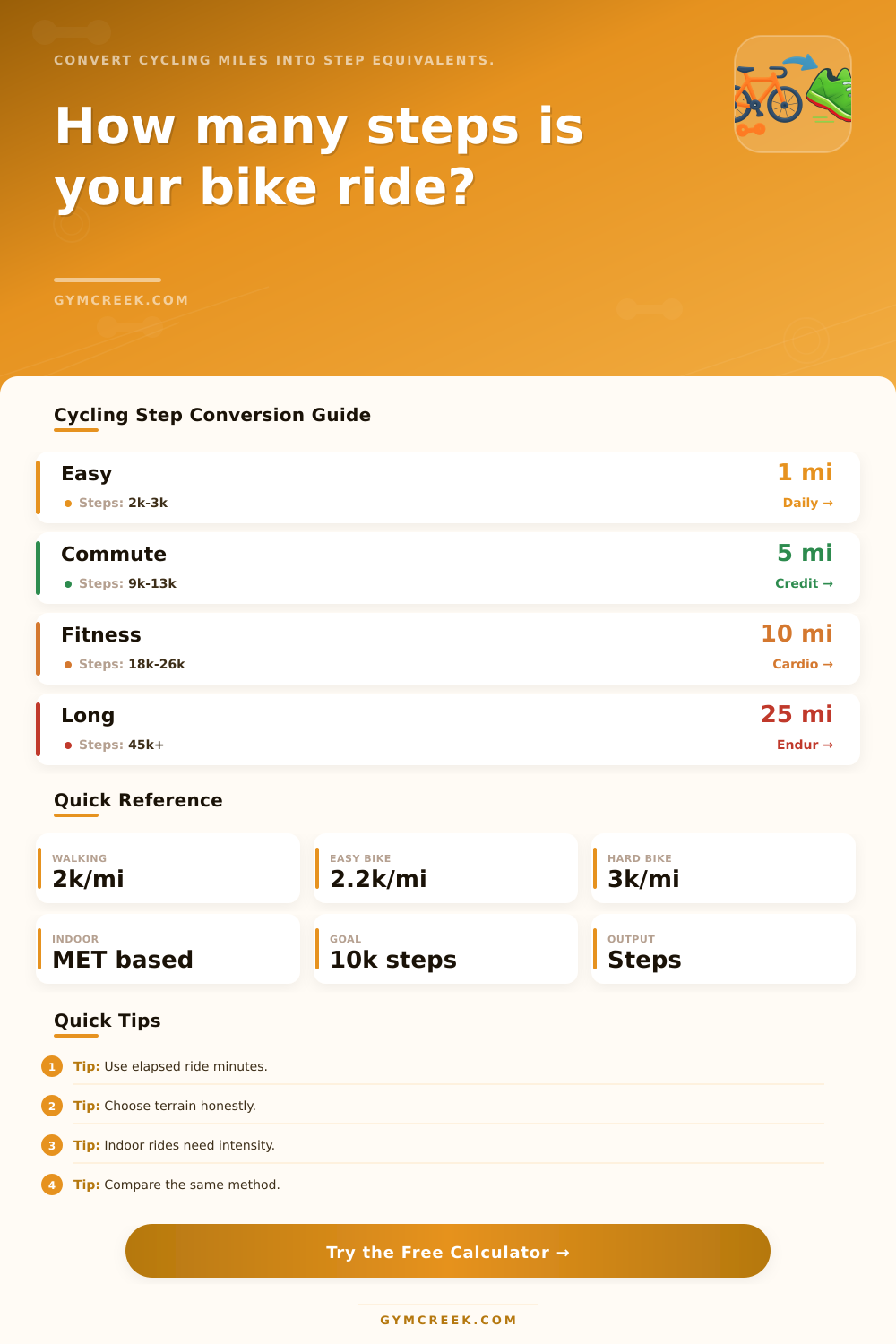
| Easy recreational ride | 2,000-2,400 per mile | Distance | Light daily movement credit |
| Moderate fitness ride | 2,400-3,000 per mile | Distance and time | Good for step-goal swaps |
| Hard interval ride | 3,000+ per mile | MET and time | Intensity matters more than miles |
| E-bike assisted ride | 1,200-2,100 per mile | Assist and terrain | Use lower credit when assist is high |
| Layer | Formula | Inputs | Use |
|---|---|---|---|
| Walking distance | Distance / step length | Miles, height | Equivalent ground steps |
| MET minutes | MET min / 3.3 x 100 | Time, intensity | Energy-equivalent steps |
| Terrain factor | Base x modifier | Road, trail, indoor | Context adjustment |
| Goal credit | Steps / goal | Goal steps | Daily tracking |
| Intensity | MET | Feel | Step method |
|---|---|---|---|
| Very easy spin | 3.5 | Conversation | Distance-led |
| Easy recreational | 5.8 | Light breathing | Blended |
| Moderate steady | 7.5 | Working | Blended |
| Vigorous fitness | 9.8 | Hard talk | MET-led |
| Intervals or race | 12+ | Very hard | MET-led |
| Method | Best for | Strength | Watch out |
|---|---|---|---|
| Blended | Most outdoor rides | Balances miles and effort | Needs duration |
| Distance-only | Simple commute logs | Easy and stable | Ignores intensity |
| MET-minute | Indoor bike sessions | Works without miles | Needs honest effort |
| Custom | Device matching | Matches your tracker | User-defined |
💡Step Conversion Tips
Fitness trackers do not count the effort used during a bicycle ride because fitness tracker are meant to count the number of steps a person takes based on the impact of there foot hitting the ground. A fitness tracker will count the number of steps a person take when their foot hits the ground, but a person does not hit the ground while riding a bicycle. Therefore, while a person is sitting on the bicycle, the fitness tracker will not count the movement of a persons leg.
Thus, the fitness tracker will not reflect the physical effort that a person puts into cycling as compared to walking, as cycling requires more physical effort then walking but the fitness tracker does not show the number of steps taken while cycling. There is no mathematical formula that can convert the number of miles that a person rides on a bicycle to the number of steps that the person performed as the number of calories or energy required for cycling can vary with the distance that a person cycle. For instance, a person can coast a bicycle down a hill which require little energy yet travels a number of miles.
Why fitness trackers do not count steps when you ride a bike
Conversely, a person can require a great deal of energy to ride up a hill which has a high degree of steepness. Because effort is required at vary levels during cycling, it is not possible to account for the number of steps by distance traveled alone. Instead, the user must account for the intensity of the bicycle ride.
The method that is used to calculate steps performed during a bicycle trip can impact the number of steps that is calculated. One method is to calculate the distance that would be traveled if the individual walk the same number of miles that were traveled on the bicycle. This approach is considered more conservative in that it does not account for the effort that an individual puts into cycling.
An alternative method is to calculate the MET minutes of exercise performed during a bicycle trip. The MET calculation values the amount of oxygen and energy used by the body during cycling compared to running in place. This calculation is more beneficial for individuals that is cycling indoors on treadmills as the distance traveled cannot be determined for indoor cycling.
Not only can the terrain that is ridden on a bicycle impact the calculation of steps performed, the type of bicycle can also impact the calculation of steps. For instance, riding on smooth road will require less energy than gravel roads. Additionally, riding an electric bike will require less energy than a manual bicycle.
These adjustment need to be made to accurately calculate the steps performed during cycling. The physical characteristic of the person can also impact the calculation of steps performed during cycling. The weight of the individual will impact the number of steps required to move the bicycle a certain distance.
A person that weigh more requires more energy to move a bicycle than a person that weighs less. Additionally, by measuring an individuals height and weight, it is possible to calculate their basal metabolic rate and their walking stride. By accounting for these characteristic, the calculation of steps performed while cycling can be accurately tailored to the individual.
The final number that is calculated through the performance of the step equivalent calculation is not the number of steps that were taken while cycling, but it is a credit of the physical effort that the individual expended while cycling. Instead of using different method to calculate the steps performed during cycling, it is better for an individual to use one method to calculate steps performed. By using the same method for cycling and walking, for instance, an individual can track the step equivalent of their endurance and cycling intensity over time.
Although the calculation of steps performed while cycling for a certain distance cannot account for each individual variable, such as the number of stop or the effect of the wind, it is still possible to use the distance, the time spent cycling, and the effort performed while cycling to determine a figure that represents the work that the body performed while cycling. Thus, though the conversion of miles to steps may not be accurate, it is still a means of reflecting the actual movement of the individual. Cycling is a form of exercise and contribute to the fitness of the individual regardless of whether the fitness tracker is counting the steps performed.