Cycling Energy Expenditure Calculator
Estimate cycling calories, mechanical kilojoules, MET load, W/kg, FTP share, calories per distance, and weekly bike energy from power, time, terrain, and rider context.
📌Cycling Energy Presets
Use measured watts when available. If you do not have power data, the calculator can estimate energy from MET intensity, speed, terrain, and ride conditions.
⚙Rider and Ride Inputs
Your ride energy
Enter ride details to estimate calories and mechanical work.
📊Metrics Grid
📑Reference Tables
| Method | Best input | Strength | Caution |
|---|---|---|---|
| Power | Watts | Bike work | Efficiency |
| MET | Intensity | No meter | Broad range |
| Blend | Watts + MET | Reality check | Still estimate |
| Speed | Distance | Fallback | Wind matters |
| Ride feel | MET range | FTP share | Typical use |
|---|---|---|---|
| Recovery | 4-6 | Under 55% | Easy spin |
| Endurance | 6-9 | 56-75% | Base ride |
| Tempo | 9-12 | 76-90% | Firm work |
| Hard | 12-16 | 91%+ | Race work |
| Context | MET effect | Energy read | Note |
|---|---|---|---|
| Flat road | 1.00x | Baseline | Steady |
| Hilly | 1.15x | Higher | Surges |
| Gravel | 1.12x | Higher | Surface drag |
| Drafting | 0.92x | Lower | Less drag |
| Output | Formula | Inputs | Why it matters |
|---|---|---|---|
| Bike kJ | W x sec / 1000 | Power, time | Work done |
| Power kcal | kJ / eff / 4.184 | kJ, eff | Food energy |
| MET kcal | MET x kg x hr | MET, mass | No power |
| BMR | Mifflin | Age, size | Daily context |
💡Cycling Calculation Tips
But all of this is theoretical unless we thinks about what’s actually happening with our bodies out on the bike. We’re pushing down on the pedal, the bike go forward and our muscles takes in stored fuel and turn it into mechanical work. So how do we know how much fuel we used? And why does it depend on something other then speed or distance?
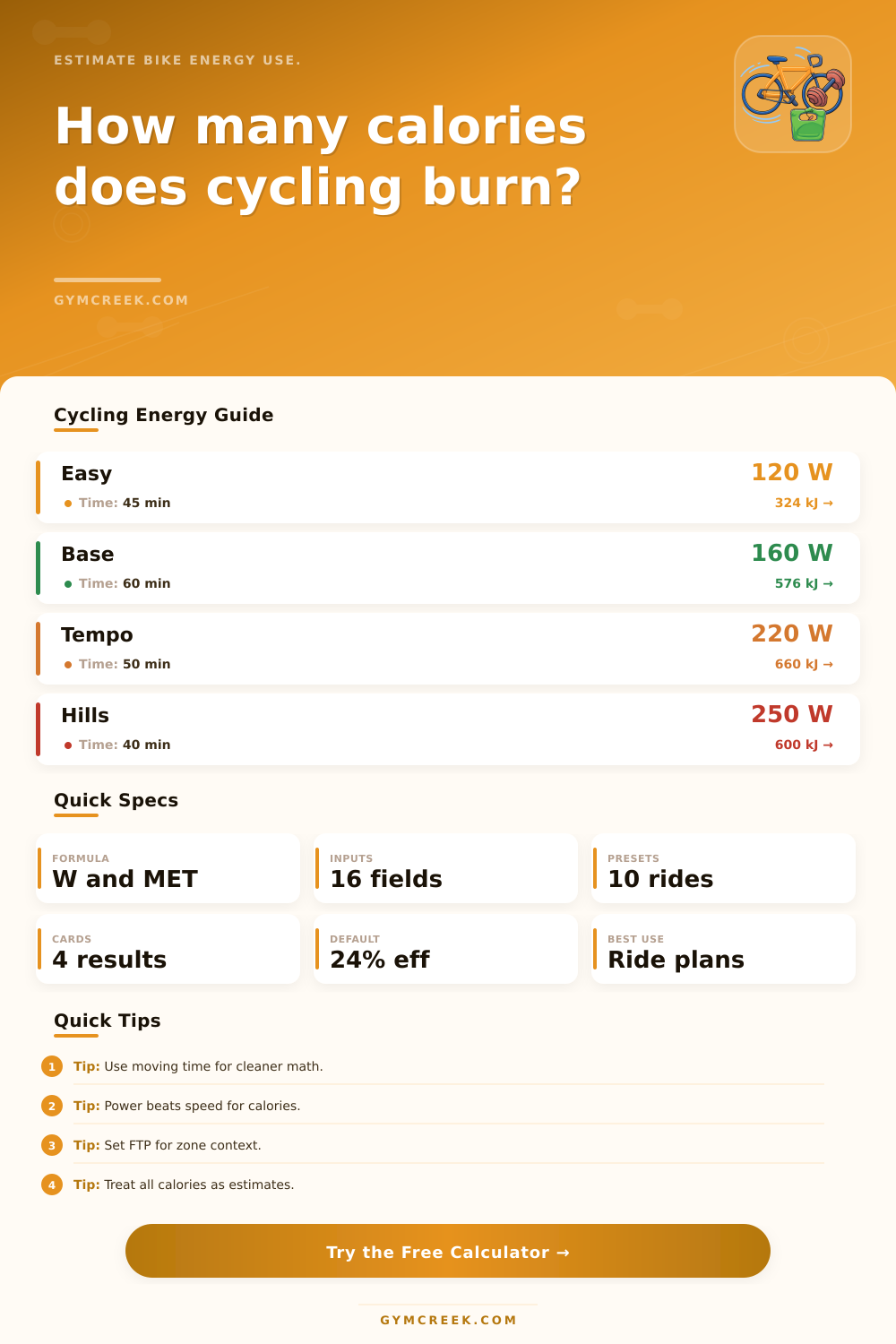
The most straightforward way to understand this is in terms of watts; that’s power, which measures force over time. The formula take both of those values. Ride duration and average watts, and transforms them into mechanical kilojoules. That’s the real-world work performed by bicycle. Calories are a single step further removed. These are food energy needed to create those kilojoules. How much you need vary according to how efficient your body is at converting chemical energy into mechanical output. Gross efficiency among most rider hovers somewhere between 22 and 25 percent.
How to Calculate Calories You Burn While Cycling
What does that mean? It means that most of the energy you burn goes nowhere near pedals. Efficiency is a more important metric than most are aware. While two riders may do equal mechanical work, they might have burned different numbers of calorie because one is more or less efficient in their use of energy (which is lost as heat).
Once you put in your efficiency, duration, and power into the calculator, it does all the math for you; taking the guessing out of converting to caloric output. But even the answer has its level of uncertainty, since efficiency depend on fatigue, cadence and previous fueling. If you don’t have a power meter there’s an alternative: MET values that instead estimate energy cost from intensity rather than direct measurement, and combine it with some inputs like bike type, wind, and terrain. That way it will reflects what actualy happened. Even though you might be going the same speed on one ride as another, a flat ride in still air is cheaper then the same distance on gravel in a headwind.
On the page itself are some reference tables showing how the multiplier shifts the estimate (so you’ll see why two rides at the same distance end up yielding different amounts of energy). And that’s where body weight comes into the discussion. When you move more mass, there’s a higher cost in energy. The same applies to riders: the heavier you are, the more kilojoules you use at the same power level and the more calories you burn at the same relative intensity. This is why the tool request weight as part of its calculations of both MET-based calories and W/kg. The former tells you how many calories you need; the latter tells you your power-to-weight ratio. If you’re planning your training volume or trying to decide what to eat before/after a long ride, you want to know both.
This is just a per-ride estimate. That one ride mean something different when taken once a week versus four times a week. Two of those same rides will be different then four. The tool takes that one-ride figure and multiplies it by your inputted number of rides. You get a total amount of energy in one week, which helps you plan how much to recover and also how much energy you’ll need to take in during that period of time.
No number can account for the day to day variance, or your own physiology. Things like recent training, heat, and hydration will all impact your efficiency and won’t be captured perfectly by any formula. If you know what each input means, and what each output is really capturing, then you still have a solid baseline based off which to work from.