Distance Cycling Calculator
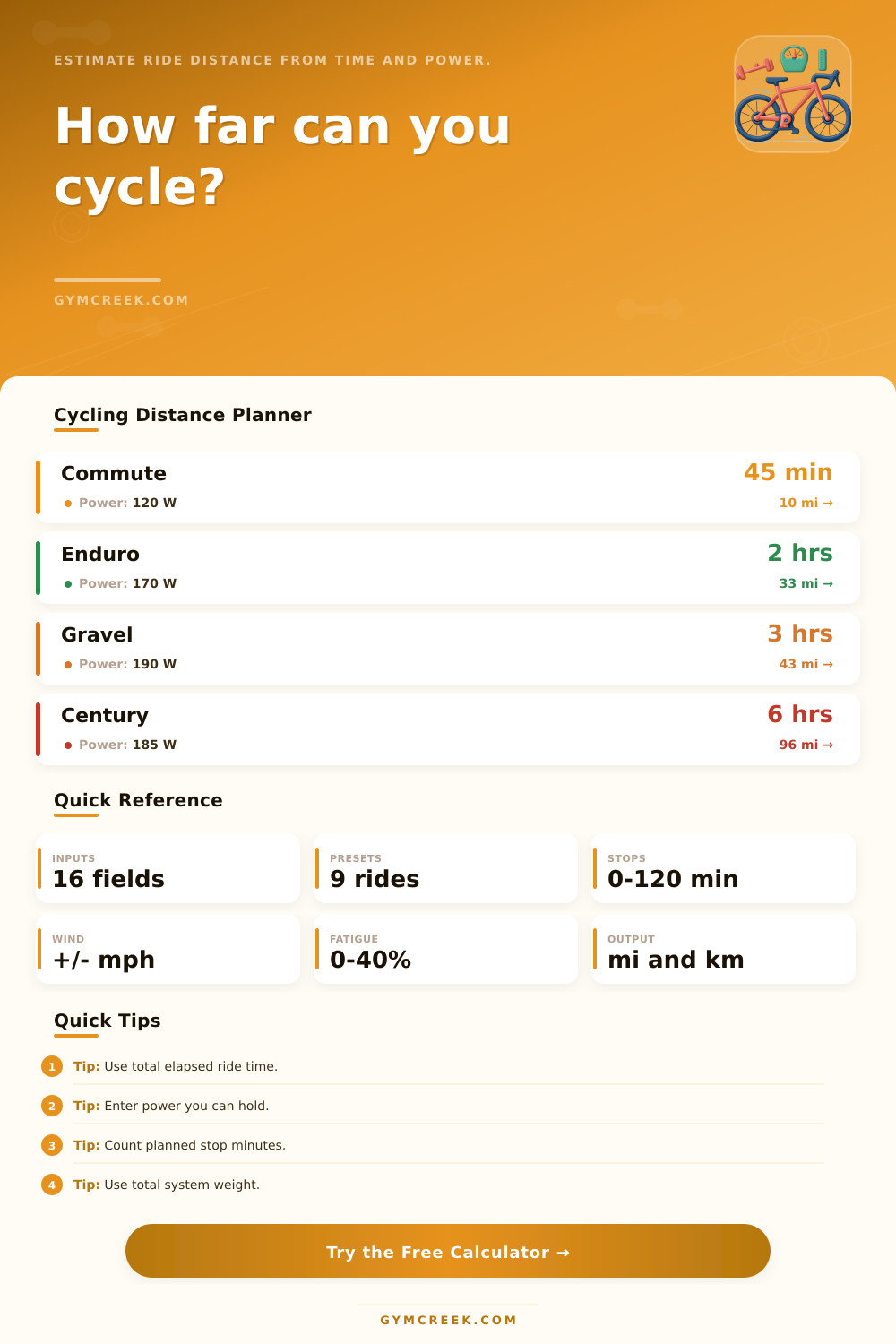
Estimate how far you can ride from available time, sustainable power, bike type, terrain, planned stops, elevation gain, wind, and fatigue instead of only converting a finished ride into speed.
📌Ride Presets
Each preset fills a complete distance planning scenario with ride time, stops, power, weights, terrain, elevation, wind, bike type, and fatigue settings.
⚙Calculator
Cycling distance snapshot
Enter ride time, power, terrain, stops, elevation, wind, bike type, and fatigue to estimate cycling distance.
📊Distance Metrics
📑Reference Tables
| Band | Typical distance | Time window | Planning note |
|---|---|---|---|
| Short utility ride | 5 to 15 miles | 30 to 75 minutes | Stops and route directness matter more than peak speed. |
| Endurance ride | 25 to 55 miles | 2 to 4 hours | Power, terrain, wind, and fueling shape the final distance. |
| Long road day | 60 to 110 miles | 4 to 8 hours | Planned stops and late fatigue can remove several miles. |
| Trail or gravel day | 15 to 70 miles | 2 to 7 hours | Surface resistance and climbing reduce distance quickly. |
| Bike type | Drag profile | Rolling setup | Best use |
|---|---|---|---|
| Road bike | Moderate | Low resistance | Paved endurance distance planning. |
| Aero bike | Low | Low resistance | Open roads, steady power, fewer stops. |
| Gravel bike | Moderate | Medium resistance | Mixed surfaces and rough roads. |
| Mountain bike | High | High resistance | Trails, dirt, and technical terrain. |
| Condition | Low impact | High impact | Distance effect |
|---|---|---|---|
| Headwind | 5 mph | 20 mph | Can cut a planned ride short, especially on fast roads. |
| Surface | Smooth pavement | Loose dirt | Higher rolling resistance lowers speed at the same power. |
| Elevation | Rolling terrain | Long climbs | Climbing power reduces horizontal distance per hour. |
| Stops | Short regroup | Long cafe stop | Elapsed distance falls even if moving speed stays strong. |
| Formula | Variables | Output | When to use |
|---|---|---|---|
| Power balance | Watts, drag, Crr, grade, mass | Ground speed | Estimate distance from sustainable power. |
| Moving time | Total time minus stops | Ride hours | Separate distance while riding from elapsed trip pace. |
| Distance = speed x time | Ground speed and moving hours | Miles and kilometers | Primary distance estimate. |
| Energy = watts x seconds | Effective watts and moving time | Mechanical kJ | Compare workload across ride plans. |
💡Tips
Planning a distance for a ride within a specific period of time can be challenging due to so many variable that may affect the distance that you can cover during that period. While you may be able to plan for a specific time period for which you will be on the bike, your power, the number of stop that you make, the wind, the road, and your level of fatigue will determine the actual distance that you will travel. The gap between time and distance is one of the reasons that many ride planning attempts end in failure.
The distance calculator for this page will calculate the distance for you with your specified variables; you wont have to guess at your distance with the potential for inaccuracies in calculating each of these factor. One of the first variables that you can consider is the amount of time that you have available for your ride. The calculator will reflect any time that you plan for your ride.
What Affects How Far You Can Ride
However, the calculator will automatically subtract the number of minute that you plan to take off from your total time for stops. Your total time for your ride will likely not include the time that you will spend stopping at place during your ride; without accounting for this, you may not reach your target distance for your ride. Another of the main variables that will impact your distance that you can ride is your power.
The power that you can produce while you are on the bike impact your distance; the more power that you can create, the more distance that you will be able to ride. Your power will impact your ability to overcome air resistance, rolling resistance, and the slope of the road that you ride on. If you plan for an amount of power that you are unable to sustain for long periods of time, your distance will likely be more less than you plan and your estimate will not be accurate after becoming fatigued.
The third of the main variables that will impact the distance that you plan to ride is your weight. Your weight and the weight of any gear that you plan to ride with will affect the distance that you can ride. The more that you and your gear weigh, the more distance that you will find it difficult to travel; your rolling resistance will increase, as will the difficulty in climbing hills.
The difference in speed between a road bike and a touring bike is an example of the impact that your weight can have on the distance that you may travel during your ride. Other variables that may impact your distance are the terrain of the route that you plan for and the impact that wind may have on your ride. Terrain impacts the efficiency with which you can turn your power into movement; pavement is more efficient than gravel or dirt path.
Similarly, if the wind is working against you on your ride, your distance will be less than if you were traveling without any headwinds. Other factors to consider include your level of fatigue. While you may have been strong during your ride when you planned for it, your strength may wane during your actual ride; you may have begun to feel fatigued due to the heat of the environment, dehydration, or the number of hour that you have ridden.
The calculator does permit you to account for the percentage of reduction in your power due to fatigue; without accounting for this, the calculator will assume that your strength is the same at the end of your ride as it was at the beginning of the ride. The elevation gain that exists along your ride may have an impact upon your distance; your ability to maintain your power will change with the grade of the road. For instance, a route with hills will require you to use some of your power to overcome gravity.
The calculator takes this elevation gain into consideration to calculate the distance that you may travel on your ride. In addition to the factors mentioned above, stops will impact your total distance that you may travel within the time frame that you plan. The calculator shows your moving speed and average speed for the ride; the stops that you take during your ride will lessen the average speed.
The tables listed on this page can help classify the type of ride that you may do. For instance, short ride will require different input than endurance or gravel bike rides. Finally, there will always be some small variable along your ride that the distance calculator cannot account for.
Traffic, construction, and other unexpected event will impact the distance that you ride. While the distance calculator may provide you with a great distance for your calculated time, plan for some extra time for the unexpected. By utilizing the distance calculator for your ride, you can perform the same route with different variables and see the way that distance changes with alterations to certain variable.
For instance, you can alter the variables for the impact of the wind, your stops, or your fatigue. By understanding the changes to distance with these changes to variables, you can gain an understanding of the way that each of these variable may impact your total distance for a ride.