Cleat Position Calculator
Estimate cycling cleat setback, spindle-to-heel mark, stance width change, toe angle, and fit check metrics from foot measurements, crank length, riding purpose, float, and knee tracking.
📌Presets
Presets load realistic cycling fit scenarios and calculate recommended cleat setback, spindle reference, lateral stance change, toe-angle setup, and comparison metrics.
⚙Calculator
Cleat position snapshot
Enter foot marks, stance width, crank length, float, and knee tracking to estimate a starting cleat setup.
📊Fitness Metrics Comparison Grid
📑Reference Tables
| Riding Purpose | Common Setback | Typical Feel | Fit Note |
|---|---|---|---|
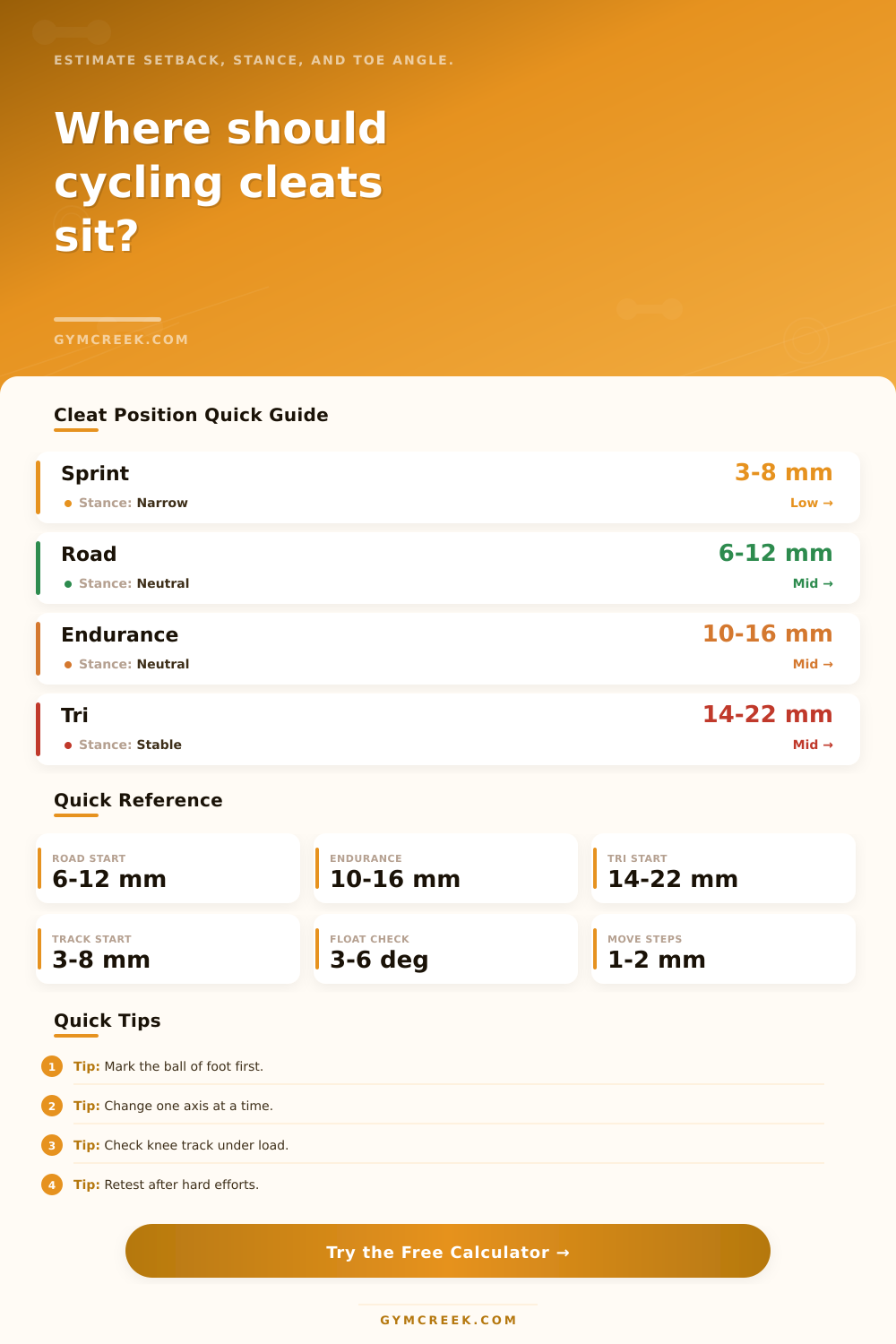
| Sprint or criterium | 3-8 mm behind ball | Sharp forefoot drive | Check calf load |
| Road all-round | 6-12 mm behind ball | Balanced power | Good first setup |
| Endurance | 10-16 mm behind ball | Stable over hours | Often calmer foot |
| Triathlon or TT | 14-22 mm behind ball | Hip angle support | Pairs with aero posture |
| Gravel or MTB | 12-22 mm behind ball | Control and comfort | Rearward is common |
| Knee Or Foot Cue | Likely Cleat Axis | Small Change | Retest |
|---|---|---|---|
| Knee dives inward | Stance width | Add 1-3 mm outside | Moderate climb |
| Knee tracks outward | Stance width | Move foot inward 1-3 mm | Steady tempo |
| Heel rubs crank | Lateral offset | Move cleat inward | Standing effort |
| Toes seek outward angle | Rotation | Add toe-out within float | Hard seated effort |
| Forefoot hot spot | Fore-aft | Move cleat back 1-2 mm | Long interval |
| Measurement | How To Use | Typical Range | Why It Matters |
|---|---|---|---|
| Foot length | Scale setback | 230-310 mm | Bigger feet need more offset |
| Ball mark | Spindle reference | 68-75% of foot | Locates metatarsal head |
| Pedal stance | Lateral baseline | 145-160 mm road | Controls knee path |
| Hip width | Target stance | 300-420 mm | Sets proportional support |
| Float | Rotation safety | 0-9 degrees | Allows natural tibial motion |
| Formula | Variables | Output | Use |
|---|---|---|---|
| Setback base | foot length × 4.2% | mm behind ball | Scales by foot size |
| Purpose bias | ride type adjustment | mm | Moves stable or aggressive |
| Spindle mark | ball mark - setback | heel to spindle | Transfers to shoe sole |
| Target stance | hip width × factor | mm center width | Lateral starting point |
| Toe angle | natural angle × 65% | degrees | Sets rotation within float |
💡Tips
You know that specific knee ache that arrives exactly forty minutes into a long ride. No matter how fit they are, no matter what the weather, it usually happens because of things like cleat placement; where the cleats is sitting two millimeters too far forward; foot rotation, your feet not matching the direction your hips will tolerate; stance width; or float reserve. Many cyclists is tinkering tinkerers. Setting up their pedals is more art than science. They wing it, make guesses, fiddle with things until they feel good. Sounds harmless? Hours wasted! And its dangerous for your knees.
Because guessing and adjusting your pedal setup can risk injury, you should of use this calculator to do all the math. By entering your precise foot dimensions, this calculator does all the math. Then it translates fuzzy feelings into measurable numbers. Based off your foot dimensions, it computes float reserve. It also estimates your toe angle, stance width changes, and setback.
How to Fix Knee Pain with a Calculator
Setback (fore/aft positioning) is the meat of the change. That’s where the cleat sits in relation to the ball of your foot. Your foot provides the leverage. And that leverage can be powerful or painful depending on position of the pivot point. Sit forward and you’re asking way more of your Achilles tendon. You develop hot spots beneath the metatarsal heads. Sit too far back and you inhibit power transfer. Plus, you put stress into your lower back because your hips has to over-rotate.
Based on your heel-to-ball measurement and foot length, the tool establishes a neutral starting point and then moves it according to riding style. Sprinters need to place their feet a bit further forward to generate explosive torque. On the other hand, endurance riders gets some benefit from being biased rearward. It opens the hip angle while minimizing calf fatigue throughout long rides.
Lateral position is less talked about but equally important. While pedaling, you want to keep your knees tracking in-line with your hips. Going too narrow will cause your knees to dive inward and create friction between the knee, or stress the outer portion of your knee. Going too wide causes you to stress the inner portion of the knee. The calculator asks you what your current pedal stance is and your standing hip width. Based on that information, it calculates whether you require a cleat shift or spacers. And it gives you an exact recommendation, down to millimeters. Down to millimeters! Not “make it a little wider” or “make it a little narrower.” No, it doesn’t do that. Because over-correcting will cause other problems in the kinetic chain.
Another often-overlooked cause of possible extra pressure is toe angle. When standing naturaly, most of us don’t point our toes directly forward. Our feet naturally tend to be angled either slightly out or slightly in. Fighting your body’s anatomy by forcing your feet to be completely straight up and down are counterproductive. Your natural foot angle and amount of pedal float is considered in the calculation. You’re recommended a rotation that aligns with your joint angles. This way, you never exceed the safe operating range of your cleat system. And you still have adequate freedom to move comfortabley. Ignoring this alignment is like trying to run sprint drills with your ankles taped straight when they naturaly bend sideways.
There’s something called float reserve that gets overlooked. Float refers to how much your foot will be able to move slightly inward/outward as you perform your pedal stroke. This movement happen without straining the knee or requiring you to unclip. So if your float reserve comes up low on the calculator, then you’re using an angle that doesn’t have a lot of margin for error. You may want a bit less toe-out. Or perhaps you’d benefit from more flexible pedals (particularly when going hard at a higher cadence). Those tweaks will help spare your joints in that scenario.
The table on the page make it clear: Different rides call for different balances of freedom and stability. Theory becomes reality during testing. Set a baseline with the calculator, and go ride hard. Feel any heat spots? Back off the cleat a millimeter or two. Start to wobble on your knees? Double-check your stance width. Only make one adjustment at a time. That way you can find out exactly which adjustment solved it. It’s all about precision. The accuracy of getting this correct means less pain at the end of the race and more miles in comfort. Your legs will thank you for that.