Calories Burned Cycling Calculator
Estimate ride calories from body weight, outdoor speed, distance, climbing, terrain, wind, drafting, bike type, and optional power watts.
📌Ride Presets
These presets are outdoor cycling scenarios, not spin-bike RPM templates.
⚙Calculator
Cycling calorie snapshot
Enter your ride details to estimate burn.
📊Cycling Metrics
📑Reference Tables
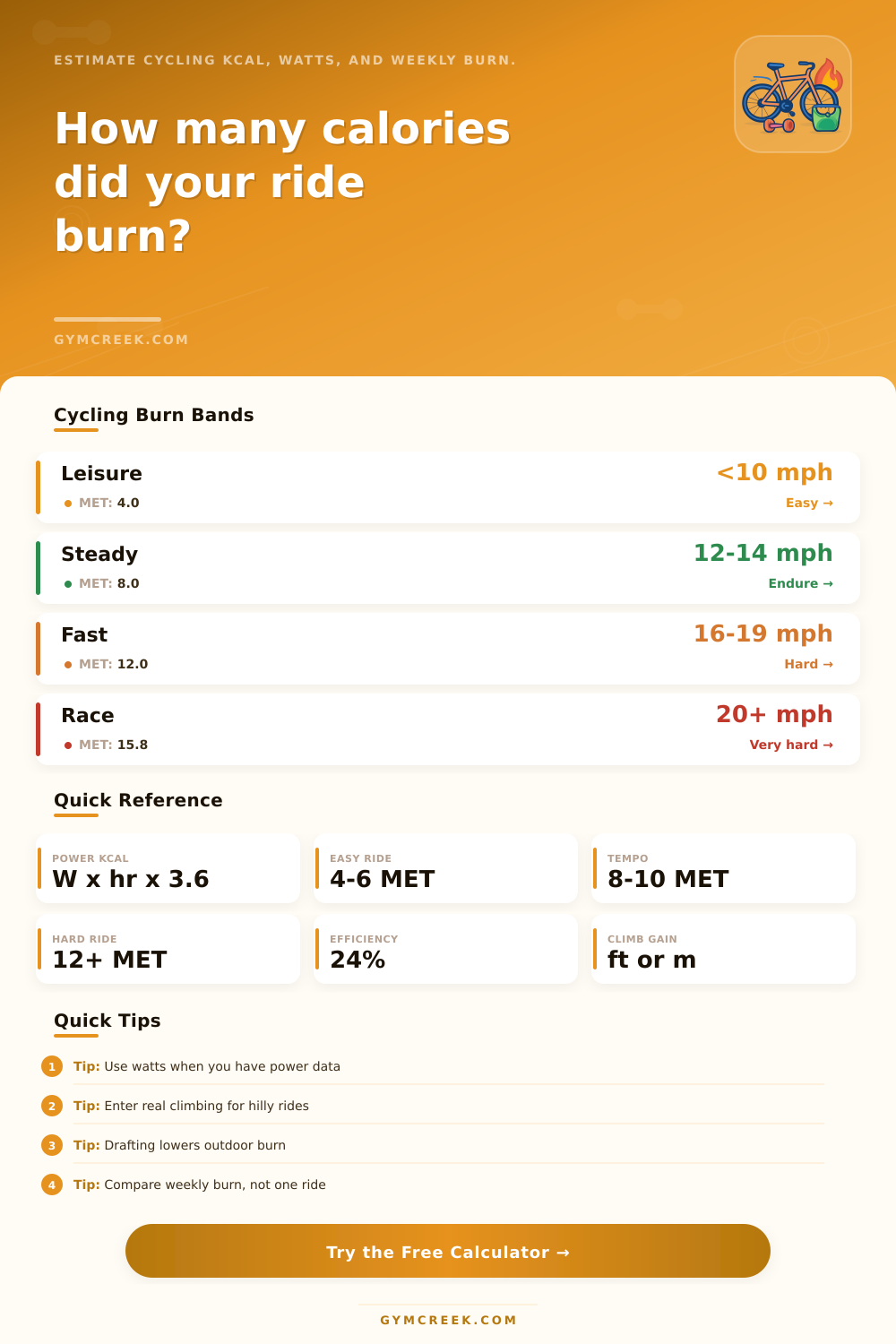
| Speed band | Imperial | Metric | Base MET |
|---|---|---|---|
| Leisure cycling | <10 mph | <16 kph | 4.0 |
| Easy road | 10-11.9 mph | 16-19 kph | 6.8 |
| Steady road | 12-13.9 mph | 19-22 kph | 8.0 |
| Brisk road | 14-15.9 mph | 23-26 kph | 10.0 |
| Fast road | 16-19 mph | 26-31 kph | 12.0 |
| Race pace | 20+ mph | 32+ kph | 15.8 |
| Bike or surface | Factor | Bike mass | Use case |
|---|---|---|---|
| Road bike | 1.00 | 8 kg | Road rides |
| Commuter | 0.95 | 13 kg | Utility pace |
| Gravel bike | 1.10 | 10 kg | Mixed roads |
| Mountain bike | 1.25 | 13 kg | Trail riding |
| Cargo bike | 1.15 | 23 kg | Loaded rides |
| E-bike assist | 0.65 | 22 kg | Assisted ride |
| Average power | 70 kg kcal/hr | Effort feel | Notes |
|---|---|---|---|
| 100 W | 358 | Easy | Recovery |
| 150 W | 538 | Steady | Endurance |
| 200 W | 717 | Tempo | Sustained |
| 250 W | 896 | Hard | Strong ride |
| 300 W | 1075 | Very hard | Race effort |
| Adjustment | Factor | Burn effect | When it matters |
|---|---|---|---|
| Rolling route | 1.08 | Higher | Repeated rises |
| Rough gravel | 1.16 | Higher | More rolling drag |
| Headwind | 1.18 | Higher | Solo exposure |
| Paceline | 0.82 | Lower | Sheltered group |
| Aero/TT | 0.90 | Lower | Lower drag |
💡Tips
The calories that an individual burn while cycling is dependent upon several different variable. Each of these variables have the ability to change the amount of energy that an individual spends while cycling. While many cyclists may believe that the effort that they feel while cycling is the same than the amount of energy that they expend, the two values is often different.
Variables like weight, speed, terrain, and wind can all have an impact on the amount of energy that is spent while cycling. One of the main variable that impacts the amount of energy that an individual spends cycling is the weight of that individual. An individual has to overcome the weight of their body, as well as the weight of their bicycle, with each stroke of their pedals.
What Affects the Calories You Burn When Cycling
An individual that weigh more than another individual will expend more energy while cycling, assuming that both individuals are cycling the same bicycle and performing the same ride. Because the heavier individual is moving their body and their bike over a greater distance, their body expends more energy to perform that movement. Thus, an individual’s body weight is a necessary input for a cycling calorie calculator to accurately model the amount of energy that their body expend while cycling.
The speed at which an individual is cycling is another variable that impact the amount of energy that is spent while cycling. However, the relationship between speed and energy spent is not linear. After reaching approximately 14 mph, the faster that an individual rides, the more energy is required to move that individual and their bicycle.
This is due to the increased energy requirement to overcome aerodynamic drag at higher speeds. Thus, two cycling scenario may have the same distance being covered, but one scenario may spend more energy than the other if the speed is greater in that scenario. The elevation gain that an individual experience during a cycling session is another variable that can increase the amount of energy that is spent while cycling.
Cycling uphill require that the individual expend energy to lift their body and their bicycle against the force of gravity. Thus, more energy is spent during a climb than during a descent of the same hill; energy cannot be recovered during the descent. Furthermore, cycling calculators separate the energy used to climb hills from the energy spent to cycle at certain speeds, allowing individuals to view how much energy was expended performing each of these task.
Other variables include the type of bicycle that an individual is using, the type of surface upon which they are cycling, wind resistance, and drafting. Each of these variables can impact the amount of energy that an individual expends. For instance, an individual using a mountain bicycle on a gravel road will expend more energy than an individual using a road bicycle on smooth pavement.
Additionally, the energy that an individual expends will decrease if that individual is drafting behind another bicyclist; drafting reduce the amount of air that the bicyclist must move. Cycling calculators account for each of these variables to provide an accurate calculation of the energy expended during a ride. One of the most direct variable to measure the energy that an individual expends while cycling is the power that they produce.
Power is measured in the average wattage that an individual produce while cycling. Wattage is the most direct measurement of the energy that an individual expends while cycling. Thus, if an individual has access to their average wattage, a calorie calculator can use that value to model the energy expenditure of that individual when cycling.
As many individuals will expend less energy than their wattage indicates, having access to both their perceived effort and their wattage will allow them to make better cycling and training decision. Beyond cycling itself, the weekly totals of energy that are expended cycling is a more important variable than the energy that is spent during any individual cycling session. Three cycling sessions at moderate level may contain more total energy than one long and strenuous cycling session.
By tracking the energy spent each week, an individual can determine the total energy that their body expends during cycling, and understanding that energy allow an individual to make decisions regarding their cycling program. Finally, the most effective use of cycling calorie calculators is in the comparison of different scenarios. By altering the settings for variables like wind and drafting, for instance, an individual can view how much energy is spent during different scenarios.
By comparing these scenarios, an individual can understand the reason that they may feel that one ride was harder than another ride. Additionally, by tracking the energy that an individual expends while cycling, they can recognize any pattern in those measurements. Following such recognition of patterns, an individual can create cycling and training goal based on those patterns.