Cycling Average Speed Calculator
Calculate moving speed, elapsed speed, cycling pace, lap splits, route-adjusted speed, power context, and weekly bike volume from ride distance and time.
📌Cycling Speed Presets
Presets fill realistic ride logs. Replace them with GPS, trainer, or head-unit data to compare moving speed, elapsed speed, and route-adjusted trends.
⚙Ride and Rider Inputs
Cycling speed snapshot
Enter ride distance and moving time to calculate average speed.
📊Speed Metrics Grid
📑Reference Tables
| Output | Formula | Inputs | Use |
|---|---|---|---|
| Moving speed | Distance / moving time | Distance, ride time | Ride performance |
| Elapsed speed | Distance / elapsed time | Stops included | Event planning |
| Pace | Time / distance | Moving time | Split pacing |
| Weekly volume | Ride x frequency | Speed, rides | Training load |
| Band | Road mph | Road km/h | Typical read |
|---|---|---|---|
| Easy | 8-12 | 13-19 | Recovery or casual |
| Fitness | 13-16 | 21-26 | Steady solo ride |
| Tempo | 17-20 | 27-32 | Trained rider |
| Fast | 21+ | 34+ | Group or race |
| Factor | Speed effect | Calculator input | Compare with |
|---|---|---|---|
| Climbing | Often slower | Elevation gain | Similar gain rides |
| Headwind | Often slower | Wind field | Weather-matched days |
| Gravel | Lower speed | Bike type | Same surface |
| Stops | Elapsed drop | Break minutes | Moving speed |
| Scenario | Distance | Time | Speed |
|---|---|---|---|
| Commute | 9 mi | 42 min | 12.9 mph |
| Base ride | 32 mi | 2 hr | 16.0 mph |
| Metric ride | 100 km | 3:45 | 26.7 km/h |
| Time trial | 40 km | 1:02 | 38.7 km/h |
💡Cycling Speed Tips
Average speed is one of those metrics most cyclists follow during workouts, but it’s not always a complete picture. Getting 17 miles per hour can reflect many different situations. It could mean riding at a speed that hit that mark in two hours. Or it could be after three hour with a headwind, a coffee break, and a flat tire. If you’re planning the duration of an event, or trying to gauge your actual fitness improvement, it’s a distinction worth noting.
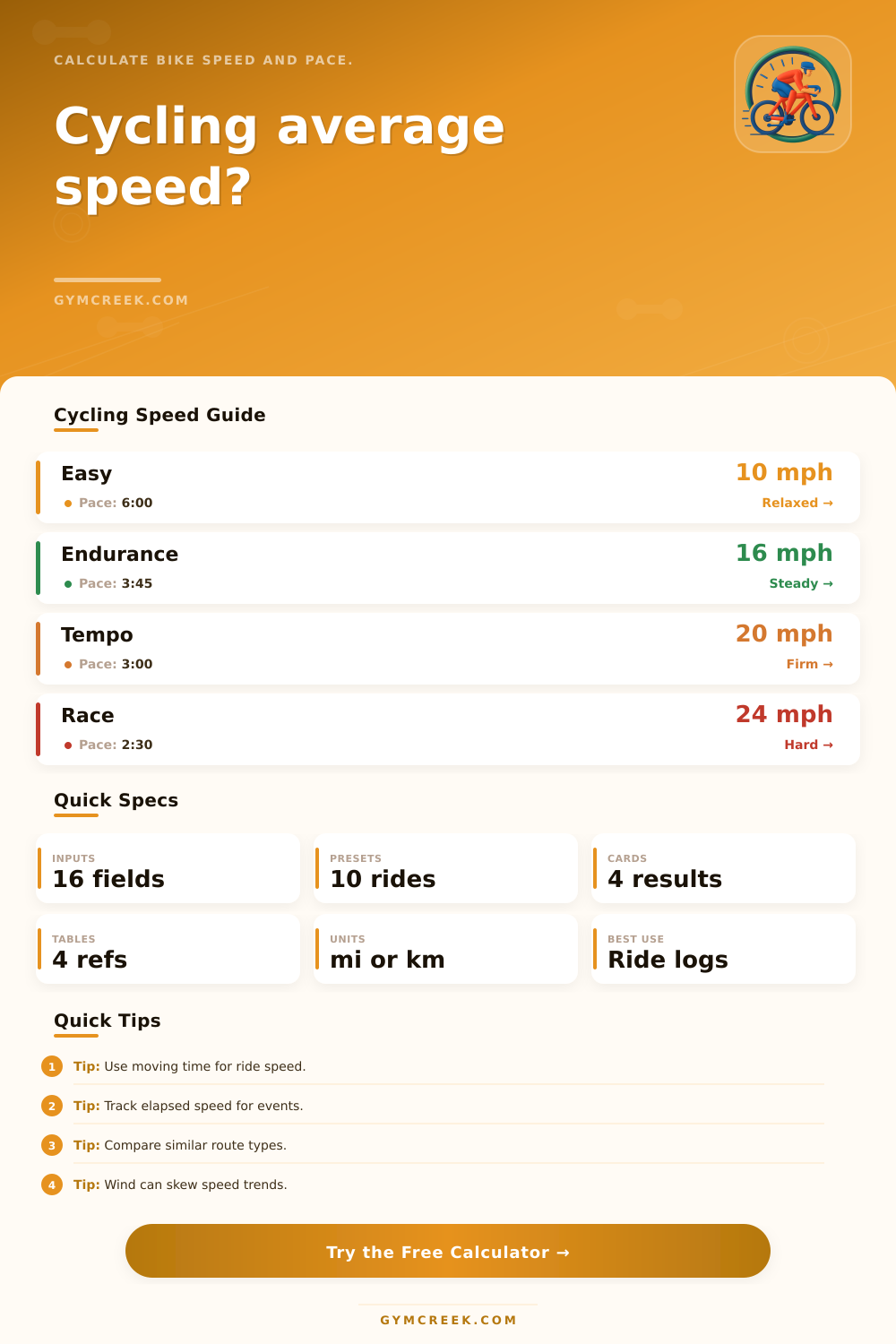
Elapsed speed include all paused time. It is your moving speed plus stop-and-go time. This is why elapsed speed differ from moving time on routes where you have mechanical problems, wait at traffic signals, or stop for lunch break.
Why Your Speed Numbers Can Be Tricky
The calculator above accepts moving time, distance ridden and stopped minutes as inputs and then calculates both metrics. Having those two number allows you to distinguish between your riding quality and interruptions in a typical day out on bike.
It gets even more complicated when you add elevation gain and wind speed into the equation. Your effort level might have felt the same as another ride. However, your average speed will be lower on a ride with lots of climbing then on a flat loop of the same distance. In the moment, headwinds also work this way, but a tailwind on the return trip can mask the cost it took on the outbound leg. The tool accounts for that, allowing you to compare rides across different courses, without having to guess what part of the difference is due to weather versus terrain.
Add in some power data. The calculator can absorbs functional threshold power and average watts and display power-to-weight and intensity factor. That tells you if that pace is indicative of good conditions or solid riding. It takes in bike type and cadence as well so you can further dial it down to account for surface drag and pedaling style; both of which impact what percentage of your energy go toward moving forward.
Rides can be tied back to weekly volume. Projected time and distance offer some idea based off how closely your schedule hews to developing endurance… I.e., if you ride the same loop four times a week, are you gaining fitness or merely repeating the same stimulus? While no individual speed number conveys that context, it’s far more important for understanding your own fitness than any isolated metric. Most long-term progress come from steady volume, not peaking at any given moment.
It is useful to know when to trust your numbers for specific decisions, such as using moving speed to compare how fit you will be on different routes. When do you care about elapsed speed (when trying to hit a cutoff window or get somewhere at a certain time)? Don’t obsess over one number on any given ride, but track both of them over months. The calculator takes away the math and lets you see pattern more clearly. You should of used it more often. It naturaly helps you see what is happening with your progress.