Cube Method Calculator
Build a Cube Method powerlifting cycle by rotating heavy, explosive, and repetition work across squat, bench press, and deadlift with training-max based loads.
📌Cube Presets
Presets load different lifter profiles, training max choices, wave positions, and assistance volumes so you can compare conservative and aggressive Cube Method setups quickly.
⚙Calculator
Cube Method wave snapshot
Enter your maxes to build the next heavy, explosive, and repetition targets.
📊Cycle Metrics
📑Dynamic Wave Tables
| Lift | Method | Main work | Load range | Assistance cue |
|---|---|---|---|---|
| Squat | --- | --- | --- | --- |
| Bench | --- | --- | --- | --- |
| Deadlift | --- | --- | --- | --- |
| Week | Squat | Bench | Deadlift | Intensity cue |
|---|---|---|---|---|
| 1 | --- | --- | --- | --- |
📘Reference Tables
| Method | Base intensity | Common sets | Intent | Stop cue |
|---|---|---|---|---|
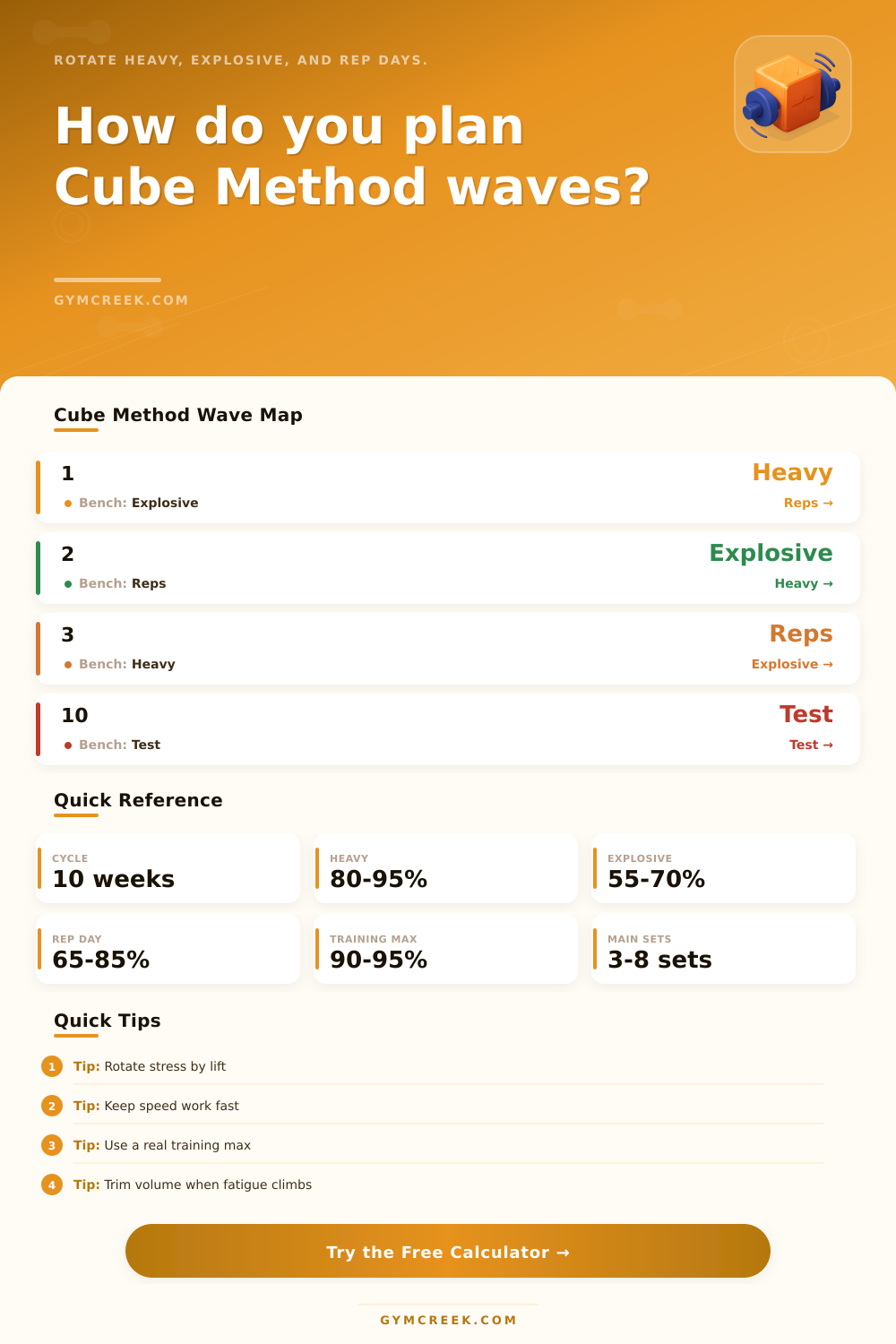
| Heavy | 80-95% | 1-5 sets | Top-end practice | Bar speed fades |
| Explosive | 55-70% | 6-8 sets | Fast force output | Speed slows |
| Repetition | 65-85% | 2-4 sets | Volume and grit | Form breaks |
| Test | 90-103% | 1-3 attempts | Express strength | No grinding |
| Emphasis | Main lift | Primary assistance | Secondary cue | Volume note |
|---|---|---|---|---|
| Off floor | Deadlift | Deficit pulls | Paused deadlift | Moderate |
| Lockout | Bench/deadlift | Board or rack work | Triceps focus | Low-mod |
| Off chest | Bench | Paused bench | Dumbbell press | Moderate |
| Quad drive | Squat | Front squat | High-bar pause | Moderate |
| Posterior chain | Squat/deadlift | RDL | Good morning | Low-mod |
| Lifter state | Training max | Why | Best for | Risk |
|---|---|---|---|---|
| Beat up | 88-90% | Recovery room | Long cycles | Too easy |
| Normal | 90-93% | Balanced stress | Most lifters | Low |
| Sharp | 93-95% | Specific load | Meet prep | Medium |
| Peaking | 95-98% | High intent | Short push | High |
💡Cube Method Tips
The Cube Method was created as a training program to be used by lifters who eventually plateau in there abilities to lift heavy weight. For these reasons, many lifters finds that lifting the same heavy weights over time results in the weights feeling increasingly difficultly to lift and leads to the development of joint pain. The method attempt to provide a solution to these problems by training each lift with three different quality: qualities of lifting heavy weights, lifting at speed, and lifting with volume.
For each lift, the method ensure that the lifter experiences each of these three quality before forcing the lifter to experience the same lift of one of these quality again. To determine with what degree of each quality the lifter should train, a calculator can assist the lifter. The calculator determines the percentage of the lifters one-repetition maximum that the lifter should lift during training based off the lifters current one-rep maximum lift and the level of fatigue that the lifter feels currently.
Cube Method: Three Simple Ways to Train
The lifter inputs their desired training max percentage into the calculator. For example, percentages between 90% and 93% is suggested for most lifter, as training at percentages close to the one-repetition maximum can lead to overtraining. Additionally, the fatigue slider will adjust the percentages that the calculator outputs for each quality if the lifter feels particularly sore or rested; lower percentage will be assigned if the lifter feels rested so as to avoid increasing the fatigue that the lifter feels each week.
The goal selector allow the lifter to adjust the training to focus upon developing strength, speed, or recovery; increasing the percentage of heavy lift if the goal is to develop strength, increasing the percentage of explosive lift if the goal is to develop speed, or decreasing the intensity of each lifting session if the goal is to provide recovery for the muscle. The calculator outputs the percentage of the one-repetition maximum that each lift will be performed at, the stress score for that training cycle, and the ten-week training schedule for the lifter. Each lift will have a target for its heavy day, explosive day, and repetition target; these targets ensure that the lifter feels prepared for the next performance of the lift with heavy weights.
Furthermore, the stress score will combine the intensity of each of the three quality with the fatigue level and the frequency with which each lift is performed each week. If the stress score is above the recommended “moderate” range for strength, the program will recommend low or moderate volume to reduce the strain placed upon the muscles. The ten-week training schedule includes rotations of the three different training methods, and the cycle will end with a test of the lifters strength or a deload week for the lifter to reduce the strength of the assigned lift.
Each lifter must make a choice of which rotation of training method to utilize within the ten-week cycle. A three-day lifting schedule can be utilized either if the lifter needs additional recovery for their muscle, or if they utilize other type of strength training methods on their off-days from the gym. Alternatively, a four or five-day lifting schedule is appropriate for lifter who can recover quickly from each training session.
Additionally, the lifter can adjust the assistance volume; higher assistance will require the lifter to perform more exercise and more single-leg exercise into their training routine, but will also increase the fatigue that the lifter feels after training; lower assistance will require the lifter to attend training for a shorter time period. The calculator will adjust for these choices in the recommendation of the total volume for the lifter. Some of the most common mistake for lifters with the Cube Method includes either treating each training session as if it will be a heavy lifting day, or ignoring the fatigue level of the lifter.
For these reasons, the rotation may collapse over time as the lifter begins to experience three heavy lifting days each week instead of one. Additionally, the strength gains that is allowed within the program may be missed entirely if the lifter ignores the built-in increase to the strength percentage within the cycle each week. Finally, the lifter can target the weak-point for emphasis; for instance, if the lifter is struggling with performing deadlift off of the floor, the assistance routine can be increased to include deficit pull; if the lifter struggles with bench press off of the chest, incorporating paused bench press and additional dumbbell work into the routine will allow the lifter to gain strength in that lift.
The Cube Method is an effective method of strength training for lifter due to the requirement of performing three different type of lifting quality for each lift before repeating any of those quality. This period of time allow for the body to recover from the fatigue that is gained after performing the strongest session of the week, while still allowing the body to gain strength in those other quality. Furthermore, because the body has already experienced the strongest lifting session of the week, the body is able to recover during the subsequent week of the ten-week cycle.
By removing the need for the lifter to perform the calculations for the method, the focus of the lifter can shift to ensuring that the lifter feels that the rotation of method for each lift fits in with the lifters schedule and energy level.