CrossFit Weight Calculator
Scale CrossFit benchmark loads from your 1RM, WOD, movement pattern, Rx weight, athlete level, fatigue factor, rep scheme, and scaling target.
📌WOD Loading Presets
Presets are planning examples. Replace the 1RM and Rx load with your tested movement standard and your gym's written workout prescription.
⚙Calculator Inputs
WOD weight snapshot
Enter your WOD details to calculate Rx percentage, scaled load, expected work, volume load, and safety scaling.
📊Metrics Grid
📑Reference Tables
| Benchmark | Typical load intent | Default reps | Pacing cue |
|---|---|---|---|
| Fran style sprint | Light to moderate thruster cycling | 45 barbell reps | Break before failure |
| Grace or fast 30 reps | Moderate clean and jerk density | 30 barbell reps | Quick singles work |
| Isabel or fast snatch | Skill-heavy Olympic cycling | 30 barbell reps | Technique first |
| Diane deadlift volume | Moderate posterior-chain fatigue | 45 barbell reps | Protect back position |
| DT barbell complex | Longer grip and shoulder fatigue | 135 barbell reps | Plan breaks early |
| Athlete level | Suggested WOD cap | Good use | Warning sign |
|---|---|---|---|
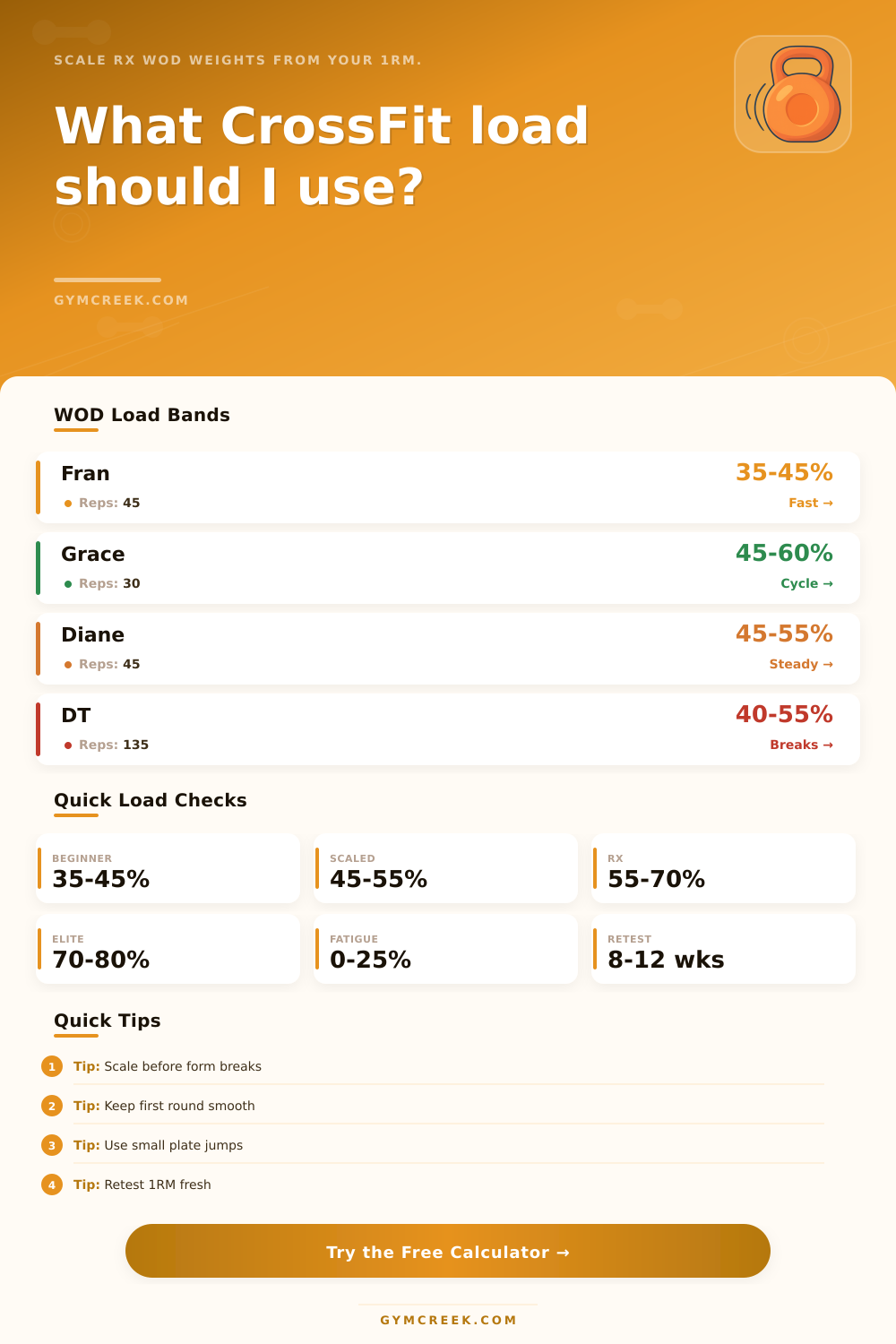
| Beginner technique base | 35-45% of 1RM | Learning positions | Missed reps |
| Scaled regular | 45-55% of 1RM | Class consistency | Long singles |
| Intermediate RX hopeful | 55-65% of 1RM | Hard sustainable work | Grip collapse |
| RX athlete | 65-72% of 1RM | Prescribed attempts | Redline too soon |
| Competitor or elite | 72-82% of 1RM | Competition setting | Failed mechanics |
| Movement | Safety modifier | Why it matters | Scale first when |
|---|---|---|---|
| Thruster | Moderate reduction | Squat and press fatigue stack | Front rack collapses |
| Clean or power clean | Small reduction | Singles are easier to manage | Catches get low |
| Snatch or power snatch | Larger reduction | Overhead skill degrades quickly | Bar path drifts |
| Deadlift | Moderate reduction | Back position under density | Hips rise early |
| Shoulder-to-overhead | Moderate reduction | Pressing fatigue changes lockout | Ribs flare hard |
| Output | Formula | Inputs used | Interpretation |
|---|---|---|---|
| Rx percentage | Rx load / 1RM x 100 | 1RM and Rx load | How heavy the written workout is |
| Scaled load | 1RM x adjusted target percent | Level, fatigue, target, movement | Recommended working load |
| Estimated reps | Rep rate x time cap | WOD, scheme, load ratio, confidence | Likely completed work |
| Volume load | Scaled load x completed reps | Load and work estimate | Total external work estimate |
| Safety scaling | Risk score from load, fatigue, skill | All inputs | Whether to hold, scale, or cut load |
💡Tips
Selecting the correct barbell weight for a CrossFit workout involve considering both the written prescription for the workout and your physical capacity. The written prescription for a workout may seem attainable, but as fatigue enters the body, the prescription may become difficult to fulfill. For CrossFit workouts, it is important to consider if the body can moves the barbell repeatedly throughout the workout.
Being able to move the barbell once dont indicate the ability to move the barbell many times throughout the workout. To determine the barbell weight for a workout, the calculator consider several factors of the individual taking the calculation. Those factors include the individual’s one-repetition maximum for the movement, the written prescription for the workout, the format for which the workout will be completed, the level of fatigue the athlete feel currently, and the target for scaling the barbell for that workout.
How to Pick the Right Barbell Weight for a CrossFit Workout
Each of these factor can change how the barbell feels during the workout. For instance, performing a workout using a specific number of repetitions can feel more completely different than performing a workout that includes a different number of repetitions. Additionally, the type of movement performed will change how the barbell feels; thus, the calculator change the calculated weight of the barbell if an individual changes from thrusters to cleans or snatches.
Finally, the level of the athlete with the workout indicate the maximum intensity of the workout, but the fatigue level of the athlete can reduce that maximum intensity. Although many individuals look at the calculated weight of the barbell to be used during a workout, the safety cue that the calculator provides is also important. The safety cue indicate whether or not the calculated weight of the barbell still matches the stimulus for the workout as written, or if the calculated weight of the barbell changed the type of test that is to be performed during the workout.
If long rests or single repetitions of movements are to be performed during the first round of a workout, the weight of the barbell may have changed the nature of the workout to a test of grip strength as opposed to a test of power and endurance in relation to the barbell. Thus, the athlete should adjust the barbell weight prior to the start of the CrossFit competition. The reference tables on the calculator page provide context to the calculations of the barbell weight.
These tables explain the relationship of various benchmarks to an individual’s one-repetition maximum for a movement. In addition, the tables explain how the pacing that is required during a workout change with the format of the workout and the type of movements that are to be performed. These tables are not rigid guidelines for workout performance, but they do provide a starting point from which to consider the variables of a CrossFit competition prior to it’s start.
Additionally, the tables also provide information regarding breathing fatigue, which may make a barbell feel heavy in relation to it’s weight during a strength training session. One of the common mistake with using the calculator is to always chase the written prescription for a workout, regardless of the fatigue level of the athlete. While this may allow for better performance during the early rounds of a competition, the athlete will likely experience slower performance during later rounds of the competition.
The alternative of always using a lower barbell weight to account for fatigue will remove the intensity of the workout that the coach prescribed to the athlete. The best barbell weight for any given workout is the one that allow an athlete to perform the first round of the workout smoothly, yet ensure that the athlete can perform the last round of the workout to be legal with the competition. Beyond the calculated weight of the barbell, the value of the calculator also exists in the habit of thinking about the different variables associated with a workout prior to the start of that workout.
Over time, an athlete will begin to notice which movement cause fatigue more quick than others. The athlete will also begin to notice how recovery impact their ability to perform with any given barbell weight. Finally, the athlete will begin to notice when written prescriptions for workouts do not match with the athlete’s current physical capacity.
Thus, not only does the calculator help an individual to understand the weight of the barbell, but it also helps the individual to learn about these variables more quick.