CrossFit Percentage Calculator
Set a WOD barbell load from your 1RM lifts, workout percentage, reps, fatigue factor, cycling style, target RPE, body weight, and movement pattern.
📌WOD Loading Presets
Presets are loading examples only. Replace the 1RM values with recent, technically clean maxes for the movement you are actually using.
⚙Calculator Inputs
WOD loading snapshot
Enter your 1RM lifts and workout settings to calculate load, scaling, intensity, volume, and pacing.
📊Metrics Grid
📑Reference Tables
| WOD type | Common percent | Rep range | Loading intent |
|---|---|---|---|
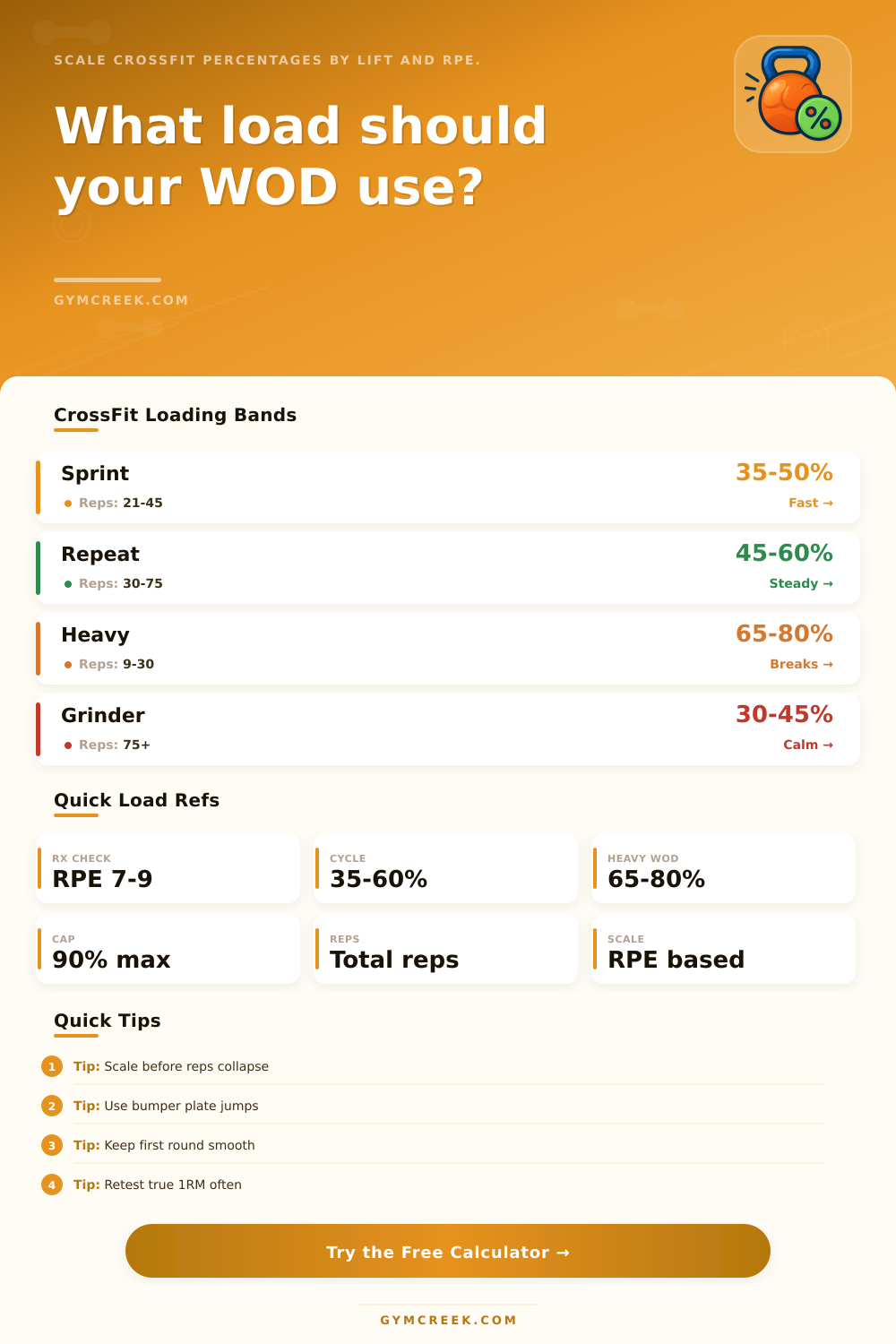
| Fast benchmark | 35% to 50% | 21 to 45 reps | Big sets, minimal hesitation, breathing controls pace |
| Repeatable metcon | 45% to 60% | 30 to 75 reps | Short planned breaks before grip or position fails |
| Heavy benchmark | 65% to 80% | 9 to 30 reps | Singles or doubles with deliberate setup and safe positions |
| Long grinder | 30% to 45% | 75+ reps | Submaximal load that lets you keep moving under fatigue |
| Style | Load modifier | Best use | Pacing cue |
|---|---|---|---|
| Touch-and-go sets | -4% | Light to moderate cycling where grip and breathing matter | Break before bar speed changes |
| Quick singles | 0% | Olympic lifts, shoulder-to-overhead, or technical fatigue | Hands return to bar on a clock |
| Mixed cycling | -2% | Most class WODs with moderate density | Start smooth, then switch to singles if needed |
| Strategic breaks | +2% | Moderate-heavy loads with planned small sets | Rest before failed reps, not after |
| Heavy singles | +4% | Low-rep heavy work inside a metcon | Brace, lift, step back, repeat |
| Movement | 1RM anchor | Common scaling issue | Practical check |
|---|---|---|---|
| Snatch | Snatch 1RM | Position loss and missed turnover under fatigue | Load should allow technically clean singles |
| Clean | Clean 1RM | Pulling becomes slow before the lungs fail | First reps should look like warm-up reps |
| Jerk or shoulder-to-overhead | Jerk 1RM | Lockout and dip drive fade when breathing spikes | Choose a load that does not force press-outs |
| Thruster | Lower of clean and jerk, then 90% | Front-rack breathing and squat speed compound quickly | Unbroken first set should still feel controlled |
| Squat | Squat 1RM | Leg fatigue changes later gymnastics and conditioning | Preserve depth and tempo before chasing RX |
| Deadlift | Deadlift 1RM | Back position and grip often fail before raw strength | Use fast singles if lumbar position fades |
| Calculation | Formula basis | Inputs used | Purpose |
|---|---|---|---|
| Prescribed load | Movement 1RM x workout percent | Selected lift and workout percentage | Builds the first RX-style target from strength capacity |
| Scaled load | Prescribed x style x RPE x fatigue | Cycling style, target RPE, fatigue factor | Adjusts for repeatability inside the WOD |
| Intensity percent | Scaled load / movement 1RM | Scaled load and movement 1RM | Shows actual training intensity after scaling |
| Volume load | Scaled load x total reps | Scaled load and reps | Estimates total barbell tonnage for the workout |
💡Tips
A CrossFit percentage calculator allow a CrossFit athlete to calculate the correct barbell weights to use for a given workout based off that athlete’s one-rep max for that movement. Many athletes will guess at their desired barbell load for their workouts. However, guessing at there loads can often place athletes in incorrect loads.
The percentage calculator for CrossFit workouts remove this guesswork by using mathematics to calculate the load that will be most suitable for the workout an athlete choose to perform. By using the percentage calculator, an athlete can maintain their loads throughout their workout. The three main inputs for the CrossFit percentage calculator are the athlete’s movement one-rep max, the percentage of their one-rep max that they want to lift, and the total number of repetitions that they will perform for the workout as well as the fatigue factor.
Use a CrossFit Percentage Calculator to Find the Right Weight
The cycling style and the target rate of perceived exertion can also be entered into the calculator. For instance, if the athlete is performing a set of touch and go repetitions, the calculator will adjust the weight that the athlete lift due to the additional requirement of grip strength and breathing required for touch-and-go repetitions. For heavy singles where an athlete rest between repetitions, the calculator will add additional weight to the barbell due to the ability to rest.
The percentage calculator processes all of these inputs at once so that the athlete dont have to calculate each of these loads in their head. Beyond calculating the loads that the athlete should lift during their workout, the percentage calculator also provide information about the load that has been calculated. The calculator will display the scaled load, which is the load that takes into account the adjustments for cycling style and effort.
This load is repeatable for the athlete during there workout. The intensity will also be displayed, which is the percentage of the athlete’s one-rep max that the calculated load is. This can help the athlete understand if they are performing a workout that trains for power or capacity.
The volume load is another output of the calculator, which is an estimate of the total amount of work that the athlete will complete during the workout. This value can help the athlete plan their muscle recovery. Finally, the calculator will display the set plan and the pace cue so that the athlete understands how often to rest and how to lift the barbell.
Reference tables are provided for CrossFit workouts that do not fit into the standard categories. For instance, both the fast benchmark and the long grinder use barbells. However, the loading intention for these two workouts are not the same.
The fast benchmark requires an athlete to perform many sets with little hesitation while lifting the barbell. The long grinder requires an athlete to maintain even movements while lifting the barbell despite fatigue. These reference bands allow an athlete to read the loads that the percentage calculator calculate to ensure that it is within the apropiate range for the workout.
Many athletes can make mistakes despite accurately entering the numbers into the CrossFit percentage calculator. For example, many athletes will treat the first round of a workout as if it is a strength set. However, the first round of a workout should actualy be a warm-up for the later rounds of the workout.
The CrossFit percentage calculator cant monitor an athlete’s grip strength or the path of the barbell that they lift. Thus, athletes must monitor their own performance. Another mistake that athletes make is ignoring the pacing suggestion that the percentage calculator provides.
The suggestion is made for athletes to ensure that their first round of the workout is as smooth as possible. If the load forces athletes to slow down or break early in the first round, the load is incorrect for that workout. Body weight is also included in the percentage calculator because relative intensity for an athlete is far more important than the absolute number of pounds that they are lifting when fatigue set in.
For instance, two strength athletes may lift the same two-hundred-pound barbell. However, the intensity of the pound that they are lifting is different. One athlete may be lifting seventy-five percent of their body weight while the other athlete may only be lifting forty percent of there body weight.
This percentage have a significant impact on the effort that an athlete can sustain for sets of high repetitions. Additionally, it also has an impact upon the strength of the lungs as well as the posterior chain of the athlete. The CrossFit percentage calculator is a starting point for athletes.
An athlete should enter the numbers into the calculator and the cook should load the barbell. However, an athlete should of perform a quick set of repetitions with the load calculated by the percentage calculator. If the athlete feels that the load is too heavy for their first few repetitions, they should reduce the load on the barbell before beginning the workout.
Conversely, if the athlete feels too light with the calculated load, they should add some weight to the barbell so that they dont ruin the stimulus that their workout intend to provide their muscles. Although the percentage calculator provides the math to get an athlete close to their target load, the athlete’s movement will determine if the load that they calculate is the correct load for that CrossFit workout.