CrossFit Open Percentile Calculator
Estimate your Open percentile, competitive band, qualification gap, rank target, and consistency score from your rank, entrant count, division, workout spread, age group, region, and field size.
⚡Open Presets
Presets are illustrative Open profiles. Replace them with your final leaderboard rank and official entrant count for a cleaner comparison.
📋Athlete Inputs
Your CrossFit Open standing
Enter your official leaderboard details and calculate to see your percentile and target gap.
📊Metrics Grid
📘Percentile Band Reference
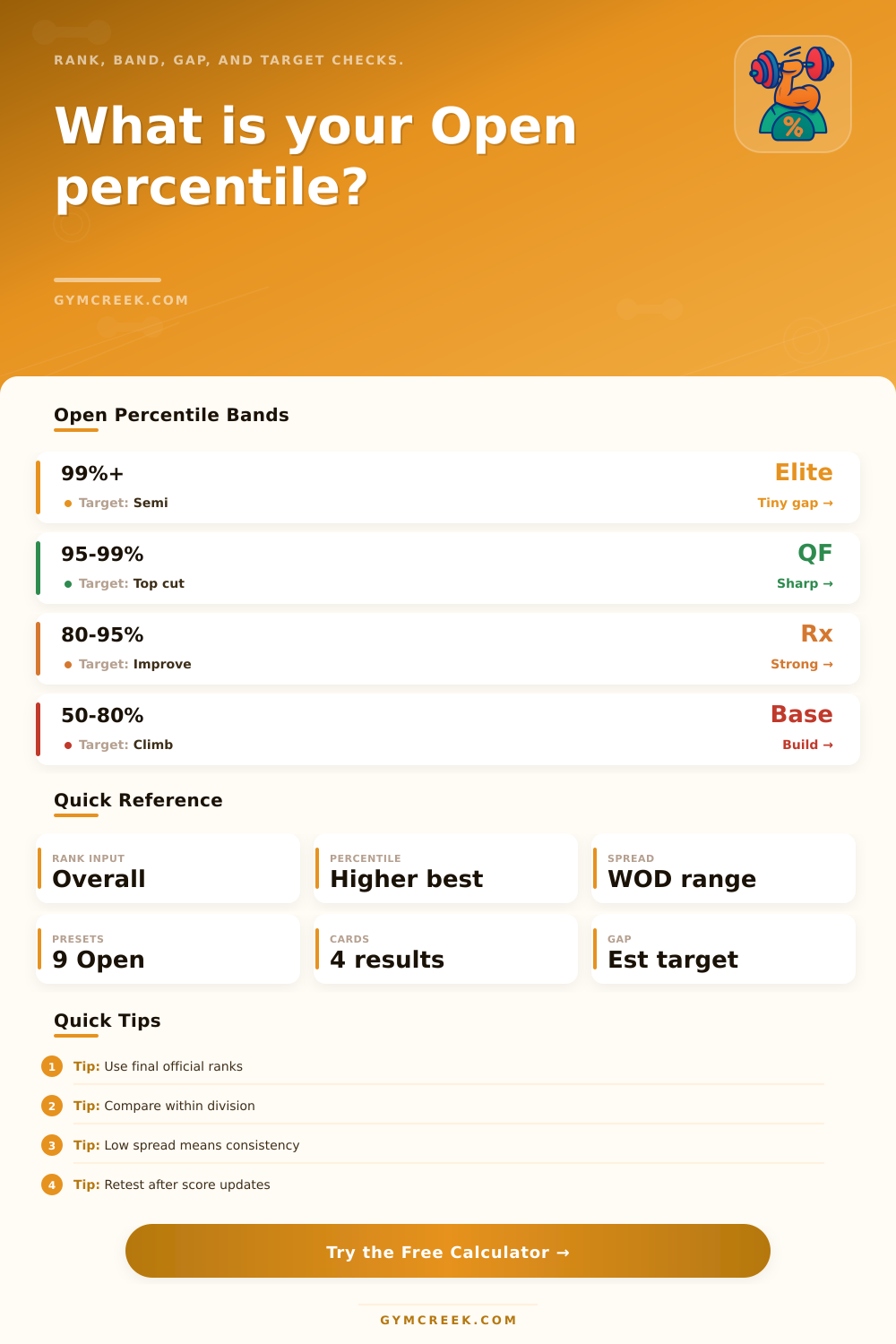
| Percentile | Division Band | Typical Meaning | Next Rank Focus |
|---|---|---|---|
| 99.5% to 100% | Semifinal bubble | Leaderboard position is close to a high-stakes cut line. | Protect weaknesses and avoid rank volatility. |
| 95% to 99.4% | Quarterfinal contender | Strong Rx result with a realistic qualification chase. | Move one bad workout into your normal range. |
| 80% to 94.9% | Competitive Rx | Above most of the field, but usually outside major cuts. | Improve skill bottlenecks and repeatability. |
| 50% to 79.9% | Solid Open base | Middle-to-upper field performance for your division. | Raise floor before chasing peak events. |
| Below 50% | Development range | Useful benchmark for training age and event exposure. | Build movement standards and pacing control. |
🎯Qualification Target Assumptions
| Division Type | Base Cut Share | Age/Field Modifier | Calculator Use |
|---|---|---|---|
| Open Rx men or women | Top 1.0% | Strong region tightens by 2% to 6% | Quarterfinal or next-stage rank target estimate. |
| Age group 35 to 54 | Top 1.5% to 2.0% | Smaller fields loosen the rank number slightly. | Masters-style comparison across age-adjusted fields. |
| Teen or 55 plus | Top 2.5% to 3.0% | Thin fields have a minimum target floor. | Prevents tiny divisions from producing impossible gaps. |
| Scaled or mixed track | Target is penalized | Scaled ranks are not treated as direct Rx equivalents. | Shows fitness standing, not an official qualifying claim. |
📝Open Scenario Examples
| Scenario | Rank / Entrants | Workout Spread | Likely Read |
|---|---|---|---|
| Elite Rx athlete | 220 / 48,000 | 700 ranks | High percentile with narrow spread and low gap. |
| Quarterfinal bubble | 780 / 42,500 | 2,100 ranks | Excellent score, but one workout may decide target reach. |
| Box leaderboard Rx | 3,900 / 39,000 | 5,500 ranks | Strong local standing with a broad global gap. |
| Scaled improver | 12,500 / 65,000 | 9,000 ranks | Useful benchmark, but scaled status limits Rx comparison. |
⚙Formula Reference
| Output | Formula Basis | Input Driver | Rounding |
|---|---|---|---|
| Percentile | 100 x (1 - (rank - 1) / entrants) | Athlete rank and total entrants | One decimal percentage point |
| Qualification gap | Adjusted rank minus target rank | Division, region, field size, and track | Whole leaderboard ranks |
| Rank target | Entrants x estimated cut share x modifiers | Division cut and age group | At least one rank |
| Consistency score | Percentile blend minus spread penalty | Workout rank spread and Rx/scaled status | 0 to 100 score |
💡Calculation Tips
The leaderboard for the CrossFit Open show each athlete a rank based on there performance in the competition. However, the rank do not provide an athlete with a complete understanding of their performance. A rank is simply a number that indicate the athlete’s standing in a list of all athletes who entered the competition.
However, a rank does not show how many other athlete entered the competition. An athlete with a rank of 1,800 might have performed exceptional well in a competition with 12,000 other athletes who entered the competition. However, a rank of 1,800 indicates a significantly lower performance if there were 60,000 athlete in the competition.
Why a rank is not enough
For these reasons, many athletes use a percentile to understand their rank in the competition. The calculator require athletes to provide several pieces of information to calculate their percentile. An athlete must select the division in which they compete.
The qualification density for athletes in the Masters division is not the same than athletes in the teen division or the Rx division. Therefore, the athlete must accurately select their division in the calculator. The workout spread that an athlete selects indicates the athlete’s consistency in performance in the CrossFit Open competitions.
An athlete with a narrow workout spread has high scores in most of the competitions in which they participate. In contrast, an athlete with a wide workout spread might have high scores in only one or two of the Open competitions that they participate in. The region strength and field size modifier are necessary to allow athletes to select their region and the total number of athletes who entered the Open competition in their region.
Some regions of the United States contain more athletes who compete in the CrossFit Open competitions than others. Therefore, using a field size modifier enable the athlete to accurately indicate whether their percentile might be too high or too low based off their region of residence. The athlete can also use the track selection to select between the Rx division, the mixed division, and the scaled division.
A scaled score is not the same as an Rx score, so the calculation of an athlete’s percentile will penalize scaled scores. The percentile will provide the first piece of information for an athlete using the calculator. However, the gap to target and the consistency score will also help to provide an athlete with a complete understanding of their performance.
An athlete with a high percentile but a low consistency score likely earned that high percentile due to one outstanding performance in one of the competition in which they participated. In contrast, an athlete with a more modest percentile and a narrow spread indicates a consistent level of performance in all of the competitions that they participated in during the CrossFit Open competitions. The gap to target will provide the athlete with information regarding how many point they have to score in order to reach their target percentile.
The consistency score will show the athlete how much variation exist in their scores in each of the Open competitions. These two scores are necessary to provide an athlete with an understanding of their long-term trajectory in CrossFit. A long-term trajectory in CrossFit is more important than one’s score in a single CrossFit Open competition.
Many athletes make mistakes when comparing their rank in one Open competition to their rank in another competition in a different year. For instance, an athlete might compare this year’s rank to last year’s rank. However, the number of athletes who entered the CrossFit Open competitions might have changed between these two year.
Additionally, these athletes might not be aware of whether the cut lines for each division have changed between these two years. As such, athletes should use the actual number of athletes who entered the CrossFit Open competitions this year in their division and use the current rules for each division. The reference bands for each athlete will translate the athlete’s percentile into a competitive description.
This competitive description will allow the athlete to understand their rank in relation to the quarterfinals in the CrossFit Open competitions. For instance, it is more useful for an athlete to understand that they are in the quarterfinals than to understand that they are in the top five percent of all athletes in their division. Additionally, the reference bands will also allow the athlete to understand the difference between being close to a cut for a competition and being comfortabley within a cut for that competition.
The calculator should be used as a point of check for athletes to monitor their performance in the CrossFit Open competitions. After the athlete enters their scores into the competition, they should return to the calculator to update their entries for each competition once officials have validated them. Additionally, they should recalculate their scores once the officials have officially announced the number of athlete who entered each division in each region.
The athlete should also use the gap to target and the consistency score to monitor their performance; improving one of their weak events will change their consistency score, and improving their score in their weakest event will change their gap to target score. These scores will become even more important after several CrossFit Opens have passed. While one CrossFit Open is difficult to analyze to determine an athlete’s trajectory in CrossFit, completing many CrossFit Opens with consistent measurement will provide the athlete with an understanding of their long-term trajectory in CrossFit.