CrossFit Fitness Level Calculator
Score your CrossFit profile from benchmark lifts, Fran time, mile or row pace, pull-ups, double unders, weekly WOD frequency, body weight, and training age.
📌CrossFit Athlete Presets
⚙Calculator Inputs
CrossFit fitness snapshot
Enter your benchmarks to see level, strength index, engine index, gymnastics index, and weakness profile.
📊Metrics Grid
📑Reference Tables
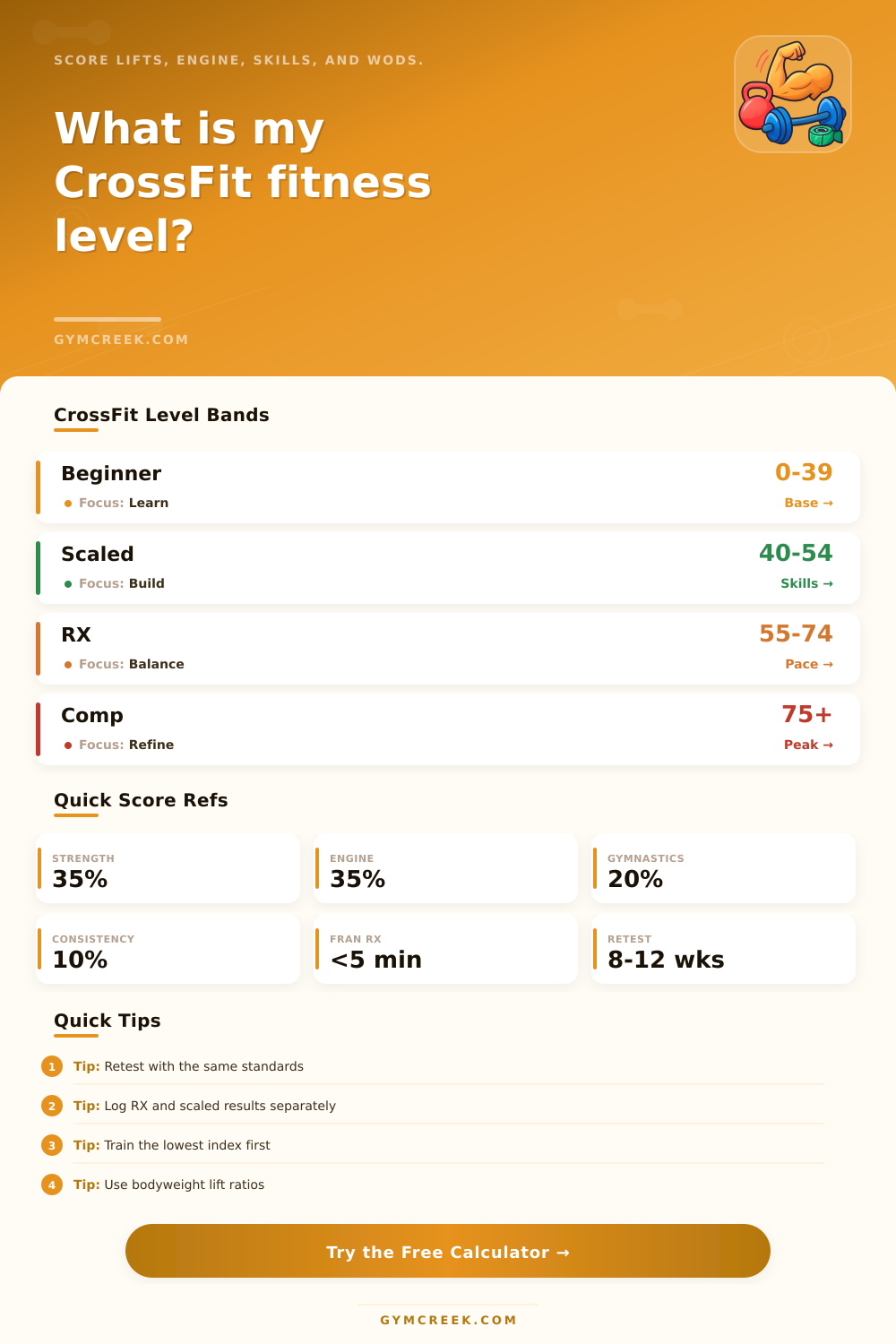
| Band | Score | Typical profile | Primary focus |
|---|---|---|---|
| Beginner | 0-39 | Learning standards and scaling most WODs | Technique, base conditioning, consistency |
| Scaled | 40-54 | Can complete many class workouts with smart scaling | Build weak skills and repeatable pacing |
| RX Ready | 55-64 | Often performs RX, but has one visible limiter | Bring the lowest index toward the others |
| Solid RX | 65-74 | Balanced class athlete with strong benchmark ability | Refine pacing and higher-skill density |
| Competitive | 75-84 | Local competition or Open-focused athlete | Small weaknesses, transitions, repeatability |
| Advanced Competitor | 85-100 | High benchmark scores across strength, engine, and skills | Precision, recovery, and sport-specific testing |
| Lift | Male score 100 | Female score 100 | How it is used |
|---|---|---|---|
| Back squat | 1.75 x body weight | 1.35 x body weight | Lower-body strength and squat capacity |
| Deadlift | 2.00 x body weight | 1.60 x body weight | Posterior chain strength and pulling capacity |
| Clean and jerk | 1.25 x body weight | 0.95 x body weight | Olympic lifting power and coordination |
| Snatch | 1.00 x body weight | 0.75 x body weight | Speed, mobility, and technical power |
| Benchmark | Score 100 | Score 50 | Score 25 |
|---|---|---|---|
| Fran | 3:00 | 7:00 | 12:00 |
| 1-mile run | 5:30 | 8:30 | 11:30 |
| 2k row | 6:40 | 8:30 | 10:30 |
| Pull-ups | 35 reps | 12 reps | 4 reps |
| Double unders | 150 reps | 40 reps | 10 reps |
| Component | Formula | Weight | Purpose |
|---|---|---|---|
| Strength index | Average lift score from body-weight ratios | 35% | Compares four benchmark lifts to practical CrossFit targets |
| Engine index | 60% Fran score + 40% mile or row score | 35% | Combines mixed-modal power with monostructural conditioning |
| Gymnastics index | 55% pull-ups + 45% double unders | 20% | Captures common class and Open skill limiters |
| Consistency index | WOD frequency plus training age | 10% | Rewards repeatable weekly exposure without overpowering benchmarks |
| Weakness profile | Lowest domain and balance gap | Report | Identifies the domain most likely to cap RX performance |
💡Tips
Knowing your fitness level in CrossFit is useful. However, knowing your fitness level can be difficulte due to an inherent inability of one workout or one lift to show your true fitness level. For instance, one day you might feel like a five-pound barbell is light and that your Fran time is competitive with others in your gym.
However, a week later, the same five-pound barbell could feel heavy and your cardiovascular strength will feel noticeable low compared to the strength that you felt a few days prior. This gap between these two scores is what a fitness level tool measures. Many athlete will utilize such a tool to understand which portion of their training is the most limiting of their overall fitness.
Use a fitness tool to find weak areas in CrossFit
The fitness level tool require several inputs from the athlete. These inputs will be the exercises that an athlete performs the most within their CrossFit classes and competitions. An athlete’s body weight is one of the requirements for the tool.
The body weight sets the context of an athlete’s strength ratios. An athlete’s back squat, deadlift, clean, and snatch strength is another of the inputs for the tool. Additionally, an athlete’s Fran time will be another of the inputs.
A mile run or a 2k row will be another of the inputs for the tool. An athlete’s pull-up and double-under count is another of the inputs for the tool. Finally, the athlete’s training age and how often the athlete train each week will also be an input for the fitness level tool.
Once the athlete enters these values, the fitness level tool will output four different domain of the athlete’s performance. The strength domain will calculate the athlete’s performance in their lifts compared to body-weight targets. The engine domain will calculate the athlete’s performance in their Fran time and longer conditioning exercises.
The gymnastics domain will calculate the athlete’s performance in their pull-ups compared to their double-under performance because pull-ups show up in more CrossFit games then doubleunders do. The consistency domain will calculate the athlete’s strength in performing their CrossFit workouts; however, it will not factor in regular performance of these workouts to override an athlete’s benchmark scores for any domain. The last value of the fitness level tool is each of these four domains weight together into a single score.
However, the athlete can only see the value of this domain by seeing which domain displays the lowest score and by seeing how much each domain trails behind the other. The gap between each domain is more important than the total score generated by the tool. For instance, if an athlete notices that their strength score is ten points lower than their engine score or their gymnastics score, it means that their strength in barbell lifts is an area that will feel difficult during their long workouts.
In contrast, if their engine score is the lowest domain within their fitness level tool, it means that their choices in pacing during their Fran games will cost that athlete more time than if they had missed a few double unders in their games. Additionally, knowing which domain trails behind others will show the athlete where to focus most of their training efforts. Most athletes will use a fitness level tool prior to beginning to plan their training for a new training block.
However, there is some common mistakes when using the fitness level tool. One of the most common mistake is to believe the tool provides an athlete with a fitness score that will last for an athlete’s career. An athlete’s physical benchmarks will change with the changes in sleep, stress, and training phase.
Therefore, an athlete should routinely retest their benchmarks every eight to twelve weeks. Another common mistake with the fitness level tool is to focus on improving the athlete’s highest domain instead of the lowest domain. Any small improvements will have a greater impact upon the athlete’s lowest domain rather than their highest domain.
Therefore, the athlete must utilize this skill to understand where to direct their training efforts. Finally, knowing the athlete’s fitness level can be of the most benefit when planning their training for the next few months. If an athlete notices a weakness in any of the domains, they can adjust the athlete’s training to address that domain.
Additionally, if an athlete scores well in each domain, it indicates that their training is already balanced and they dont have to make any major change to their training regime. Either way, the athlete can make training decisions based off the information given by the tool instead of their performance in their last training game.