CrossFit Box Calculator
Choose a safer box jump or step-up height from athlete height, inseam, jump ability, current box height, reps, movement style, workout type, and risk level.
📌Box Jump Presets
Presets are training examples. Replace the numbers with your own measured height, inseam, vertical jump, box height, reps, and workout context.
⚙Calculator Inputs
Recommended box plan
Enter your numbers and calculate to compare the planned box height with a safer training recommendation.
📊Box Metrics Grid
📘Reference Tables
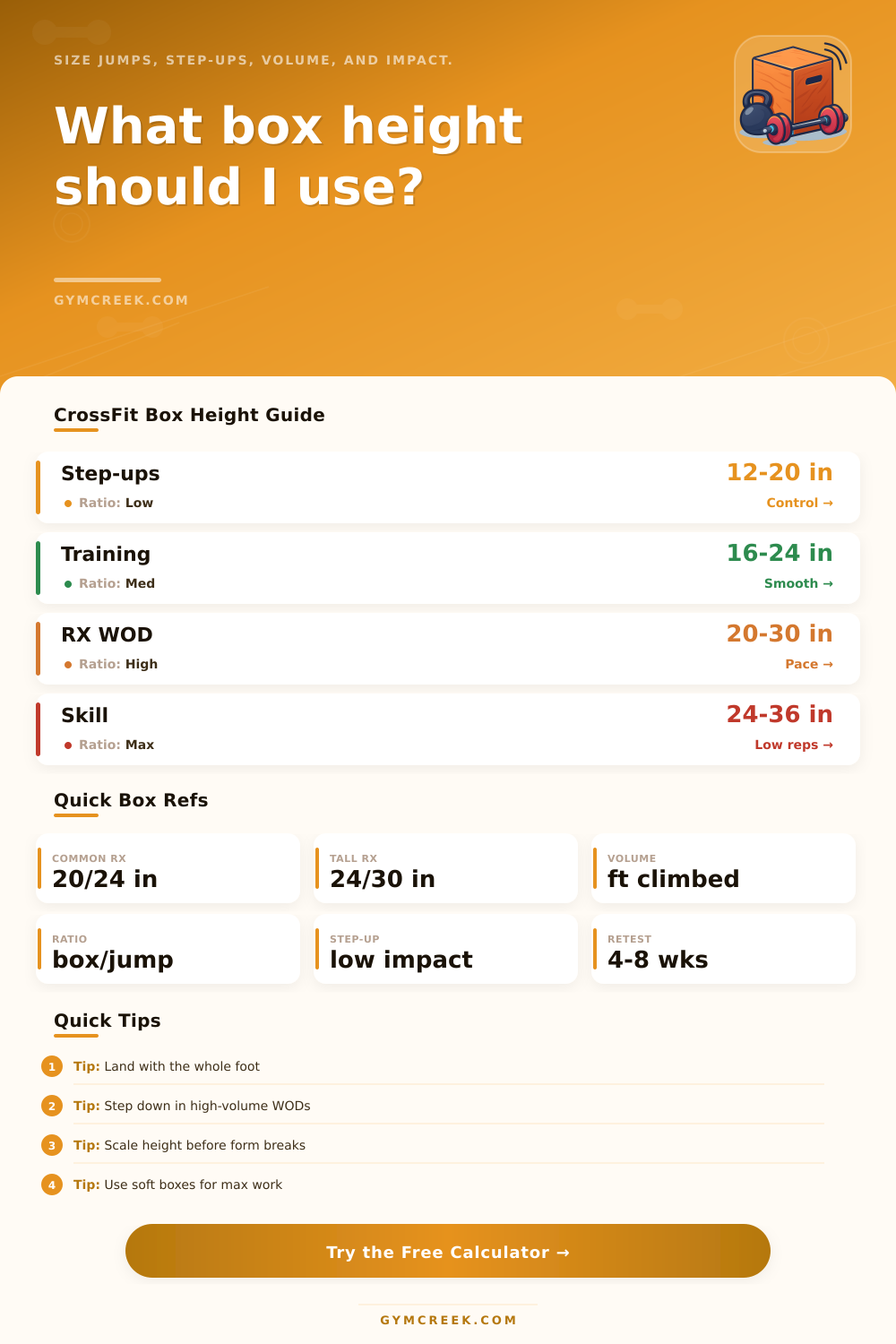
| Training use | Typical height | Best movement | Scaling cue |
|---|---|---|---|
| Warm-up and return-to-training | 8-16 in / 20-41 cm | Step-ups or low jumps | Prioritize control and confidence. |
| General CrossFit training | 16-24 in / 41-61 cm | Jump up, step down | Good for repeatable technique under fatigue. |
| RX benchmark range | 20-30 in / 51-76 cm | Box jumps or mixed reps | Use only if landings stay quiet and balanced. |
| Max height skill practice | 24-42 in / 61-107 cm | Low-rep jumps | Keep volume low and use soft boxes. |
| Box / vertical ratio | Read | Workout fit | Action |
|---|---|---|---|
| Below 0.80x | Low jump demand | Volume, beginners, step-downs | Keep pace smooth and full-foot landings. |
| 0.80-1.10x | Moderate WOD demand | Most normal class workouts | Use planned height if fatigue is manageable. |
| 1.10-1.30x | High demand | Shorter sets or skilled athletes | Scale reps, step down, or lower the box. |
| Above 1.30x | Max-skill territory | Low reps only | Avoid for high-volume metcons. |
| Workout type | Height modifier | Volume concern | Recommended bias |
|---|---|---|---|
| Skill practice | 100% | Low | Use a clean landing height and rest enough. |
| EMOM or intervals | 82% | Moderate | Leave room for repeatable jumps each minute. |
| Sprint couplet | 86% | Moderate-high | Favor fast stand-up and safe step-downs. |
| Chipper or endurance WOD | 75-78% | High | Scale height before late-round misses appear. |
| Low-rep max height | 110% | Low | Use soft boxes, spotters, and long rest. |
| Signal | Keep RX | Scale height | Switch movement |
|---|---|---|---|
| Landing quality | Quiet, full-foot, knees track | Heels miss or knees cave | Pain, stumbles, or rushed descent |
| Rep volume | Under 75 clean reps | 75-150 dense reps | 150+ reps or heavy fatigue |
| Jump ratio | Under 1.10x | 1.10-1.30x | Above 1.30x in a metcon |
| Risk profile | Normal and fresh | Conservative or sore | Returning athlete or joint concern |
💡Box Jump Notes
Choosing the correct height for the box jump or step-ups that you will perform require careful planning. The height you choose for the boxes will impact your safety and performance with these exercises. Several factors impact the choice of height for a box jump or step-up exercise.
These factors includes your height, the height of your vertical jump, the number of repetitions that you will perform, and the type of exercise that you are performing. While many people will use the height of the box that you used during your last set or the height that another person is using as the basis for the height for your box jump or step-ups, this can create mistakes. A height that can be used for a few repetitions might become dangerous if you are performing a set of high repetition workout due to the fatigue that your leg will experience.
How to Pick the Right Box Height for Jumps and Step Ups
Your vertical jump and the height of the box that you jump on are two of the most important factors to consider before you begin your jump or step-up exercise. If you choose a height for the box that is close to your maximum vertical jump, then each jump will become more difficult as your strength for jumping decline due to fatigue. Conversely, if the height of the box that you choose is significantly lower than your vertical jump height, then you will have more time to land safe on your exercise.
The type of exercise that you are performing will also impact the height of the box that you choose. If you are performing a workout with a high volume of jump, then you will need to choose a lower height than if you were performing a short, skill based workout with fewer repetitions. The types of jumps that you will perform will also impact the height of the box that you use.
Doing a hundred box jump of a specific height will place a different load on your body than doing a hundred step-ups of the same height. However, both exercises will require the same amount of vertical travel from your legs to jump on the box. Because step-ups are generally performed at a higher rate then box jumps, it is important that individuals who perform step-ups choose a lower height to reduce the impact that is placed on their legs with this exercise.
Both step-ups and box jumps are exercises whose physical demands most individuals underestimate. Finally, the structure of the workout will determine how many recovery periods your legs will experience during the workout. Workouts that allow your legs to rest in between sets will allow you to use a more higher height of box than workouts that do not allow your legs to rest.
Your physical condition can also have an impact upon the height of the box jumps or step-ups that you perform. If you are performing the exercises as a return to sport for an injury or if you have sore ankles, you will need to use a higher margin for error and therefore use a lower height for the box jumps or step-ups compared to a healthy individual who have strong legs. The calculator above will allow you to calculate your ideal height for your box jumps and step-ups by inputting your height, your inseam, your vertical jump, your chosen box height, the number of repetitions for your set, the type of exercise that you will perform, and your level of fatigue.
Based off your inputs, the calculator will output for you a recommended height for your boxes, the jump ratio that your box jumps will use, and the impact that your jumps will have upon your body. This information will allow you to decide whether to use the height that is indicated within your workout or to use a different height for your box jumps or step-ups. The tables referenced within this article provides additional information on the height of the boxes that you can use based upon the different types of workouts that you will perform.
Your jump ratio will allow you to understand the demands that your box jumps will place upon your body. Additionally, the impact upon your body that your jumps will have can allow you to understand the impact that your exercise will have upon your body. Information from these tables will remove the guesswork from your selection of the height of the boxes from which you will jump.
You should aim to land with your full foot on the exercise and to step down from the boxes when performing high volume sets of jumps. The calculator will allow you to understand whether your chosen height for the boxes will work against your desired strength and habits for jumping. The goal of this calculator is to allow you to choose a height for your jump boxes that will allow you to perform the exercise without your jump form declining.