Cross Trainer Stride Length Calculator
Estimate a comfortable elliptical stride length from height, inseam, natural step length, cadence, mobility, current machine size, and workout purpose.
📌Fit Presets
Presets load realistic user and machine profiles so you can compare ideal stride, usable range, current fit score, and cadence comfort.
⚙Body And Machine Inputs
Cross trainer stride snapshot
Enter body measurements and machine details to estimate a useful stride range.
📊Fit Metrics Grid
📑Reference Tables
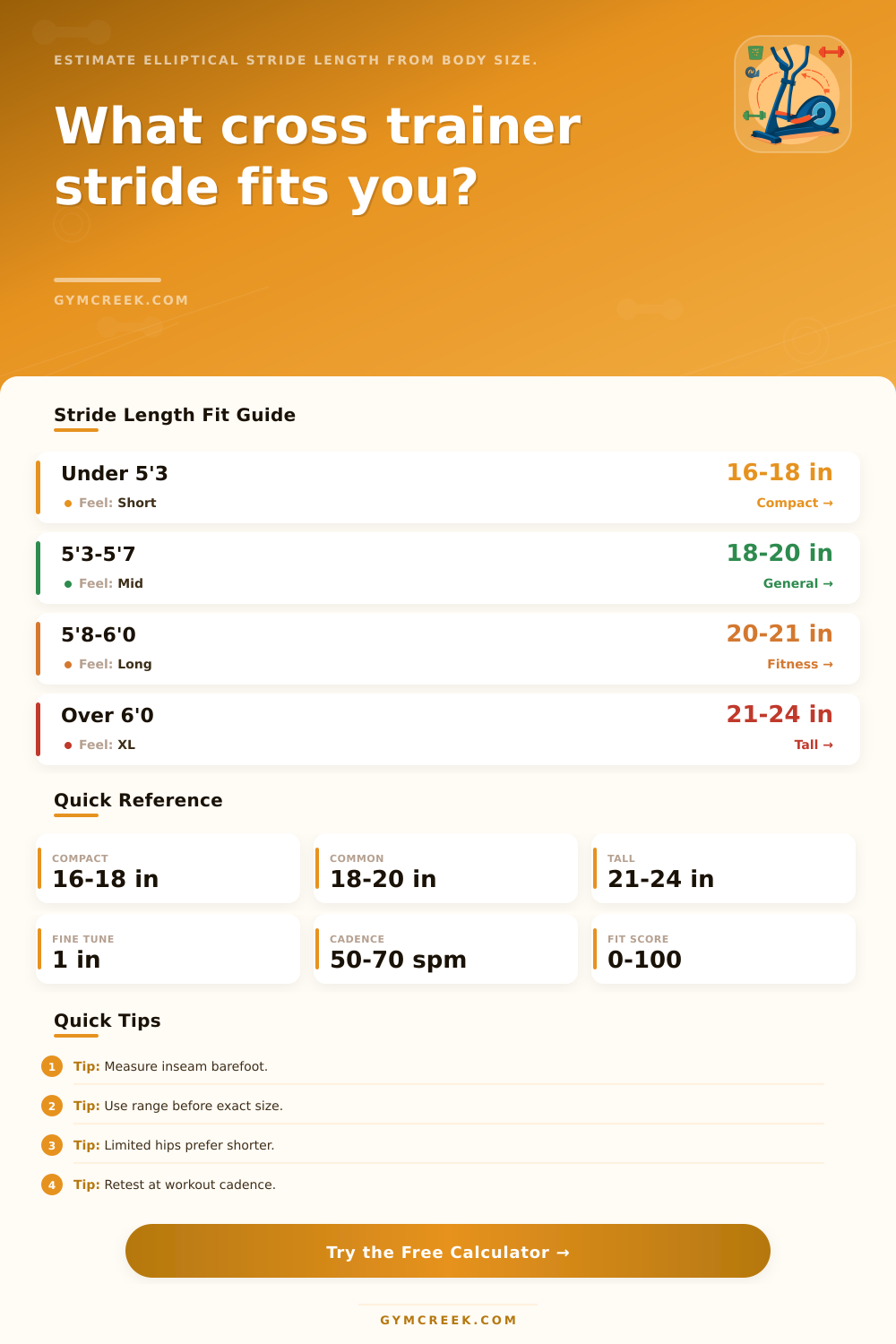
| User height | Common stride | Typical feel | Watch for |
|---|---|---|---|
| Under 5 ft 3 in | 16-18 in | Compact and quick | Overreach above 20 in |
| 5 ft 3 in to 5 ft 7 in | 18-20 in | General fitness | Choppy 16 in paths |
| 5 ft 8 in to 6 ft 0 in | 20-21 in | Smooth cardio | Short home units |
| Over 6 ft 0 in | 21-24 in | Longer gait | Limited fixed stride |
| Signal | Likely cause | Stride move | Retest |
|---|---|---|---|
| Choppy feel | Too short | Longer if possible | 1 in |
| Overreach | Too long | Shorter range | 1 in |
| Knee irritation | Path mismatch | Shorter or lower ramp | 5 min |
| Hip pinching | Top-stroke crowding | Shorter and lower | Easy pace |
| Purpose | Bias | Why | Cadence |
|---|---|---|---|
| General fitness | Neutral | Repeatable rhythm | 55-70 spm |
| Endurance | Slightly long | Smooth path | 55-65 spm |
| HIIT | Slightly short | Faster turnover | 65-85 spm |
| Rehab pace | Shorter | Joint control | 45-60 spm |
| Layer | Input | Output | Role |
|---|---|---|---|
| Height | Standing height | Stride model | Body scale |
| Inseam | Leg length | Gait model | Leg travel |
| Step | Walking step | Cross-check | Natural rhythm |
| Context | Goal and comfort | Adjustment | Fine tuning |
💡Fit Tips
The stride lengths of an elliptical machine is the measurement of the distance that the pedal will travel in relation to you body. A stride length that is too short may make it feel like you are jogging in place with choppy movements. A stride length that is too long may make you feel like you are overreaching with each stride, potentially leading to strain in your hip flexors.
Because stride length should relate to the physical proportion of your body, you must find the correct stride length for your body to avoid discomfort in your lower back or hips. One of the factor that will influence stride length is your height. However, another factor that will influence stride length is your leg proportions.
Find the Right Stride Length for Your Elliptical
For example, individuals that have longer torsos and shorter legs may require a different stride length then individuals who have shorter torsos and longer legs. Your standing inseam is the best measurement of your leg length, not your total height. With these two measurement, you can calculate the stride length that will best allow your body to move in relation to an elliptical machine.
The way that you use the elliptical will impact the stride length that you require. For example, if you are performing intervals, you may require a shorter stride length than if you are performing endurance activities on the elliptical. If you are performing intervals, you want to allow for a faster movement of your feet.
However, you cant perform these type of intervals with a large stride length. Therefore, the machine must allow you to adjust your stride length according to the speed with which you wish to performing your intervals on the elliptical. Another factor that may influence stride length is your mobility in relation to your hip.
Individuals with high mobility in their hips may be able to utilize stride lengths that extend deep into their joint range of motion. Other individuals with limited mobility in their hips may feel as if they are feeling a pinching sensation in their hips when utilizing deep stride length. In these cases, individuals should utilize shorter stride lengths.
Additionally, the incline settings of the elliptical will impact the stride length that you utilize. As the incline of the elliptical increases, the stride length will change in relation to the machine, and you will have to adjust your stride length accordingly. The thickness of the footwear that you wear will have an impact on your stride length.
Thick shoes will introduce a distance between your foot and the ellipticals pedals. As you perform many strides during your elliptical workouts, the thickness of the shoes will impact your alignment on the elliptical. Therefore, your stride length should account for the thickness of your footwear.
The physical signal of your body may indicate that your stride length is incorrect. For example, if your movements feel choppy, your stride length is likely too short for your leg lengths. A feeling of sway in your lower back may indicate that your stride length is too long for your body.
You can fine-tune the stride length on the elliptical to remove strain from your joints and to allow your muscles to perform the movements required of the elliptical. Overall, you want to find a stride length that feels stable and smooth when you are performing your workouts on the elliptical. Your stride length may feel good at a slow rate of speed, but you should test your stride length at your target rate of speed for the elliptical to ensure that it is the correct stride length for your body.
If your stride length for the elliptical matches your biological proportions, your body will feel more efficient with the elliptical machine and it will be easier for you to use.