Cross Country Skiing Calorie Calculator
Estimate Nordic ski calories from body size, classic or skate technique, pace, trail grade, snow condition, pack weight, moving time, rests, distance, wind, and cold exposure.
📌Presets
Each preset loads a real Nordic skiing scenario and recalculates with technique, terrain, snow, pack load, moving time, and rest time.
⚙Calculator
Cross country skiing calorie snapshot
Enter technique, pace, terrain, snow, pack, distance, and duration to estimate Nordic skiing calories.
📊Ski Session Metrics
🧮Formula Result Cards
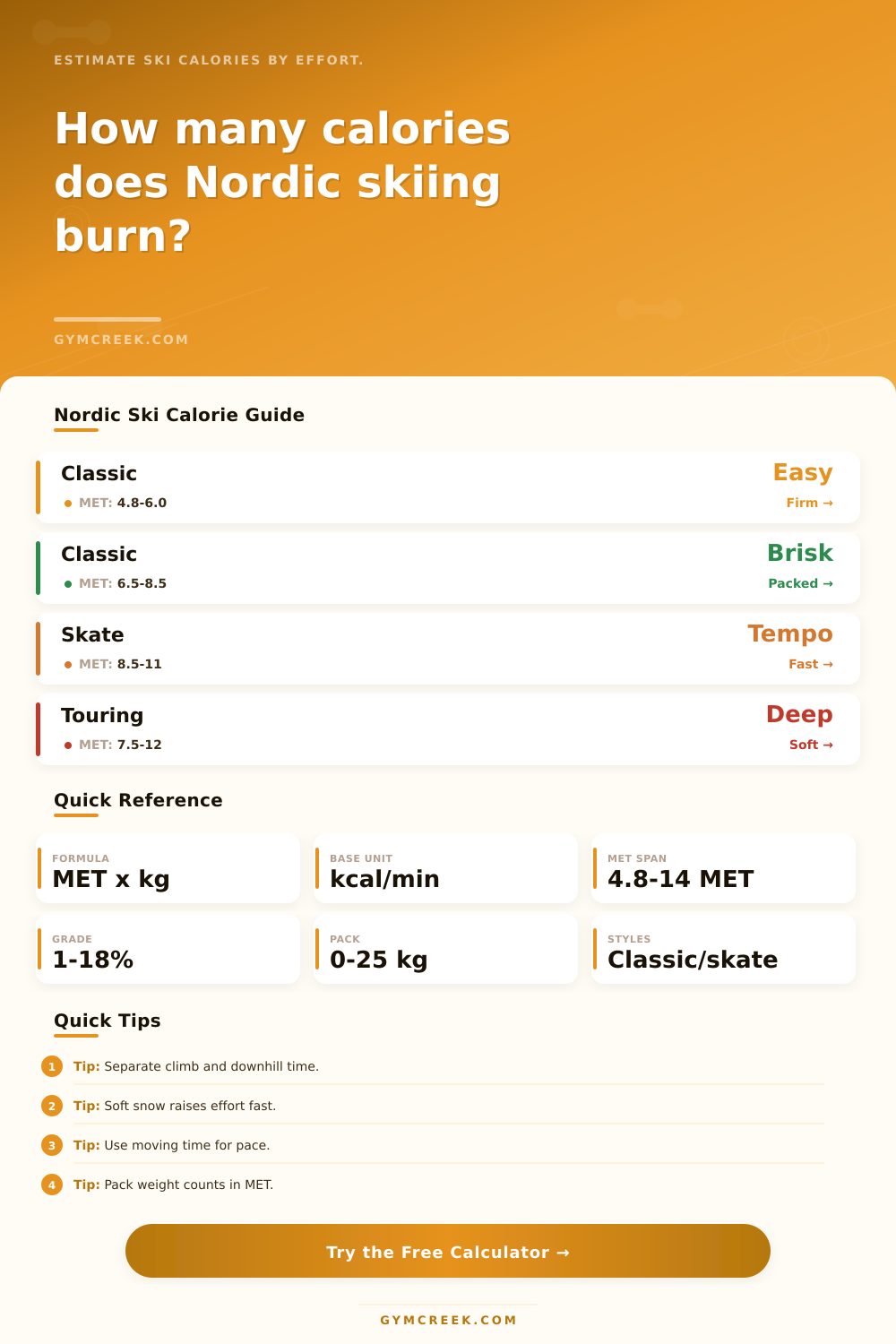
Calories per minute = MET x 3.5 x body weight in kg / 200. The calculator applies this to moving ski time.
Classic, skate, double-pole, backcountry, and race styles each start from a different MET table by selected pace.
Grade, downhill share, snow condition, wind exposure, clothing bulk, pack load, and session purpose adjust the base MET.
Mifflin-St Jeor estimates BMR from weight, height, age, and gender, then activity level estimates TDEE for session share.
📑Reference Tables
| Technique | Easy | Steady | Hard |
|---|---|---|---|
| Classic diagonal stride | 4.8 MET | 6.3 MET | 8.8 MET |
| Skate skiing | 7.0 MET | 8.6 MET | 12.5 MET |
| Double-pole focused | 5.8 MET | 7.4 MET | 10.8 MET |
| Backcountry touring | 6.5 MET | 8.0 MET | 11.5 MET |
| Race mixed technique | 8.0 MET | 10.2 MET | 14.0 MET |
| Snow Condition | Glide Feel | Modifier | Typical Route |
|---|---|---|---|
| Fast transformed | Very quick | 0.94x | Icy track |
| Firm groomed | Efficient | 1.00x | Corduroy |
| Fresh groomed | Moderate | 1.06x | Powder top |
| Soft slow snow | Draggy | 1.14x | Warm trail |
| Deep ungroomed | Heavy | 1.24x | Backcountry |
| Wet sticky | Stop-start | 1.18x | Spring snow |
| Grade Zone | Average Grade | Modifier | How It Feels |
|---|---|---|---|
| Net downhill | Below 0% | 0.88-0.98x | More glide |
| Flat rolling | 0 to 2% | 1.00x | Rhythmic |
| Rolling climb | 2 to 5% | 1.05-1.15x | Steady work |
| Sustained climb | 5 to 9% | 1.16-1.30x | High demand |
| Steep climb | 9% plus | 1.31-1.45x | Very hard |
| Formula | Variables | Output | When Used |
|---|---|---|---|
| MET kcal | MET, kg, min | Calories | Main estimate |
| Grade factor | Grade, glide | Modifier | Trail load |
| Pack factor | Pack, body kg | Modifier | Gear load |
| Mifflin BMR | kg, cm, age | Baseline | Daily context |
💡Tips
There’s always a certin type of jolt when you step out of the car at any Nordic center: the crisp air, those perfect-looking tracks, and your heart-rate still idling. Prepare for a peaceful glide, but three minutes later your legs feels like lead and your lungs are on fire. Cross-country skiing is a great deception. From the outside looking in, it looks easy. It is a leisurely glide across woods. But it’s really a full-body metabolic furnace that has most skiers wondering what happened to all their calories.
Enter the calculator above. Plug in the conditions and your effort level. The calculator will handle the rest, whether you just burned a lunch or breakfast.
How the Calculator Works
But the confusion always boils down to one thing: Effort vs. Distance. A mile is a mile when you’re running, but that’s not necessarily true when you’re skiing. A mile on firm, groomed corduroy is very different than a mile in loose, unpacked powder. This is where the tool comes in handy. It allows you to choose your snow conditions, which makes an enormous difference in amount of energy it costs you. Because soft snow has drag, you have to work harder to keep up speed. Before you know it, a leisurely day out becomes an interval workout. Your heart rate go up while your pace stays the same. Your body isn’t simply moving through space; now it is also battling friction caused by the snow.
But it’s also about technique. Diagonal stride mechanics for classic skiing engage core and hips. Skate skiing require a powerful, symmetrical push to hit glutes and quads hard. To show that point, page has a reference table that demonstrates how MET values changes with pace and style. For example, you may find that a steady classic pace feels doable, but if you switch up to skate skiing at the same subjective effort level, your calorie burn will jump because the whole body drives every push. That’s why many skiers underestimate how much effort they are using because they focus on how smooth their movement looks rather than the force needed to create that glide.
And then there’s that quiet calorie destroyer: your pack. When you’re backpacking or on a tour, you’ve got all kinds of stuff with you: water, layers, safety equipment, perhaps even a camera or two? Each pound make climbing that next hill harder on your body. That’s why the calculator has a spot for you to plug in how much you weigh (it’s not nothing). With a twenty pound pack on a ten percent incline, your hike becomes a strength training session. People tend to underestimate how much effort their entire load require. They forget that they have to lug it all around.
Other things are subtler but still important, such as wind and temperature. An exposed ridge will see you bracing your upper body against headwind, which feels like resistance bands and requires you to dig harder with your poles. Even if you are sweating from the effort, cold air takes extra energy to keep your body temperature steady. These environmental factors is considered by the tool in providing a better picture of the session. You can be wrapped up toasty-warm and think the cold isn’t an issue. But it’s adding a little steady tax to your burn as your body works overtime to keep your core warm.
Knowledge is power: These variables help us train smarter and understand what we’re doing. Want to shed some pounds? Hilly terrain (or soft snow) can double your work-per-mile, so plan your route accordingly to get maximum burn without adding miles. Racing? Your wind exposure (or pack weight) are contributing to your inflated MET score, so adjust your pacing strategy to match.
This isn’t about abstract data points. The numbers are not just abstract data points; they is a map of how your body interacts with the environment. Ultimately, cross-country skiing is as much about managing energy as it is about spending it. How do you get better? Use the calculator for sure, but then tune your ear and eye to the trail itself. When does the snow become sticky? What happens if the wind picks up? And how does this hill compare to that one?
Pay attention to those things and all of a sudden, that initial run doesn’t shock you so much. It’s no longer a question of “where’d my energy go?” It’s a question of “where do I need to get it from now?” And that knowledge transforms a confusing workout into a calculated, efficient experience. You step off the trail knowing not only what you’ve done, but why it felt like it did.