Crimp Strength Calculator
Estimate crimp force, body-weight load, edge-adjusted strength, hang quality, and readiness from a weighted or assisted hangboard test.
📌Presets
Each preset loads a realistic hangboard scenario with body mass, assistance or added load, edge depth, grip type, hang time, arm count, effort, and recovery.
⚙Calculator
Crimp strength snapshot
Enter a valid hang load, edge depth, time, arm count, RPE, and recovery state to calculate.
🧮Formula Cards
📊Crimp Metrics Grid
📑Reference Tables
| Benchmark | Two-Arm BW Load | Common Edge | Typical Use |
|---|---|---|---|
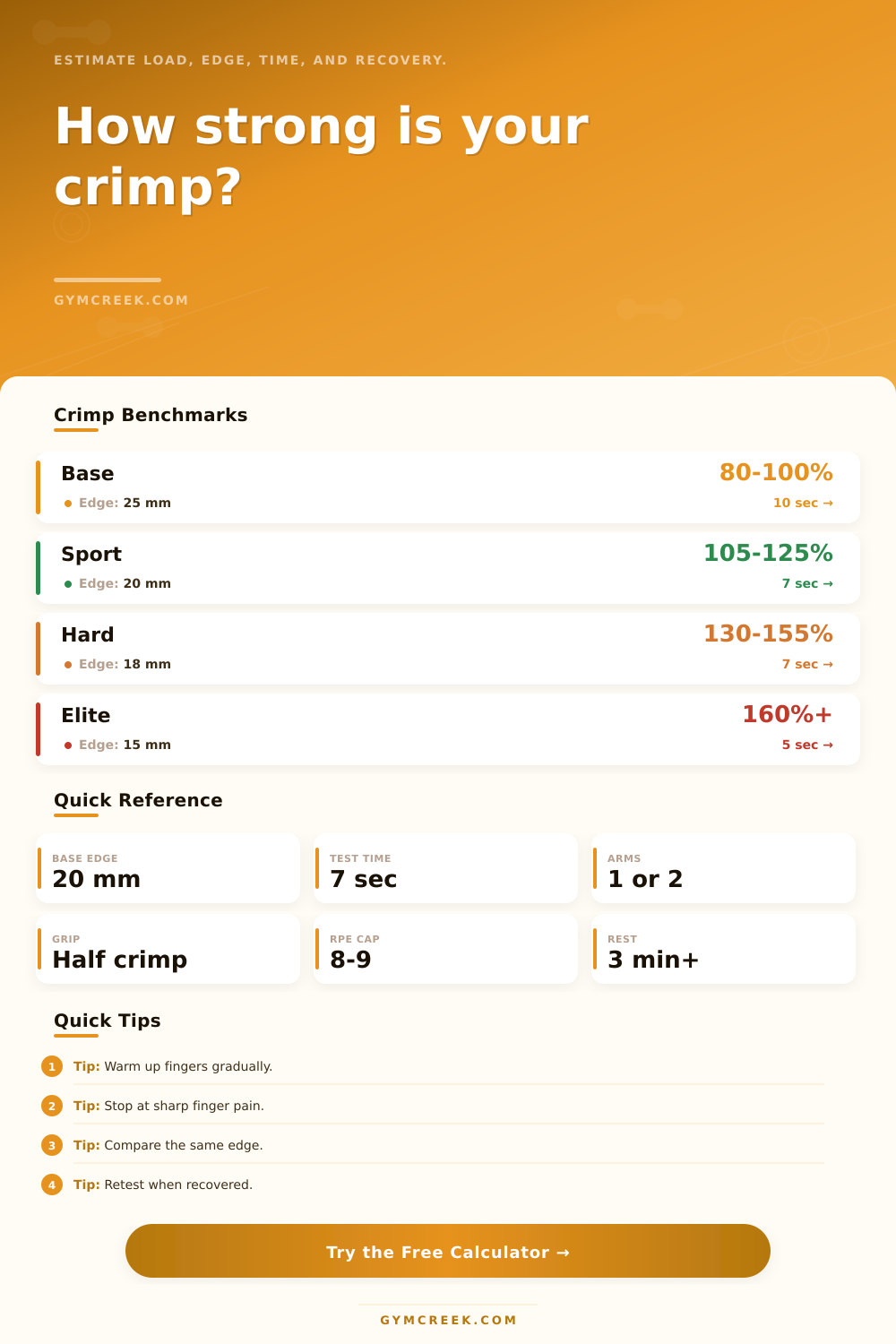
| Base strength | 80-100% body weight | 25-30 mm | Learning consistent hangs |
| Intermediate | 105-125% body weight | 20 mm | General sport and bouldering |
| Advanced | 130-155% body weight | 18-20 mm | Harder board and limit boulders |
| Elite crimping | 160%+ body weight | 15-20 mm | High-end finger strength tests |
| Edge Depth | Relative Difficulty | Best Test Style | Caution |
|---|---|---|---|
| 30 mm+ | Lower | Entry max hang or warmup | May understate small-edge skill |
| 20 mm | Standard | Most repeatable max-hang testing | Use strict shoulder position |
| 15-18 mm | High | Advanced small-edge comparison | Reduce load jumps |
| 10-12 mm | Very high | Specific small-edge exposure | Avoid fatigue-based maxing |
| Grip Type | Factor | Strength Context | Safety Note |
|---|---|---|---|
| Half crimp | 1.00 | Standard crimp comparison | Keep wrist controlled |
| Open hand | 0.92 | Lower crimp stress, broad carryover | Often safer for volume |
| Full crimp | 1.08 | High specificity to small holds | Higher pulley strain risk |
| Two-finger drag | 0.70 | Specialized finger isolation | Use conservative loads |
| Recovery State | Readiness Effect | Suggested Test Choice | Stop Signal |
|---|---|---|---|
| Full rest | Best comparison | Max hang or baseline | Technique breakdown |
| Good rest | Usually reliable | Submax or controlled max | RPE spikes early |
| Mixed rest | Fatigue likely | Technique and repeatability | Tender finger sensation |
| Poor rest | Retest preferred | Warmup-only screen | Pain, swelling, sharp pull |
💡Safety Tips
This means your hang test becomes measured and translated into a real number, how strong are you at climbing? Maybe you’re great at holding on to a thin edge, but that’s not what feeling like means.
The calculator above gives you a speedometer to see how you improve. No more guessing about your training and wondering if you’re getting strongerer.
How to Measure Your Climbing Strength Safely
Hanging at a hundred percent of their body weight on a twenty millimeter edge are the solid baseline for an intermediate climber. It’s a good yardstick because it’s easily repeatable; no fancy machine, no extra weights needed. It’s a fixed point you can use to compare yourself different than three months ago to today. You don’t have to add five pounds to move forward; you simply must hang the same amount of weight on a narrower edge.
As you’ll see in the reference table below, the smaller the edge (down to five millimeters) the harder it becomes. The test’s difficulty depends on grip type.
For measuring purposes, you should half-crimp since this targets flexor tendon strength. With full crimps, there is increased stress on the pulleys and greater potential for injury. Half crimping is standard for measurement because it isolates flexor tendon strength without the extreme strain of a full crimp or safety of an open hand.
To account for these differences in grip style, the calculator include a difficulty factor. Even with identical loads, a relaxed hand will be easier to keep closed than a tight fist. If it didn’t adjust for this, you might overestimate your strength due to a painful grip.
How accurate it is depends on how well you’re recovering. If you’re in bad shape or tired then having strong fingers won’t help. Your reported level of fatigue/sleep shows in the readiness score that will penalize your results.
Strength is dynamic; it doesn’t just have one number. Tiredness is not strength. You get junk data if you try to test while exhausted. Then you make bad programming choices thinking you’re plateaued when you’re actualy just tired.
Tiny edges are delicate. As you go down in hold width, the force on your hands goes up quickly. Below about twenty millimeters wide, most climber will shy away from an edge if they don’t have years of tendon conditioning under their belt.
For those hard spots, the tool flashes safety flags. Better to fail at the test with a bad score than to get hurt and be out of commission from climbing for months. The difference between progress and injury is often just five millimeters of edge and one smart decision to walk away.
“Crimp strength isn’t about what’s the hardest hang you can make when you’re super amped up at the crag. Crimp strength is about being consistent over time. It is about making a base to climb hard routes without breaking yourself down. Instead of just checking your max load use the data to inform your volume week by week. Don’t look at spikes but look at trends in your edge adjusted index. Look at the numbers, they’ll tell you how your body has adapted to training. Your fingers are precision instruments not grappling hooks. The goal is to climb longer and safer rather than hanging as hard for a few seconds. Strength is measured out in seasons of progression not seconds of effort.”