Crab Walk Calorie Calculator
Estimate calories burned from crab-walk distance, time, hip height, direction, body weight, surface, sets, rest, and shoulder, triceps, and hip-bridge demand.
📌Crab Walk Presets
Each preset changes travel distance, work time, hip position, direction, surface, sets, rest, and demand modifiers before calculating.
⚙Calculator
Crab walk calorie snapshot
Enter body weight, distance, time, hip height, direction, surface, sets, and rest to estimate the session.
📊Metrics Grid
🧮Calculation Logic
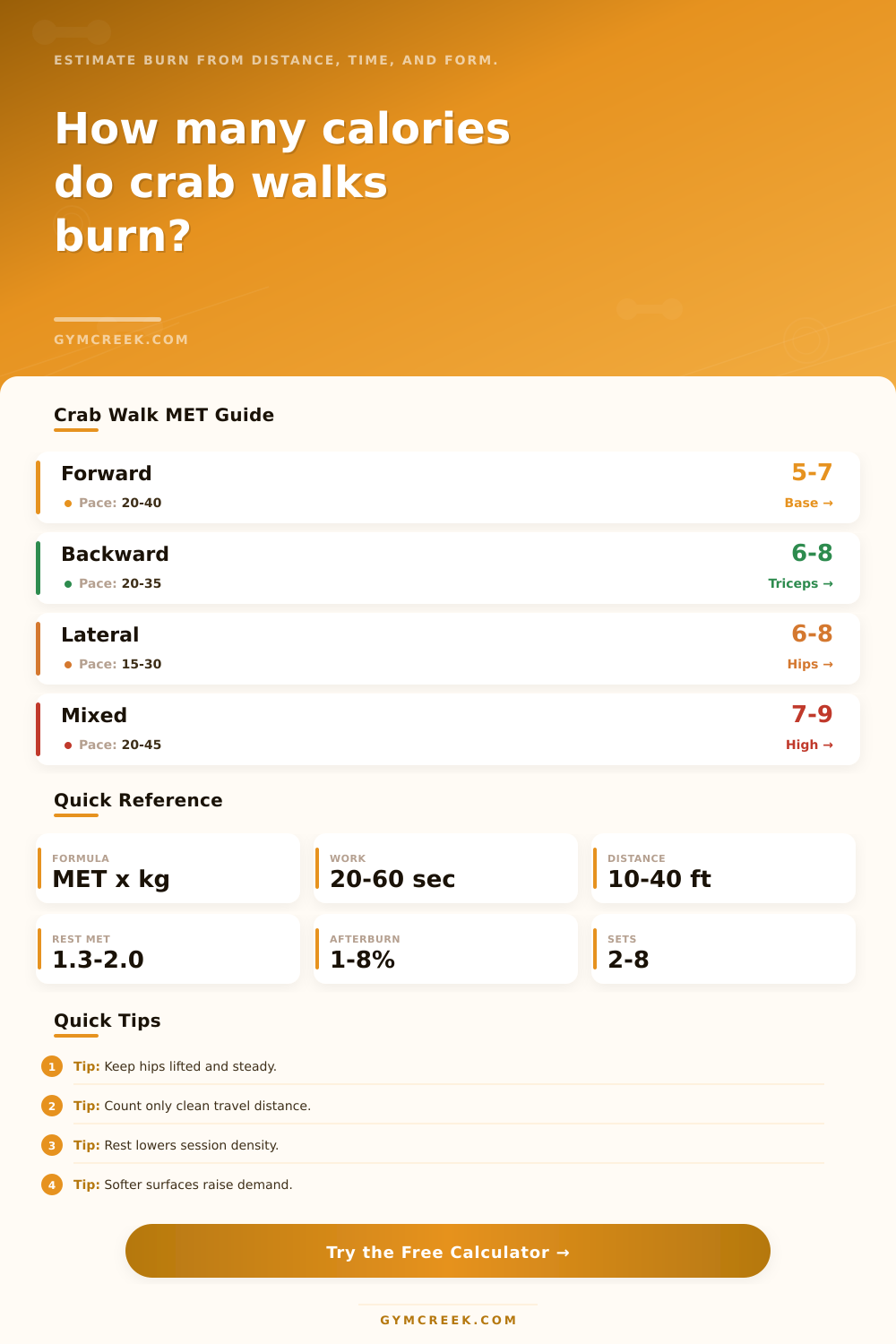
Calories per minute = MET x 3.5 x body weight in kg / 200. This calculator uses that formula for active crab-walk time.
Distance per set divided by time per set creates a travel speed modifier, so fast short sets and slow long sets are not treated the same.
Hip position, shoulder support, triceps lockout, and bridge effort each adjust the base MET to reflect the way the crab walk is actually performed.
Surface friction changes the active cost, rest adds recovery calories, and dense hard sets add a small oxygen-cost estimate.
📑Reference Tables
| Direction | Base MET | Typical Speed | Primary Demand |
|---|---|---|---|
| Forward crab walk | 5.9 MET | 20-45 ft/min | General conditioning and shoulder support |
| Backward crab walk | 6.5 MET | 18-38 ft/min | Triceps lockout and coordination |
| Lateral crab walk | 6.7 MET | 14-32 ft/min | Hip stability and shoulder loading |
| Square pattern | 6.9 MET | 16-34 ft/min | Direction changes and trunk control |
| Loaded crab walk | 7.8 MET | 12-30 ft/min | High upper-body and hip-bridge demand |
| Hip Height | Modifier | What It Means | Calculator Effect |
|---|---|---|---|
| Low sagging hips | 0.82x | Bridge drops and stride shortens | Lowers active MET |
| Low tabletop | 0.94x | Controlled but less hip extension | Slightly lower MET |
| Neutral tabletop | 1.00x | Balanced hips and clean travel | Baseline estimate |
| High bridge | 1.10x | Glutes stay engaged through each step | Raises active MET |
| Feet elevated bridge | 1.18x | Longer lever and higher support load | Highest hip modifier |
| Surface | Modifier | Best Use | Notes |
|---|---|---|---|
| Smooth gym floor | 1.00x | Baseline testing | Repeatable pace and friction |
| Exercise mat | 0.96x | Skill practice | Comfort may reduce speed cost |
| Indoor turf | 1.05x | Conditioning | More friction than a hard floor |
| Grass field | 1.08x | Outdoor circuits | Uneven foot placement adds work |
| Sand or beach | 1.20x | Hard finishers | Soft ground raises travel cost |
| Formula Piece | Variables | Output | Used For |
|---|---|---|---|
| MET kcal | MET, kg, min | Calories | Active work burn |
| Speed factor | Distance, time | Multiplier | Pace adjustment |
| Duty cycle | Work, rest | Percent | Session density |
| Mifflin BMR | kg, cm, age | Calories | Daily context |
💡Tips
Chances are if you’re walking around on all fours, moving side-to-side as you go, you’ve tried crab walks before. Or perhaps you saw them performed on social media and thought they might be a good laugh and look like a nice way to get some movement going through your hips and shoulders. They feel stupid when you start: here you are on all fours, knees bent, hips up off the ground, and now you’re walking backward and sideways like a little crustacean. And yet there they go again, trainers adding them into their circuits, because this exercise make you stabilize your body in a position few of us ever hold our bodies in during the day. The instability is what creates the burn, and it’s not even always about getting those limbs moving. Your arms and legs has to do the work while your hips stay up off the ground, but not too high; you want your core to be tight enough to prevent any sagging.
Enter your time, distance, and bodyweight into the calculator above. This spares you from doing the conversion and coefficient math. The calculator then crunches the numbers to approximate the MET, or metabolic equivalent of task, of how you performed movement. Hip height is another important input that often gets overlooked. The lower your hips sag toward the ground, the less work your core and glutes has to do. This is why the calculator adjusts downward to account for the lower calorie burn from droopy hips. When your torso is tight and lifted and you’re holding a high bridge though, the demand spikes considerably. It’s a subtle mechanical change, but it alters physical cost: Are you performing a strength endurance exercise or simply crawling around on the floor? Those are considered two very different things by the calculator.
Why Crab Walks Are Good for You
And then there’s direction. Not exactly like you’d think. Forward crab walks tend to feel more natural because we can see what we’re doing. They also make for a good baseline to condition from. Backward: You can’t see where you’re going. Your brain has to do more work to get your feet where they need to be. Combined with an awkward elbow-straightening angle, this tends to increase the felt effort level. The table I’ve included on the page shows this; backward and lateral variations carry greater MET values different than just traveling forward. Why? Well, lateral movements challenges the hip abductors and demand constant micro-adjustments to maintain balance. That makes a difference if you’re specifically targeting a muscle group.
Surface texture is another variable that changes the equation. When you walk across a smooth gym floor, your feet can slide just a little bit, decreasing friction and making movement more efficient. Try walking on turf, grass or sand; each of those steps will require greater force to stop and propel yourself onward. This is why the tool adds modifiers for all different types of surfaces; physics doesn’t give a crap about how motivated you are. The soft ground will absorb some of the energy that you’d otherwise use to propel yourself forward, forcing you to recruit more muscle in order to compensate. Expect the calorie estimate to rise if you’re training outdoors (which is a good problem to have, since it means your workout is harder than it appears).
This may sound counterintuitive, but the calculation takes into account rests. Your muscles repair micro-tears and your heart rate stay high even when you aren’t moving, meaning your body is always at work during rest. The calculation counts that time as recovery MET so it doesn’t lower your total session burn. Your overall density is greater if you do lots of little bursts of work interspersed with little rest, which means there’s also kind of an afterburn effect because your metabolism will be slightly elevated once you’re done. That’s a marginal gain, but those tiny gains add up to real changes in body composition over weeks and months.
Don’t think about chasing the biggest number on the screen. Think instead about what your body was doing during that session, because when it displays a big number, it probably means you were working hard (either in speed, difficulty of the surface or in holding a hard-to-keep hip position), and you can adjust accordingly. Conversely, when it’s a low number, maybe you’re hanging out too long between strokes, or perhaps you weren’t keeping your hips up. Adjust your inputs to reflect what actually happened. It’s not gaming the system; it’s getting an accurate view of your effort.
They don’t look serious, which is why I think we undervalue crab walks, they’re just goofy looking. They’re just a little playful. But that doesn’t mean they’re not serious fitness. It’s not about having a grimace on your face, it’s about paying attention to what’s happening in your body and moving deliberately. Knowing how much effort goes into a motion will help you plan to match. Whether you’re using these moves for conditioning, warmups, or just plain old goofing off and having fun, a goofy scuttle becomes a measured strategy. You may be walking like a crab, but you’re training like an athlete.
Actualy, it should of been easier if the floor was flat. It feels naturaly better when movement is smooth. The moddern way to train is hard. If you want to feel comfortabley, try more reps.