Countermovement Jump Calculator
Estimate CMJ height, flight time, takeoff velocity, peak power, relative power, and RSI-mod from jump mat, force plate, video, or manual test data.
📌Presets
Each preset fills realistic CMJ test values and recalculates the output cards immediately.
⚙Calculator
Countermovement jump snapshot
Enter jump data to estimate height, velocity, power, and RSI-mod.
📊CMJ Metrics Grid
🧮Formula Cards
Flight-Time Jump Height
When flight time is known, jump height is estimated from projectile motion using gravity and total airborne time.
height = g x flight time^2 / 8Takeoff Velocity
Takeoff velocity links vertical displacement to the speed needed at takeoff when air time starts.
velocity = square root(2 x g x height)Sayers Peak Power
The Sayers equation estimates peak lower-body power from CMJ height in centimeters and body mass in kilograms.
power = 60.7 x jump cm + 45.3 x kg - 2055RSI-mod
Modified reactive strength index compares how high the athlete jumped against the time required to take off.
RSI-mod = jump height m / time to takeoff s📑Reference Tables
| Profile | Developing | Solid | High Output |
|---|---|---|---|
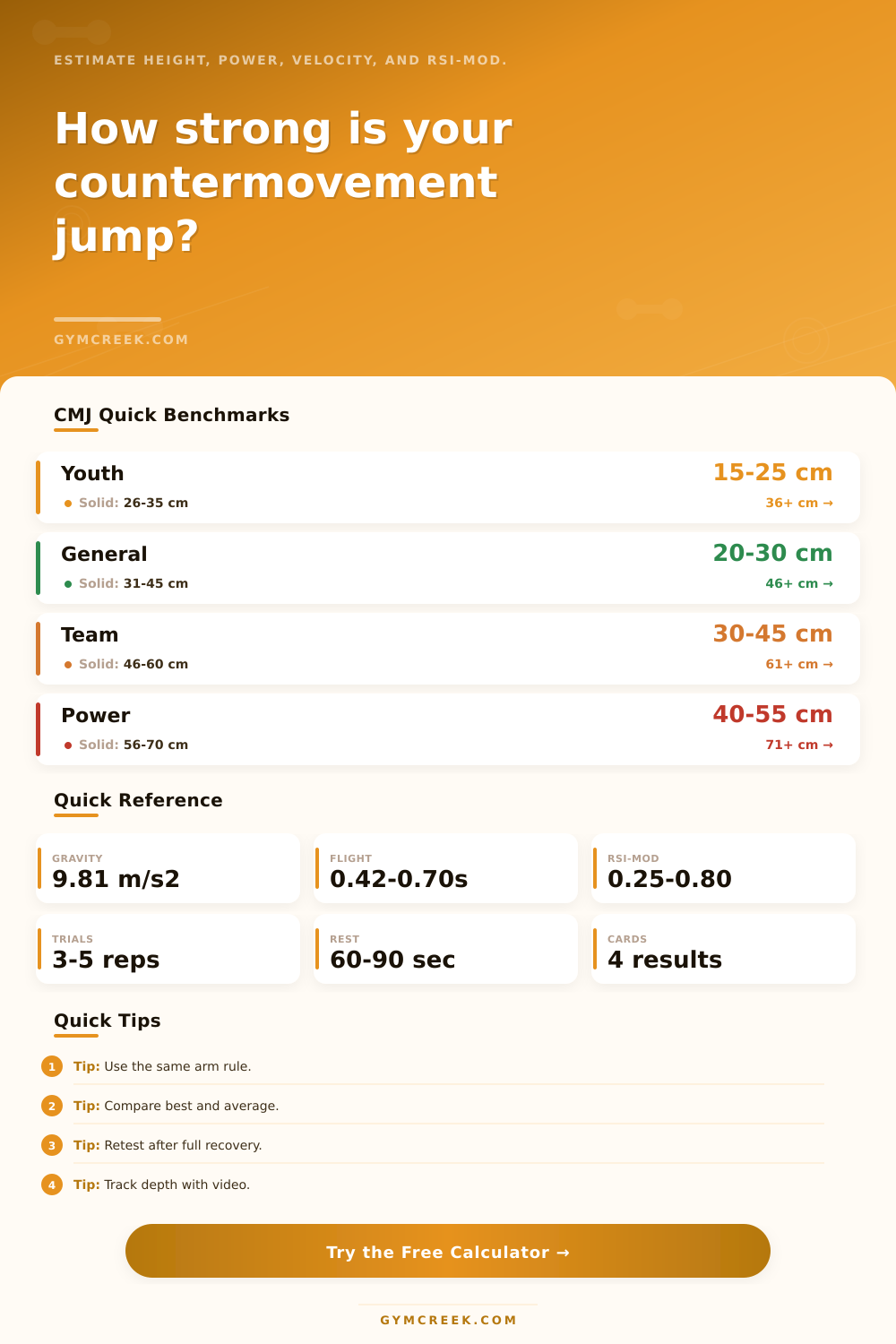
| General fitness | 20–30 cm | 31–45 cm | 46+ cm |
| Field sport athlete | 30–42 cm | 43–58 cm | 59+ cm |
| Court sport athlete | 32–46 cm | 47–62 cm | 63+ cm |
| Power athlete | 38–52 cm | 53–68 cm | 69+ cm |
| Measurement | Formula | Good Practice | Common Error |
|---|---|---|---|
| Flight time | g × t² / 8 | Same landing shape | Tucking knees |
| Jump height | Device or tape value | Use best clean trial | Mixing arm rules |
| Time to takeoff | Start to takeoff | Consistent threshold | Late movement start |
| Loaded CMJ | Body plus load | Report total load | Comparing unloaded |
| Formula | Inputs | Output | Best Use |
|---|---|---|---|
| Projectile height | Flight time | Jump height | Jump mat or video |
| Sayers peak power | Mass and height | Watts | Field power estimate |
| Relative power | Watts and mass | W/kg | Compare body sizes |
| RSI-mod | Height and time | m/s index | Readiness tracking |
| Scenario | What To Watch | Useful Output | Retest Cue |
|---|---|---|---|
| Baseline testing | Best and average | Height plus power | 3–5 trials |
| Readiness check | Drop from normal | RSI-mod trend | Same warmup |
| Power block | Watts per kg | Relative power | Weekly check |
| Return to play | Movement quality | Consistent trials | Side comparison |
💡Tips
A countermovement jump is a type of jump. It seems straightforward: Stand up, squat down, explode up. It look like a raw strength test; it’s really a measure of your nervous system’s ability to coordinate that raw strength.
Most athletes think that the more they work their butt off in the squat rack, the higher they’ll jump. Half-true. The other half are speed. You can be as strong as you want, but if you’re slow, you won’t convert it into vertical height.
How to Measure Your Jumping Power
Once you enter either your height or flight time, calculator does the math for you. No need to learn projectile motion equations or gravity coefficients. But in order to have confidence in any number, you must also eliminate the variables that will screw up most field tests.
Arm swing are the largest offender. If you allow your arms to swing freely during one test but keep them on your hips for another, you’re comparing two completely different athletic events. With this tool, you can choose an arm rule so that context aligns with your protocol. It won’t alter the physics of the jump, but it will alter how you interpret the resulting number. Free swinging arms add momentum which can artificially inflate height, whereas restricting arms isolates lower body more cleanly. Consistency is more important then perfection here.
Height isn’t everything, though, anyone serious about training knows it’s just a vanity metric. You’ve got to know where the height came from. For this, the calculator use the Sayers equation, which connects body mass to jump height and links that to wattage (peak power). It will also give you takeoff velocity: How fast did you leave the ground? That’ll tell you something about the quality of your force production. If you can jump well but slowly, chances are you’re relying too much on stiffness instead of active drive. This is important information for coaches to determine if an athlete would benefit from more plyometrics or strength work.
Oh, and then there’s that whole reactive strength index thing, or RSI-mod. It’s kind of a measure of both efficiency and stiffness (jump height divided by how long it took you from touch down to leap off). You might jump high but take too long to launch, which causes your RSI to drop. Which, again, is where folks screw up; they think height is everything, not paying attention to the price tag in time. A high, slow jump isn’t as valuable in sport as a solid, quick one.
The page has its own reference table laying all this out. It uses groups or bands of athletes so you can gauge your speed-power mix compared to other guys. Different sports require different things, a linebacker doesn’t need the same output as a basketball player. Based off your profile, the tool will adjust its benchmark to match. If you’re a power athlete, perhaps it should of predict higher absolute watts. If you’re a youth athlete, maybe it’s about consistency and technique. If you’re a weekend warrior, don’t get hung up comparing your raw numbers to those of an elite sprinter. Track the trend lines against your own baseline. You’ll often find subtle shifts in takeoff time or relative power that indicate whether you’re fatigued or recovered before you feel sore at all.
Remember, results mean nothing without testing protocol. Use the same surface, warm-up appropriately and take 3-5 trials discarding the outliers. If you are coming back from an injury, look for clean mechanics and symmetry instead of highest numbers. A video assists in catching any toe tucks or too much depth which skews the number. The calculator relies on clean input, but you must ensure the test itself is honest.
Ultimately though, the countermovement jump is a conversation between your body and the ground. It’s a sign of how quickly you’ll respond and how forcefully you’re able to push off. So take that dialogue and turn it into a number that you can follow. And in turn, let that number drive your training; so you can jump higher, move faster and know that what you see on paper is truthful.