Core Endurance Test Calculator
Score flexor, extensor, and side-bridge holds with McGill-style endurance ratios, side balance, and retest flags.
📌Presets
Each preset loads a realistic four-hold test profile and recalculates the endurance ratios.
⚙Calculator
Core endurance snapshot
Enter the four hold times to score endurance balance.
📊Ratio Metrics
📑Reference Tables
| McGill-style check | Green zone | Caution zone | Flag zone |
|---|---|---|---|
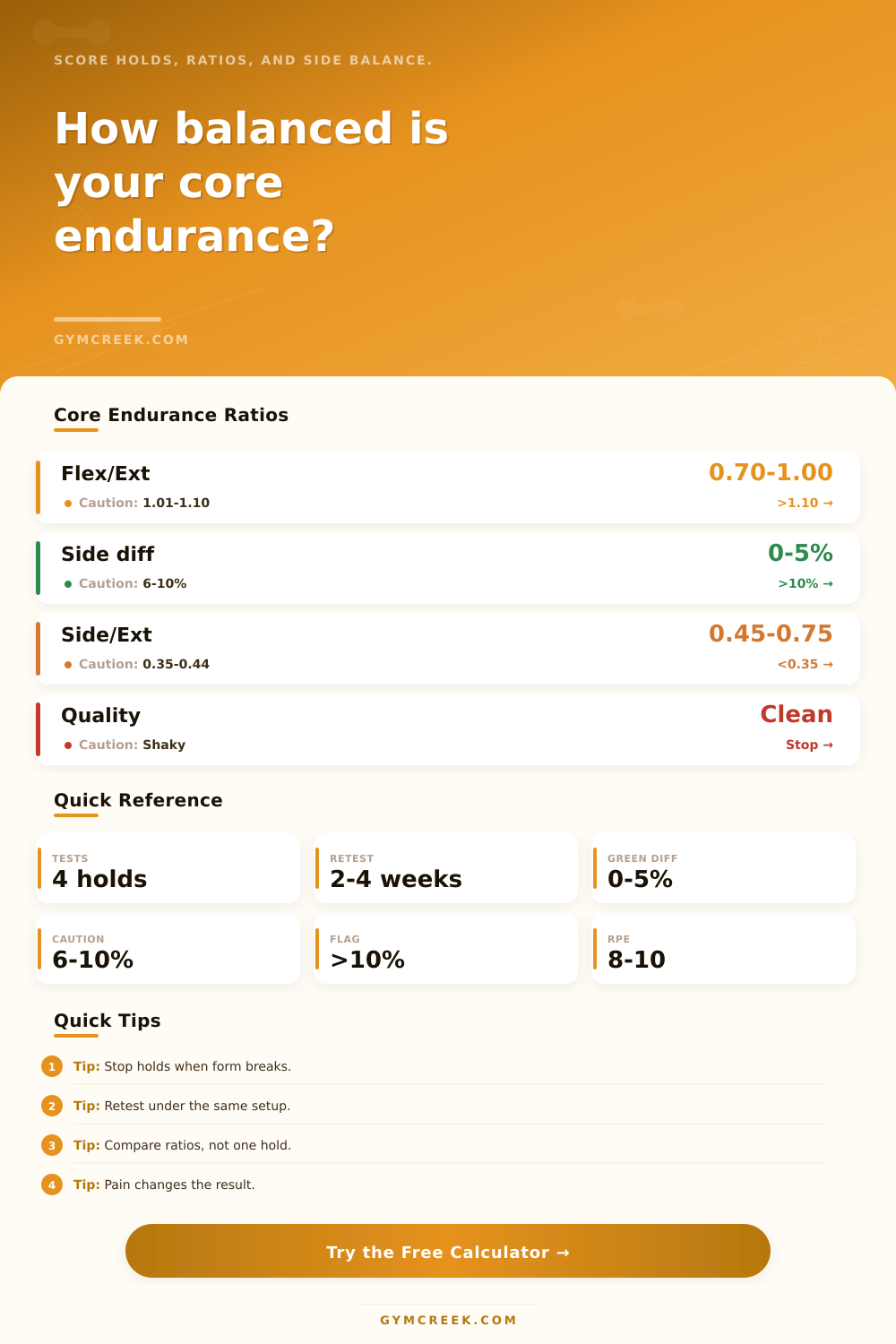
| Flexor to extensor | 0.70-1.00 | 1.01-1.10 | Above 1.10 |
| Side bridge difference | 0-5% | 6-10% | Above 10% |
| Average side to extensor | 0.45-0.75 | 0.35-0.44 | Below 0.35 |
| Protocol quality | Strict stop | Minor cues | Symptom stop |
| Reference group | Flexor hold | Extensor hold | Side bridge |
|---|---|---|---|
| Male baseline | 136 sec | 161 sec | 95-99 sec |
| Female baseline | 134 sec | 185 sec | 72-77 sec |
| General fitness | 90-120 sec | 120-160 sec | 60-90 sec |
| High demand | 120+ sec | 160+ sec | 90+ sec |
| Test quality | What it means | Score impact | Next step |
|---|---|---|---|
| Strict | Clean stop | Full trust | Track trend |
| Good | Minor cueing | Small penalty | Repeat same setup |
| Loose | Timing varied | Moderate penalty | Retest soon |
| Symptom stop | Not maximal | High penalty | Get guidance |
| Scenario | Common pattern | Main flag | Focus |
|---|---|---|---|
| Desk lifter | Low sides | Asymmetry | Side bridge |
| Runner | Good flexor | Side gap | Anti-rotation |
| Powerlifter | Strong ext | Flex ratio | Brace control |
| Field sport | Mixed holds | Fatigue gap | Retest cycle |
💡Tips
Your core strength isn’t found in the amount of crunches you complete in a single day. True core endurance is silent. It’s when your trunk muscles is able to create rigidity through prolonged periods under load without losing their position; sagging, shaking or leaking the pressure. Why does that matter? Because strength is only half the battle. Stability make all the difference when it comes to durability.
So instead of focusing on rep count, we’re going to test this by shifting our focus to time under tension. How long can you keep your neutral spine intact while fighting against bending forward, backward, or to the side? Balance, not just time, is math of a good assessment. Just because you can plank for three minutes doesn’t mean you’re a champ if your back extensors collapses after 90 seconds. That’s a structural imbalance in the making.
How to Test Your Core Strength and Balance
Once you enter the four holds of your choosing into the calculator above, it’ll do the math for you. You don’t need to figure out the ratios yourself and there is no way to hide those sneaky imbalances. We’re seeking harmony here: harmony between the back of your body and the front of your body. When one side are much stronger than the other, it is typically a sign of a compensation pattern. This can result in injury when you move quick or lift more weight.
One example is flexor-to-extensor ratio. Ideally, these two sides of your muscle profile will be roughly equal in strength (at least not far enough apart that either one is being overworked compared to the other). If your back muscles is much weaker than your front muscles, you’ll be more prone to lower back strain and anterior pelvic tilt throughout your daily life. Weak flexors paired with strong extensors, on the other hand, can make for stiffness that stops efficient movement.
The chart on the page show it nicely, Green sections represent areas of symmetrical strength; Red flags indicate when you’d do well to intervene. Once you know what these lines look like, you can make an informed decision about continuing to push yourself hard or shifting into balance-boosting mode.
Then there’s the issue of side stability. Like being right-handed, most of us favor one side. It’s normal and to be expected to find a small disparity in the left/right side bridge. But if that difference grows more then five percent, you’re now looking at an asymmetry worth noting. It doesn’t need to be perfect, just not a liability on the weak side. Training only on your dominant side (because it’s easier) will increase the discrepancy. The tool takes this into account and highlights any differences. This allows you to isolate the lagging limb with some unilateral holds or anti-rotation work.
It’s also important that their testing protocol was solid. If they stopped themselves with a “tired” feeling instead of actual form breaking, then the number means nothing. Likewise, if their coach give inconsistent cues and they keep pausing in between sets, the number gets noisier and noisier. You have to commit to strict stopping criteria. Your form failed when your back arches too far off the ground or your hips drop below a straight line. And by pushing through bad form, you’re teaching your body to think instability is normal.
Progress will be evident when you retest. Ideally, do so every other week-to-month at exactly the same time and under exactly the same circumstances. Don’t adjust the test protocol; don’t change anything about the setup, rest periods or timing method. That way you can tell the difference between genuine gains in muscle endurance versus any variables that may have crept into the results (technique drift, fatigue, etc.). One week your number skyrockets, then the next it plummets, that’s measurement error, not physical backsliding. Over several months, tracking trends gives you a far better idea of your core’s health than any individual snapshot alone.
But all this comes down to endurance, in its most basic sense: resilience. It is the kind of body that lets you move freely without fear or effort, acting as the backbone to every other advancement. The ability to create a well-proportioned body through deliberate form and careful ratio means less constraint and more possibility. Drop the minutes; find your symmetry. Let your inner peace lead you far.