Concentric Eccentric Ratio Calculator
Compare lift tempo, estimated force-time share, total time under tension, and eccentric emphasis for strength, hypertrophy, control, or return-to-training work.
📌Presets
Each preset loads a real lifting scenario with movement-specific bodyweight contribution and eccentric bias.
⚙Calculator
Tempo ratio snapshot
Enter your set tempo and load to compare concentric and eccentric demand.
📊Tempo Metrics
📑Reference Tables
| Goal | Concentric | Eccentric | Typical Ratio |
|---|---|---|---|
| Speed strength | 0.5-1 sec | 1 sec | 1:1 to 1:2 |
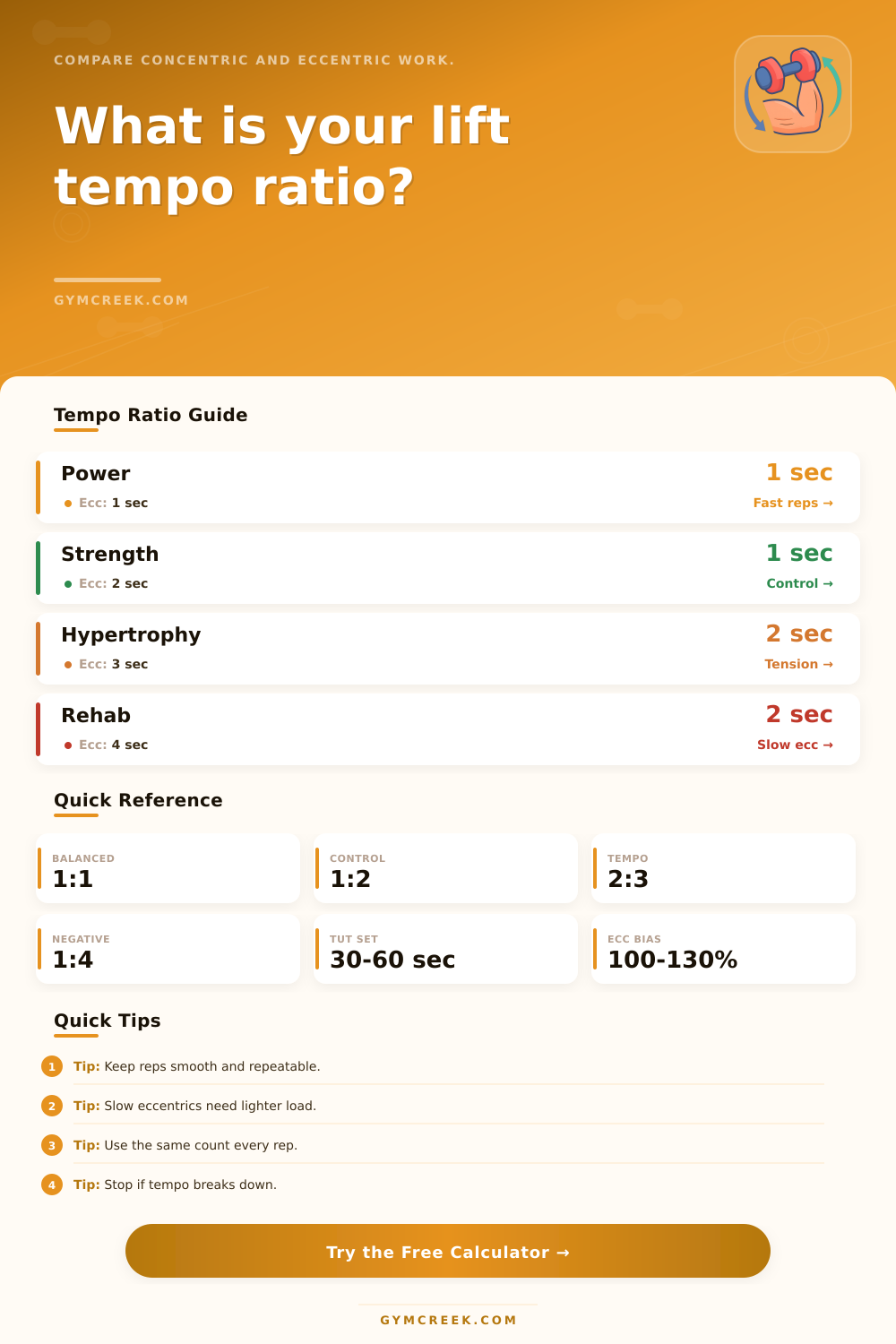
| General strength | 1 sec | 2 sec | 1:2 |
| Hypertrophy | 1-2 sec | 2-4 sec | 1:2 to 2:3 |
| Motor control | 2 sec | 3-5 sec | 1:2 to 1:3 |
| Movement | Body Load | Load Note | Tempo Note |
|---|---|---|---|
| Bench press | 5-10% | Mostly bar load | Pause changes demand |
| Back squat | 80-90% | Bar plus body mass | Control the descent |
| Pull-up | 100% | Body plus added load | Negatives can dominate |
| Push-up | 60-70% | Hands support body | Keep body rigid |
| Scenario | Tempo | Ecc Bias | Best Use |
|---|---|---|---|
| Speed Bench | 1-1 | 100% | Bar speed |
| Tempo Squat | 2-4 | 115% | Position work |
| Pull-Up Negative | 1-5 | 130% | Control |
| RDL Control | 2-3 | 115% | Posterior chain |
| Metric | Formula | Meaning | Use |
|---|---|---|---|
| Tempo ratio | Con sec / Ecc sec | Timing split | Compare rep style |
| Total TUT | (Con + Ecc) x reps x sets | Total tension time | Volume context |
| Force-time | Force x seconds | Impulse estimate | Phase demand |
| Ecc share | Ecc FT / total FT | Eccentric emphasis | Fatigue planning |
💡Tips
To avoid guessing amount of effective tension being applied, just input your desired load and tempo into the calculator (above), and it will crunch the numbers for you. Inputting concentric and eccentric seconds set the time-under-tension. An even split will deliver a different stimulus then a one second-push-two-second-lower pattern. The tool break it down into force-time shares.
That’s important since strength respond to peak force output; hypertrophy responds to cumulative tension. Without consciously balancing these tension ratio, you can’t optimally hit both targets.
Why Tempo Matters for Strength and Size
Then there’s the odd phase, think of this as a braking section of your lift. It’s here that controlled lower reps can feel more taxing than their explosive counterparts because the braking action put far greater stress on muscle fibers and connective tissue than the concentric push portion ever will. Rushing through this section eliminate any chance of triggering growth response, in essence, cheating yourself out of half the rep.
The tool comes bundled with reference tables that pairs your goals with corresponding timing strategies. For a pure-power or -speed goal, minimal time on both sides is what you’re after; for control or size, you’ll blow out that window considerablly.
Secondly, inputting your bodyweight contribution is a detail many lifter overlook. When you’re doing something that involve moving your bodyweight along with the external weight (squats, pull-ups), it will adjust load factor to match. This simply means that a five-second negative on a bodyweight squat produce significantly more total tension compared to same tempo on a light dumbbell curl.
What you’re calculating here is impulse; force times time. The higher the RPE score, the bigger the force variable. Longer tempos means a larger time variable. The product of both these numbers determine just how much work your nervous system has to do. However, we have a practical boundary on how slow we can be. If it’s so slow that it takes longer than eccentric part of range of motion, you’re not getting enough of a load to drive adaptation. At that point, you might as well just move air rather than build tissue.
That’s where the eccentric bias feature works in this tool. It lets you apply a heavier load in the bottom phase while not pushing your joints beyond their safety limits. A bias of a hundred and ten percent mean you’re doing slightly better than raw strength would of indicate in terms of control, but it’s still a sustainable place to train from. Any higher bias risk breaking down your form or causing injury.
One common mistake in this approach is inconsistency with timing through the set. You might grind out the first rep slow and cheat momentum on the last three, this will muck up the data you’re attempting to recieve. The calculator works under the assumption that each rep has the same tempo. That’s the only way the numbers has meaning. Varying how fast you do it at random doesn’t train an adaptation; it just moves some weight around. Exercise become engineering when you’re consistent.
In conclusion, follow no one’s advice but your own, matching pace to purpose instead of reading stuff off the internet. If you’re looking to bust through a strength plateau or build more resilient tendons, go slow eccentric. If you’re working on explosive movement patterns, do them fast. The tool enables you to make those decisions based off metrics. It makes vague intentions into measurable sessions. You’ll know exactly what you did and why it worked.
It is better than hoping it works. Accidental effort doesn’t build a good workout plan. Deliberate choices do. Control the outcome by controlling the descent just as much as you control the ascent. You know that distinction because it’s what sets effective training apart from casual lifting. You don’t leave your gains on the floor when you lower into an exercise.