Concentration Curl Calculator
Estimate strict single-arm curl strength, compare sides, and see how RPE, tempo, range of motion, and elbow support change the quality-adjusted result.
📌Presets
Each preset loads a realistic single-arm concentration curl scenario, then recalculates the strictness-adjusted results.
⚙Calculator
Concentration curl snapshot
Enter both arms to estimate strict strength and side balance.
📊Metrics Grid
📑Reference Tables
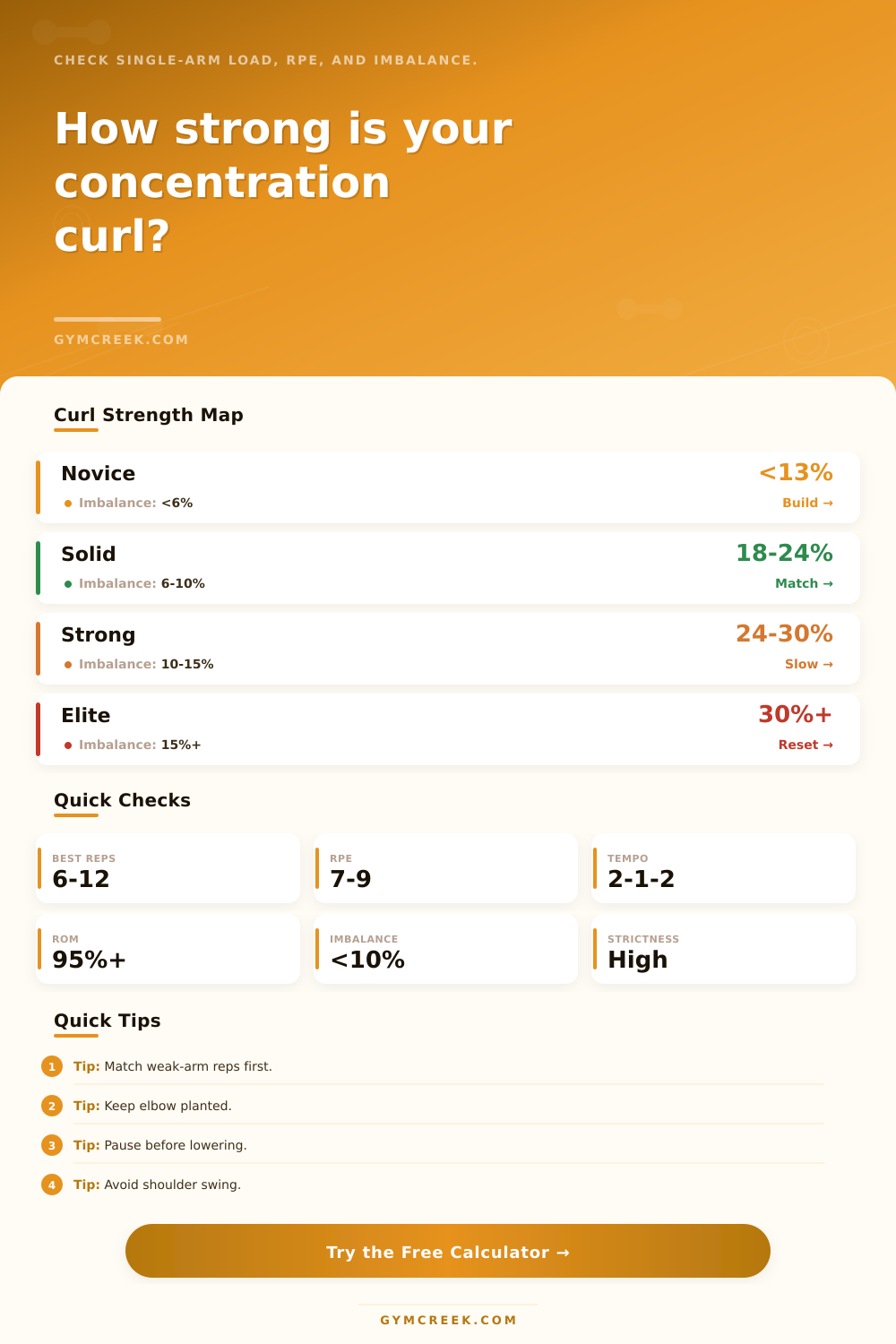
| Single-arm level | Strict 1RM vs bodyweight | Typical signal | Next focus |
|---|---|---|---|
| Novice | Under 13% | Learning isolation | Repeatable form |
| Recreational | 13-18% | Base strength | Clean volume |
| Solid | 18-24% | Good biceps strength | Small load jumps |
| Strong | 24-30% | Advanced isolation | Tempo control |
| Elite | 30%+ | Rare strict strength | Joint-friendly pacing |
| Modifier | Best input | Penalty zone | What it changes |
|---|---|---|---|
| Strictness | Textbook strict | Body English | Quality 1RM |
| Elbow brace | Inner thigh planted | Sliding support | Stability score |
| Tempo | 2-1-2 or slower | Bounce reps | Control score |
| ROM | 95-100% | Under 80% | Rep validity |
| Imbalance | Meaning | Loading choice | Tracking note |
|---|---|---|---|
| 0-5% | Excellent symmetry | Progress together | Keep reps equal |
| 6-10% | Manageable gap | Weak side leads | Match strong side |
| 11-15% | Clear asymmetry | Hold strong side | Retest weekly |
| 16%+ | Large gap | Reduce load spread | Prioritize control |
| Goal | Target reps | RPE target | Recommended output |
|---|---|---|---|
| Balance | 8-12 | 7-8 | Weak-arm load |
| Strength | 4-8 | 8-9 | Top strict set |
| Hypertrophy | 10-15 | 8-9 | Average load |
| Return control | 12-15 | 6-7 | Slow tempo |
💡Tips
While many consider this an odd little isolation exercise, it’s also one of the most thorough bicep integrity tests around. Your elbow is tucked into your inner thigh. You’re sitting on bench. There’s no room to sneak momentum here. Strip out the shoulder involvement, the torso lean and the swing, and all that remains is straight-up mechanical disadvantage.
No wonder the exercise seem so damn heavy relative to a basic dumbbell curl. Tension is maintained from start to finish. The lever arm are lengthened. The long head of the biceps is forced to perform tasks it typically gets to skip.
Why This Exercise Is Good for You
It’s an afterthought movement to most lifters. They’ll chuck on a couple of light reps at the end of their workout. Big mistake. Because the position is so strict, it provides a much better gauge of how strong you realy are when compared to a compound lift that distributes the load across several joints.
You don’t need to guess at conversion factors, coefficients, etc. Just input your efforts and weights and the calculator above will crunch numbers for you. It normalizes the results against your body mass.
If you let your elbow drift from your leg, or bounce up and down, the tool will ding you for that attempt. Why? Because quality is more important than quantity. If you perform a heavy rep but use poor form, what did you realy accomplish? You’ve basically performed a different exercise that pull in the traps and shoulders rather then the arms.
This also shows in area of side imbalance. How often do you hear someone say they’re stronger on one side? It is all too common. We’re all dominant on one side or the other, and typically it stems from being right- or left-handed. If we’re not careful, that dominance infiltrates our workouts. What happens is a lot of folks will work their strong arm upwards and their weak arm stay way back there.
With this calculator, you’re forced to look at each side individually. It’ll calculate your separation and provide percentages. There’s a normal amount of separation here, but anything large means you’ve got some sort of compensation pattern that may lead you to an injury down the road. The page has a handy reference table that makes this clear, and it reveals that even a 10% difference should of being addressed.
It’s as simple as this: Always begin with your weaker arm. See what kind of reps you can knock off clean, and then try to match those on your stronger side. It seems restrictive at first, but over time it evens the stimulus.
The other variables that alter the equation are tempo and range of motion. Lifting thirty pounds for six slow reps isn’t the same as lifting thirty pounds for twelve reps, right? Muscle recruitment, metabolic demand, and time under tension all changes with these differences. For example, building density through a slow, controlled eccentric phase differs from bashing weight up and down in a fast bounce.
To adjust for this, the tool factors in your tempo selection when estimating your one-rep max. If you’re going quick, then the rep quality is suspect and the estimated strength are lowered accordingly. On the other hand, if you take three seconds to lower the weight, the tool knows that control was used. Again, it is a small thing, but it matters.
This isn’t just a training for the completion of a set. You’re training for size, strength, or both. It can also be helpful to look at your strength relative to your body weight. If you’re one hundred and fifty pounds and you lift fifty pounds, congrats! That’s impressive. That’s pretty good. But if you’re two hundred and fifty pounds, it is less so impressive.
This tool normalizes your score based off your body weight and gives you a percentage based on where you fall: either elite, solid, or novice. This will help you see where you’re at, as well as prevent you from comparing yourself with other people at the gym. You’re only competing with your own mechanics.
But at the end of the day, that’s all the concentration curl is (a mirror). It reflects back on you everything you put into it. If you’re sloppy with it, weight will fight you. If you’re precise with it, you’ll discover strength you didn’t know you had.
The numbers are nothing more than a guide; true gain lies in the discipline required to hold your elbow planted. You’ve got to slow yourself down. You’ve got to listen to the weaker side. That’s how you build a strong, yet balanced physique. And though the process is slow, the results is honest.